Table of Contents >> Show >> Hide
- Why baked salmon is the weeknight MVP
- Buy the right salmon (so the oven doesn’t have to perform miracles)
- The 5 rules for juicy salmon (a.k.a. how not to make fish jerky)
- The fastest baked salmon method (sheet pan, high heat, 10–15 minutes)
- Foil or parchment packets (aka “salmon that can’t really mess up”)
- Low-and-slow baked salmon (buttery texture, great for meal prep)
- Seasoning ideas that make salmon taste exciting (not obligatory)
- Turn baked salmon into healthy meals in a snap
- Food safety, storage, and the “don’t leave it out” reality check
- Troubleshooting: common baked salmon problems (and quick fixes)
- Final takeaway: the simplest way to bake salmon well
- Extra: My real-life baked salmon experiences (the stuff recipes don’t confess)
Salmon has a funny reputation: it’s the “fancy dinner” fish that also somehow shows up on Tuesday nights when you’re wearing sweatpants and questioning your life choices. The good news is that baking salmon is basically the culinary equivalent of hitting the “easy” buttonfast, forgiving, and (when done right) wildly delicious. The even better news? You don’t need a chef’s knife set, a coastal zip code, or the patience of a saint.
This guide will show you how to bake salmon so it comes out juicy and flavorfulwhether you like it flaky and well-done or tender with a slightly rosy center. You’ll get simple timing rules, the temperature truths nobody tells you, seasoning ideas that actually taste like something, and meal-prep tricks that make future-you feel very loved.
Why baked salmon is the weeknight MVP
If your goal is “healthy dinner that doesn’t taste like punishment,” oven-baked salmon is a top contender. It’s a solid source of protein, and it’s famous for omega-3 fats. Plus, it pairs with basically anything: rice, potatoes, salad, roasted vegetables, noodles, tortillas… even scrambled eggs (don’t judgetry it).
Three reasons baking beats babysitting a pan
- Hands-off: The oven does the work while you rinse a cutting board and pretend you’re organized.
- Even cooking: Heat surrounds the fish, so you’re less likely to scorch the outside while the center stays raw.
- Easy cleanup: Parchment paper and foil deserve a holiday.
Buy the right salmon (so the oven doesn’t have to perform miracles)
You can bake any salmon successfully, but a few quick choices make it easier:
Fresh vs. frozen
Frozen salmon is not “second-rate salmon.” It’s often frozen quickly after harvest and can be excellent. If it’s frozen, thaw it safely in the refrigerator overnight. In a rush? Put the sealed package in a bowl of cold water and change the water every 30 minutes until thawed.
Skin-on vs. skinless
Skin-on fillets are more forgiving because the skin acts like a little protective jacket. You can bake skin-side down and decide later whether to eat it. If you want crispy skin, you’ll likely finish under the broiler or use a different technique (more on that soon).
Thickness matters more than weight
When people ask, “How long do I bake salmon?” the only honest answer is: “How thick is it?” A thick center-cut fillet cooks differently than a thin tail piece. Keep your eyes (and ideally a thermometer) on the thickest part.
The 5 rules for juicy salmon (a.k.a. how not to make fish jerky)
Rule 1: Temperature is your best friend
Time is a suggestion; temperature is a decision. If you can, use an instant-read thermometer and check the thickest part. For safety, official guidance commonly points to 145°F as the safe minimum internal temperature for fish. Many cooks prefer pulling salmon earlier for a more tender texture. If you’re pregnant, immunocompromised, older, or cooking for someone who is, play it safe and go for the recommended safe temperature.
Rule 2: Pat it dry before seasoning
Moisture on the surface turns into steam, and steam is the enemy of good browning. Use paper towels and pat the fillets dry. This one step makes your seasoning stick better and your salmon taste more like dinner and less like “wet fish situation.”
Rule 3: Salt early (even if it’s just 10 minutes)
A little salt before baking helps the fish taste like itself, but better. If you have time, salt 10–20 minutes ahead while the oven preheats. If you don’t, salt right before it goes in. This is a no-shame zone.
Rule 4: Don’t overcook out of fear
Overcooked salmon is usually the result of “I’m just going to leave it in for five more minutes to be sure.” That’s how you go from “juicy and flaky” to “why is my mouth so dry?” Use visual cues plus temperature for confidence.
Rule 5: Rest for 2–3 minutes
Pull the salmon out, let it rest briefly, and it will finish gently. This tiny pause helps keep juices where they belong: in the fish.
The fastest baked salmon method (sheet pan, high heat, 10–15 minutes)
This is your weeknight workhorse: quick, simple, and adaptable. It’s perfect for salmon fillets and busy humans.
What you’ll need
- Salmon fillets (skin-on or skinless)
- Olive oil or melted butter
- Salt and pepper
- Optional: lemon, garlic, Dijon, paprika, herbs
- Parchment paper (highly recommended)
- Instant-read thermometer (highly, highly recommended)
Step-by-step: oven baked salmon, the easy way
- Preheat the oven to 425°F (or 450°F if you like more browning).
- Line a sheet pan with parchment paper for easy cleanup.
- Pat salmon dry, then place it skin-side down.
- Season: drizzle with oil/butter, then add salt and pepper. Add any extras (see flavor ideas below).
- Bake until the salmon flakes easily and reaches your preferred doneness:
- 1-inch thick fillets: about 10–15 minutes at 425–450°F
- Thinner pieces: start checking around 8–10 minutes
- Thicker pieces: may take 15–18 minutes
- Rest 2–3 minutes, then serve.
Quick doneness guide (use temp + looks)
- More tender, slightly rosy center: pull around 125–130°F (texture-focused; not the strict “well-done” approach)
- Flaky and fully cooked: aim for 140–145°F and opaque flesh that separates easily
Visual cues help too: baked salmon should turn opaque on the outside and flake with gentle pressure. If it’s still translucent in the thickest part, it needs more time. If white stuff (albumin) leaks out, it’s not “ruined”it usually just means the fish cooked a bit aggressively. A sauce will fix the vibes.
Foil or parchment packets (aka “salmon that can’t really mess up”)
Packet-baked salmonoften called en papillote when done in parchmentis ideal when you want moist, gentle cooking and built-in sauce. It’s also great if someone in your house says they “don’t like fishy smells,” because packets keep aroma contained.
How to bake salmon in foil
- Heat oven to 400°F.
- Place salmon on a large piece of foil. Add salt, pepper, a little oil, lemon slices, and quick-cooking veggies (thin asparagus, zucchini ribbons, cherry tomatoes).
- Seal the foil into a packet with some air space inside (steam needs room).
- Bake 12–18 minutes, depending on thickness, then open carefully (hot steam!).
Parchment packet tip
Parchment tends to give a cleaner, gentler cook than foil. If you’re meal-prepping and want salmon that stays tender the next day, parchment is a smart move.
Low-and-slow baked salmon (buttery texture, great for meal prep)
High heat is fast, but low heat is plush. If you want salmon that feels extra tender and almost buttery, try roasting at a lower temperature. This method is also fantastic for serving salmon cold later in salads, bowls, and sandwichesbecause it stays moist.
How to do it
- Set oven to 300°F (or even 250°F if you’re patient).
- Season salmon simply: salt, pepper, olive oil, and maybe chili flakes.
- Roast until it reaches your preferred donenessoften 25–35 minutes depending on thickness.
Low-and-slow is where a thermometer really shines. It’s the difference between “wow” and “I accidentally made salmon confit, but without the confit.”
Seasoning ideas that make salmon taste exciting (not obligatory)
Salmon is rich, so it loves bright acids (lemon, vinegar), salty punches (soy sauce, miso), and herbs. Pick one “direction” and commit. Here are quick combos you can mix in a bowl and brush on before baking.
1) Lemon-garlic butter (classic, never embarrassing)
- Melted butter + minced garlic + lemon zest + a squeeze of lemon
- Optional: parsley or dill
2) Dijon-maple glaze (sweet-salty weeknight magic)
- Dijon mustard + maple syrup + olive oil + pinch of salt
- Optional: smoked paprika
If your glaze has a lot of sugar, keep an eye on browning at 450°F. If it starts getting too dark, drop to 425°F or finish cooking without the broiler.
3) Miso-ginger (big flavor, low effort)
- White miso + grated ginger + a little honey + splash of rice vinegar
- Optional: sesame oil and scallions after baking
4) “Taco night” salmon (because joy matters)
- Chili powder + cumin + garlic powder + salt + lime
- Serve in tortillas with cabbage slaw, avocado, and a yogurt-lime sauce
Turn baked salmon into healthy meals in a snap
Baking salmon is step one. Step two is turning it into a meal that doesn’t require a second cooking project. Here are fast, balanced pairings that feel intentional:
Easy side pairings
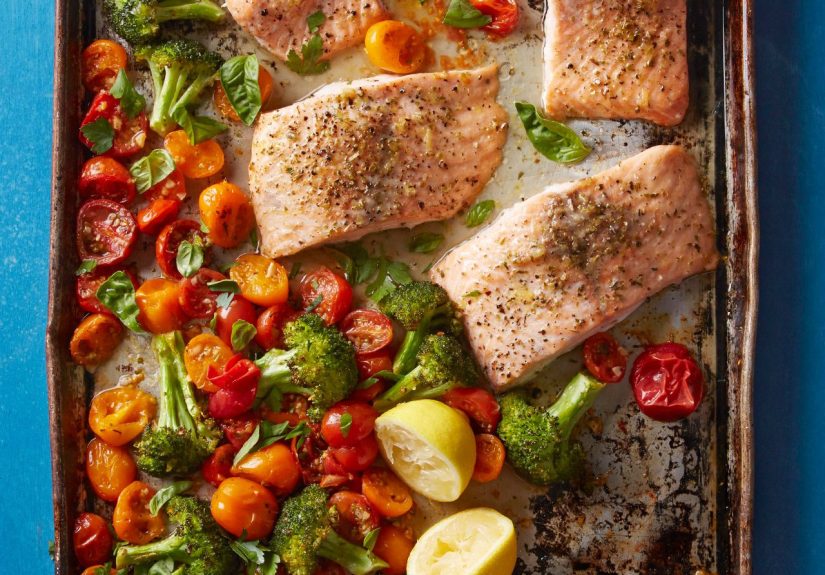
- Sheet-pan dinner: roast broccoli, green beans, or Brussels sprouts on the same pan (start veggies first if they’re thick-cut).
- Grain bowl: rice, quinoa, or farro + salmon + cucumbers + quick dressing.
- Salad upgrade: big greens + salmon + citrus + nuts + vinaigrette.
- Comfort plate: salmon + roasted potatoes + lemony yogurt sauce.
Leftover salmon ideas that don’t feel like leftovers
- Salmon rice bowl: flake salmon into rice, add soy sauce, sriracha, and cucumber.
- Breakfast moment: salmon on toast with cream cheese, capers, and red onion.
- Salmon salad: mix flaked salmon with Greek yogurt or mayo, Dijon, celery, and herbs.
- Pasta shortcut: toss salmon with lemon, olive oil, garlic, and spinach.
Food safety, storage, and the “don’t leave it out” reality check
Fish is not the food to casually forget on the counter while you scroll your phone “for five minutes” (a.k.a. 47 minutes). Keep these basics in mind:
- Cook to a safe temperature: fish is commonly recommended to reach 145°F for safety.
- Refrigerate promptly: don’t leave cooked fish out for more than 2 hours (or 1 hour in very hot conditions).
- Fridge life: cooked fish is typically best used within 3–4 days.
- Reheating tip: reheat gently so it doesn’t dry outthink low oven or quick microwave bursts.
Troubleshooting: common baked salmon problems (and quick fixes)
“My salmon is dry.”
It likely overcooked. Next time: pull earlier, rest briefly, and use a thermometer. Also consider foil/parchment or low-and-slow if dryness is your recurring villain.
“White stuff is coming outhelp!”
That’s albumin, a protein that can seep out when salmon cooks quickly or aggressively. It’s safe. Reduce heat slightly, cook a little gentler, and finish with a sauce (lemon butter, yogurt-dill, chimichurri).
“My seasoning slid off.”
Pat the fish dry first. Oil helps seasoning cling. Also: don’t drown it in liquid marinade right before baking.
“The fish tastes ‘fishy.’”
Freshness matters. Use bright flavors (lemon, vinegar), and store raw salmon cold and sealed. If you’re sensitive to aroma, bake in a parchment packet with citrus and herbs.
Final takeaway: the simplest way to bake salmon well
If you remember nothing else, remember this: hot oven, dry surface, salt + fat, and don’t overcook. Whether you go high-heat on a sheet pan, gentle in a packet, or low-and-slow for meal prep, baked salmon can be fast, healthy, and legitimately craveable. And yesyou can absolutely serve it on a Tuesday and still feel like a person who has it together.
Extra: My real-life baked salmon experiences (the stuff recipes don’t confess)
I used to think salmon was “high stakes.” You know, the kind of ingredient you cook only when you’re emotionally prepared for disappointment. My early attempts were classic: I’d bake it “until it’s definitely done,” which is a fancy way of saying I turned a beautiful fillet into dry, flaky confetti. Then I’d drown it in lemon juice like that would bring it back to life. (It didn’t. It just made me feel productive.)
The moment everything changed was the first time I used a thermometer and realized salmon doesn’t need a dramatic overcooking monologue. You check the thickest part, you pull it when it’s close, and you let carryover heat do its quiet little miracle. Suddenly, salmon went from “occasion food” to “why am I not doing this every week?” food. I also learned that patting it dry is the difference between salmon that roasts and salmon that steams in its own sadness.
Another real-world lesson: not all salmon pieces behave the same. Tail pieces cook faster. Center cuts take longer. If I’m baking multiple fillets and they’re uneven, I either: (1) fold the thin end under itself to make thickness more uniform, or (2) pull the thin pieces earlier and let the thicker ones finish. This sounds picky, but it saves you from that annoying situation where one piece is perfect and the other is a dessert topping for your dog (kidding… mostly).
Flavor-wise, I used to overcomplicate itten spices, three sauces, a sprinkle of existential dread. Now I treat salmon like it’s already bringing plenty to the party. Salt, pepper, oil or butter, and one “main character” flavor works best: lemon-garlic, miso-ginger, Dijon-maple, or a smoky spice blend. Then I add something fresh after bakingherbs, citrus, scallions, a quick yogurt sauce. Finishing touches matter because they make salmon taste bright and intentional, not like it came from a “healthy eating” lecture.
On busy weeks, I’ll roast a bigger piece and plan for leftovers on purpose. Cold baked salmon is underrated: flaked into a salad, tucked into a wrap, or piled into a rice bowl with cucumbers and a fast sauce. I’ve even eaten it straight from the fridge while the microwave warmed ricezero glamour, maximum satisfaction. The key is cooking it gently enough that it stays tender the next day, which is why I love low-and-slow roasting when meal-prepping.
Lastly: I’ve made peace with the “white stuff” (albumin). It shows up when the fish cooks a little hard, and it used to offend me personally. Now I take it as a reminder to nudge the temperature down a bit next timeor to use foil/parchment when I want ultra-moist results. And if it does appear? I don’t panic. I add a sauce, squeeze lemon, scatter herbs, and carry on like the confident adult I am pretending to be. That’s the secret of fast, healthy salmon dinners: good technique, flexible expectations, and a solid condiment strategy.