Table of Contents >> Show >> Hide
- Why a Space Telescope Was Worth the Trouble
- The First Spark: 1946 and the Long Wait
- The Pitch Meeting That Lasted a Generation
- Designing Hubble: A Telescope That Could Take a Beating
- Budget Reality, Technical Reality, and the Art of Not Getting Canceled
- Assembly, Integration, and the Delays Nobody Ordered
- Launch Becomes Real: STS-31 and the April 1990 Deployment
- A Quick Timeline: Hubble From Idea to Launch
- What the Pre-Launch Story Teaches Us
- Experiences: Ways to Feel the “Idea to Launch” Journey for Yourself
- Watch launch footage like it’s a season finale (because it kind of is)
- Visit a museum exhibit and notice how big “big” actually is
- Try the “Spitzer challenge”: explain the 1946 idea in one minute
- Follow an interactive timeline like a detective
- Build something small to understand something huge
- Host a “Hubble night” with images and the backstory
- Conclusion
The Hubble Space Telescope didn’t begin as a shiny cylinder riding a Space Shuttle into the sunrise. It began as a stubborn idea:
what if we put a serious telescope in space and let it breathe air that isn’t… air? (Astronomers are poets; engineers are the people who have to make the poem fit in a cargo bay.)
Hubble’s “from idea to launch” story is a decades-long relay race. The baton gets passed between dreamers, committees, budget wranglers,
optical perfectionists, ground-system builders, and Space Shuttle crewssometimes smoothly, sometimes like a fumble that bounces into the political stands.
And yet, by April 1990, the telescope that started as a mid-century thought experiment became a real observatory circling Earth at orbital speed.
Why a Space Telescope Was Worth the Trouble
If you’ve ever tried to look at something through a hot car windshield on a summer day, you already understand the basic problem with Earth-based astronomy:
the atmosphere is helpful for breathing, terrible for image quality. Turbulence blurs starlight, and the atmosphere also blocks big chunks of the electromagnetic spectrum.
Ultraviolet light, for example, gets absorbed before it can reach most ground telescopesgreat for life on Earth, bad for astronomers who want the full cosmic menu.
In 1946, astronomer Lyman Spitzer laid out the logic in a report that essentially said: “Above the atmosphere, you get sharper images and access to wavelengths you can’t
study properly from the ground.” That idea didn’t instantly become a funded NASA program (shocking, I know), but it planted a seed that never really stopped growing.
The First Spark: 1946 and the Long Wait
Lyman Spitzer’s orbiting-observatory vision
Spitzer’s 1946 argument was both scientific and practical: put a large telescope in orbit, and you can observe without atmospheric blur and with broader wavelength access.
It was a bold proposal in an era when “spaceflight” was still more of a concept than a commuting option.
Turning a dream into a plan (1960s–early 1970s)
Decades later, the idea matured through studies and advocacy. In the 1960s, scientific committees weighed what a large space telescope could do that ground instruments
could not. The “Large Space Telescope” concept became a serious target: a major observatory that could serve a wide research community, not just one experiment team.
The shift here is important: Hubble’s origin story isn’t only “a telescope got built.” It’s “a community convinced itselfand then convinced fundersthat an orbiting
observatory should be a national scientific tool.” That meant defining science goals broad enough to justify the cost: sharper imaging, faint-object astronomy,
and long-term access for many researchers.
The Pitch Meeting That Lasted a Generation
Big science missions are part physics and part politics. The physics says, “We can measure and image things never seen before.”
The politics says, “Cool. Now explain it in a way that survives a committee hearing.”
In the 1970s, the Large Space Telescope moved from “studies and wish lists” into a funded development effort. But funding pressure and engineering reality forced
trade-offsbecause they always do. The telescope had to fit the Space Shuttle’s cargo bay and survive the thermal mood swings of low Earth orbit.
Why the Space Shuttle mattered
Hubble was designed around two big Shuttle-era ideas:
- Launch capability: the Shuttle could lift a large payload into low Earth orbit.
- Serviceability: astronauts could repair and upgrade the telescope in spacelike a pit crew, but with more checklists and fewer snacks.
That serviceability decision would become one of Hubble’s defining features. Even before launch, it shaped how the observatory was built:
modular components, astronaut-accessible bays, and systems intended to be swapped and upgraded.
Designing Hubble: A Telescope That Could Take a Beating
The optical heart: a 2.4-meter primary mirror
Hubble’s main mirror is 2.4 meters acrosslarge enough to be powerful, small enough to be practical for the Shuttle era. Building it required extreme precision.
The mirror’s shape and smoothness had to support crisp imaging from orbit, where you can’t just walk outside and tweak the alignment with a friendly screwdriver.
Responsibility for different pieces of Hubble was spread across NASA centers and contractors. NASA’s Marshall Space Flight Center led development of the telescope,
while Goddard Space Flight Center played a major role in instruments and mission operations. Contractors built major hardware elements, and the overall system had to
come together as one stable, precisely pointing observatory.
Pointing: the “hold still” challenge
Getting a large telescope to point accurately while orbiting Earth is like trying to take a crystal-clear photo while riding a roller coasterexcept the roller coaster
is going about 17,000 miles per hour, and your camera has to stay locked on a target that looks like a glitter dot.
Hubble’s fine guidance and control systems were engineered to keep it steady, because sharp optics are useless if the telescope can’t hold a target precisely.
This requirement influenced everything: structure, gyroscopes, guidance sensors, and the software that coordinated pointing and observations.
Operations: building a science factory on the ground
Hubble wasn’t just hardware in orbitit needed a “brain trust” on Earth to schedule observations, process data, and deliver results to scientists.
That’s why the Space Telescope Science Institute (STScI) was established as a community-oriented science operations center. The point was to make Hubble a shared
resource for astronomers, not a private lab instrument.
This was a surprisingly big philosophical step: building the telescope was only half the job. Building the system that would turn raw data into usable sciencereliably,
for yearswas the other half.
Budget Reality, Technical Reality, and the Art of Not Getting Canceled
Hubble’s journey wasn’t a straight line. It was more like a cosmic spiral galaxy: it looped, stalled, and occasionally made you wonder if the whole thing would ever
settle into a stable orbit (pun absolutely intended).
Development stretched across the 1970s and 1980s, with schedule pressure, cost concerns, and technical hurdles. When you’re building a one-of-a-kind optical system
that has to function in space, “a little behind schedule” can turn into “we’ve invented new calendar emotions.”
Still, the mission’s advocates kept the coalition intactscientists, NASA managers, contractors, and policymakersbecause the scientific payoff was compelling and
the observatory was positioned as a flagship capability.
The telescope gets a name: 1983
In 1983, NASA announced the Large Space Telescope’s official name: the Hubble Space Telescope, honoring astronomer Edwin Hubble, whose work helped establish that
the universe is expanding and that galaxies exist beyond the Milky Way. It was a symbolic moment: the project was no longer just a concept; it had an identity
and a legacy to live up to.
Assembly, Integration, and the Delays Nobody Ordered
By the mid-1980s, Hubble’s hardware was coming togetherbut “coming together” for a space observatory doesn’t mean snapping Lego bricks. It means aligning optics,
validating instruments, integrating subsystems, testing in conditions that approximate space, and making sure the entire observatory can survive launch and operate
autonomously.
NASA originally planned an earlier launch window, but the schedule slipped due to technical readiness and integration timelines. Then an event outside the project’s
control reshaped the timeline entirely: the Space Shuttle Challenger disaster in January 1986 grounded the Shuttle fleet, pausing missions and forcing a reassessment
of priorities and safety. Hubble’s launch was delayed until Shuttle flights resumed and the telescope was ready to fly.
The delay wasn’t just “waiting around.” A grounded Shuttle program meant the whole architecturelaunch plans, training, payload integration, and operations readiness
had to adjust. When you build around a specific launch system, a pause in that system reverberates through everything.
Launch Becomes Real: STS-31 and the April 1990 Deployment
After decades of advocacy, design, construction, and waiting through Shuttle stand-downs, Hubble finally got its ride.
The Space Shuttle Discovery carried the Hubble Space Telescope on mission STS-31.
Countdown drama: because space is never boring
Launch campaigns are famous for their tension: a thousand systems must work correctly, at the same time, in the correct order.
STS-31 had its own pre-launch twists. A planned launch attempt earlier in April was scrubbed due to an auxiliary power unit valve issue, pushing the mission to its
eventual successful launch date.
Then came April 24, 1990. Discovery lifted off, carrying Hubble toward orbit. In spaceflight terms, the launch was the handoff between two eras:
Hubble’s “idea era” ended, and its “working observatory era” began.
Deployment: the moment the baton crossed the finish line
On April 25, 1990, the crew deployed Hubble from the Shuttle’s payload bay into low Earth orbit. This is the quiet magic moment:
a spacecraft the size of a bus, designed for precision, released into an environment that is both delicate (for optics) and brutal (for engineering).
From there, Hubble could begin the careful commissioning processwarming up instruments, calibrating pointing, and preparing for “first light.”
But even before its first big public images, the launch itself was a landmark: a decades-long scientific vision had officially reached space.
A Quick Timeline: Hubble From Idea to Launch
- 1946: Lyman Spitzer publishes a case for an orbiting observatory above Earth’s atmosphere.
- 1960s: Scientific committees and studies expand the Large Space Telescope concept into a community observatory.
- 1970s: The Large Space Telescope moves into funded development; practical design constraints take shape.
- 1981: STScI is established to support science operations and community access.
- 1983: The Large Space Telescope is officially named the Hubble Space Telescope.
- 1986: The Challenger disaster delays Shuttle flights and pushes Hubble’s launch further out.
- April 24, 1990: Hubble launches aboard Space Shuttle Discovery on STS-31.
- April 25, 1990: Hubble is deployed into orbit.
What the Pre-Launch Story Teaches Us
1) Big missions are coalitions, not solo acts
Hubble happened because many groups aligned: scientists who could articulate high-value goals, engineers who could translate those goals into hardware, institutions that
could run operations, and policymakers willing to fund a long-term project. Remove any one of those legs, and the stool wobbles.
2) Designing for servicing was a strategic choice
Hubble’s Shuttle-compatible, serviceable design was not just an engineering detailit was a philosophy. It assumed the mission would evolve and that upgrades would
keep it scientifically relevant. That mindset helped make Hubble a long-lived observatory rather than a one-shot experiment.
3) Time is part of the price tag
The story from 1946 to 1990 isn’t a sign of failure; it’s a sign of scale. When technology, institutions, and budgets all have to mature to meet an idea, “decades”
can be a realistic unit of measure. Hubble’s pre-launch journey is a reminder that some scientific leaps happen slowlyuntil, suddenly, they’re in orbit.
Experiences: Ways to Feel the “Idea to Launch” Journey for Yourself
Hubble’s origin story can feel abstractdates, committees, and engineering decisions stacked like a timeline sandwich. But there are surprisingly vivid ways to
experience the “from idea to launch” arc so it feels less like a textbook and more like a real human adventure.
Watch launch footage like it’s a season finale (because it kind of is)
One of the best ways to grasp the emotional weight of April 1990 is to watch STS-31 launch and deployment footage. You’ll notice something interesting: the mood
is not “casual science fair.” It’s focused, careful, andif you know the decades behind itpretty moving. Every callout and checklist item is the sound of thousands
of people trying to make sure a 1946 idea doesn’t turn into a very expensive story about gravity winning.
Visit a museum exhibit and notice how big “big” actually is
Reading “2.4-meter mirror” is one thing. Standing near full-scale displays or detailed models is another. Museums (especially aerospace-focused ones) tend to make the
observatory feel real: you start noticing handholds for astronauts, modular bays, and the fact that the telescope looks like it was built by people who truly believed
humans would come back and work on it. The serviceability details are a whole language of optimism.
Try the “Spitzer challenge”: explain the 1946 idea in one minute
Here’s a fun (and surprisingly revealing) exercise: pretend you’re pitching Spitzer’s orbiting telescope idea to a skeptical friend in 1946. You get one minute.
You can’t use the phrase “because it’s cool.” You have to explain atmospheric blur, blocked wavelengths, and why orbit is worth the cost and complexity.
Doing this makes you appreciate how hard it is to “sell” fundamental science before anyone has seen the payoff.
Follow an interactive timeline like a detective
Timelines from NASA and science institutions let you trace cause-and-effect: why certain design choices were made, how delays cascaded, and how operations infrastructure
(like STScI) was built in parallel. If you read it like a detective story“What problem were they solving here?”the timeline stops being a list and starts feeling like
a chain of hard decisions.
Build something small to understand something huge
If you’re a hands-on person, build a simple paper or model version of Hubble (or even sketch it with labeled components). The goal isn’t artistry; it’s comprehension.
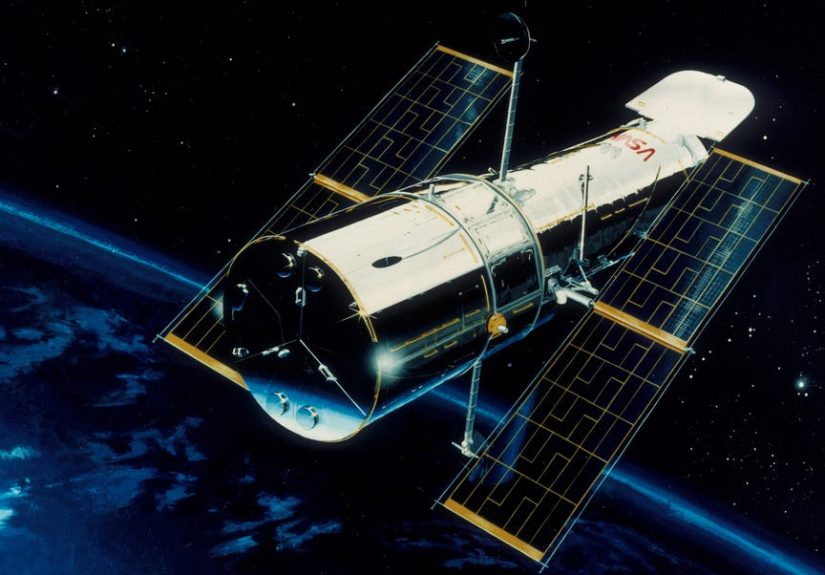
Once you label the primary mirror, instrument bays, and solar arrays, you start seeing how “telescope” is an understatement. It’s an entire spacecraft built around
precision opticsand it had to survive launch forces, temperature swings, and years of operation.
Host a “Hubble night” with images and the backstory
Even though this article focuses on idea-to-launch, pairing that story with early iconic Hubble imagery (viewed legally from official public galleries) makes the journey
feel complete. You can watch launch footage, read a short summary of the original space-telescope argument, then look at what an atmosphere-free observatory can reveal.
The experience lands best when you remember: people fought for decades to make those photons end up on our screens.
Ultimately, the “experience” of Hubble’s pre-launch story is the experience of patience: the patience to keep refining a concept, keep building coalitions,
keep testing hardware, and keep preparing for a launch system that can change the schedule overnight. And if you’ve ever tried to finish a group project where one
person disappears and another rewrites the whole doc at 2 a.m., congratulationsyou already understand the vibe. Hubble is just that, but in space, with optics.
Conclusion
The Hubble Space Telescope’s journey from idea to launch is a reminder that “overnight success” sometimes takes 44 years. It began with a 1946 argument for escaping
Earth’s atmospheric limits, grew through decades of scientific advocacy and engineering trade-offs, and finally reached orbit in April 1990 aboard STS-31.
By the time Hubble floated free of Discovery’s payload bay, it wasn’t just a telescopeit was proof that a long, complicated, very human process can still deliver
something extraordinary.