Table of Contents >> Show >> Hide
- The Spark: When “New Carlin” Hit YouTube
- What “War” Means Here (Hint: It’s Not About Punchlines)
- The Legal Clash: A Carlin Estate vs. “A.I. George Carlin”
- Why A.I. Comedy Is a Special Kind of Mess
- The Bigger Context: Performers, Writers, and the “Digital Replica” Era
- So What’s Actually Allowed? (And Why It’s Still Complicated)
- What Ethical A.I. Comedy Could Look Like (Yes, That’s a Thing)
- Conclusion: The Real Punchline Is Consent
- Experiences From the Front Lines of A.I. Comedy (500+ Words)
There are a lot of ways to honor a legendary comedian. You can listen to the specials. You can buy the box set.
You can quote the bits so often your friends start filing noise complaints with your group chat.
Orapparentlyyou can feed decades of someone’s work into a machine, slap their name on a new “special,” and call it innovation.
That last option is the one that made Kelly Carlin, daughter of George Carlin, grab the metaphorical megaphone and announce:
Absolutely not.
Her response to A.I.-generated comedy isn’t just a protective reflex over a famous last name. It’s a line in the sand about consent,
authorship, and what we’re willing to let technology do in the name of “content.” And in early 2024, that line got a headline-sized label:
Kelly Carlin “declares war” on A.I. comedy.
The Spark: When “New Carlin” Hit YouTube
The modern internet has two dependable hobbies: (1) resurrecting things that should stay peacefully in the past, and
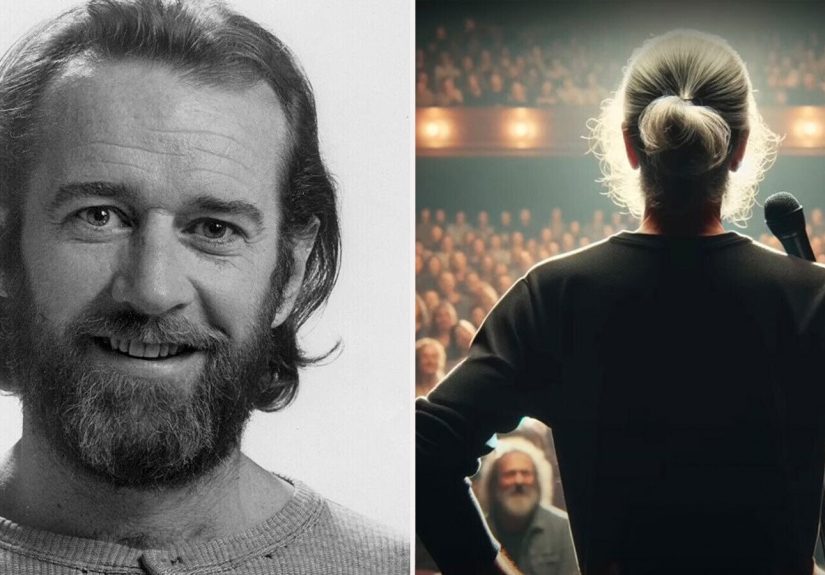
(2) insisting it’s doing everyone a favor. In January 2024, an hour-long video billed as a George Carlin “special” appeared online,
framed as an A.I. impersonation that mimicked his voice, cadence, and perspective on modern topics.
The title aloneGeorge Carlin: I’m Glad I’m Deadwas the kind of edgy wink that works great when the actual comedian is alive
and consenting… and significantly less great when he’s not. According to reporting on the dispute and subsequent settlement, the Carlin estate
argued the project exploited Carlin’s identity and body of work without permission, while the creators presented it as a tech-driven comedic exercise.
Kelly Carlin’s reaction wasn’t subtle. She described the idea as a violation of something deeply human: the lived experience that fuels comedy.
Her message wasn’t “please don’t.” It was closer to: “This is the wrong road. Turn around. Now.”
What “War” Means Here (Hint: It’s Not About Punchlines)
Let’s be clear: nobody’s trying to outlaw silly jokes or ban robots from open-mic night. “War,” in this context, is about the right to control
a person’s name, voice, and likenessespecially when that person’s identity is valuable enough for strangers to monetize.
For Kelly Carlin, the issue wasn’t simply that the A.I. special was (to many viewers) awkward, uncanny, or creatively thin.
It was that it treated her father’s comedic voice like a downloadable skin in a video game: click “install,” enjoy the vibes, ignore the ethics.
She also sounded the alarm for other families. In public comments at the time, she urged fellow heirs and estates to pay attentionbecause once
the technology exists, it doesn’t stop at one famous name. In other words: today it’s “Carlin,” tomorrow it’s anyone whose voice can be scraped,
cloned, and sold back to the public as nostalgia.
The core arguments behind the “war”
- Consent isn’t optional. Being famous isn’t the same thing as being available for unlimited reuse.
- Comedy is not just “style.” A cadence and a rasp aren’t a soul, a life, or a worldview.
- Legacy can be damaged. A synthetic performance can reshape public memoryespecially for younger audiences.
- The business incentives are broken. “Cheap resurrection” is profitable, so it will keep happening unless challenged.
The Legal Clash: A Carlin Estate vs. “A.I. George Carlin”
The estate of George Carlin filed a lawsuit in federal court in late January 2024 against the company behind the “special” and its associated creators,
alleging violations tied to Carlin’s intellectual property and publicity rights. In early April 2024, the dispute ended in a settlement.
The settlement’s practical outcome was simple and significant: the “special” would be taken down, and the defendants agreed not to use Carlin’s
image, voice, or likeness going forward without written permission from the estate. The message to the industry was even louder:
estates are willing to litigate, and “we put a disclaimer on it” is not a magic spell.
An extra twist made the whole episode feel like an internet matryoshka doll. In reporting surrounding the case, a representative for one party suggested
the script may have been written by a human rather than generated entirely by A.I.which, ironically, doesn’t fix the central problem.
If anything, it underlines it: the real value wasn’t “machine creativity.” It was the ability to wear George Carlin’s identity like a costume.
Why the settlement matters beyond one video
Even without a courtroom verdict, the settlement functioned like a flare shot into the air: a warning that synthetic comedy built on a real person’s identity
can trigger serious legal and reputational risk. It also offered a preview of how these fights may play outfast takedowns, negotiated restrictions,
and a growing expectation that creators must secure rights before “reviving” someone for entertainment.
Why A.I. Comedy Is a Special Kind of Mess
A.I. can imitate a lot of things. It can imitate a painter’s brushwork. It can imitate a singer’s tone. It can imitate the rhythm of a stand-up bit.
But comedy is more than a pattern. Comedy is timing, taste, risk, and a lifetime of earned perspectivefiltered through a specific human nervous system.
That’s why “A.I.-generated comedy” creates a unique kind of harm: it doesn’t just borrow a voice, it borrows trust.
Audiences see a name they respect and assume a baseline of intent and quality. When the result is synthetic, the trust is being traded like currency
and the person whose identity backs the transaction isn’t in the room.
Three ways A.I. comedy blurs the line
-
Impression vs. replication: A human impressionist is obviously a performer doing an act.
A digital voice clone can feel like the “real” person speakingespecially to casual listeners. - Parody vs. replacement: Parody comments on the original. Replacement tries to be the original and cash in on recognition.
- Homage vs. monetization: A tribute can celebrate a legacy. A synthetic “new special” can compete with that legacy for attention and value.
The Bigger Context: Performers, Writers, and the “Digital Replica” Era
Kelly Carlin’s public stance landed in a moment when entertainment unions and lawmakers were already wrestling with A.I. and identity.
Recent labor agreements and policy debates have increasingly focused on “digital replicas”synthetic versions of a performer created from prior work
or captured data.
The direction of travel is clear: informed consent, disclosure, and compensation are becoming the expected baseline. The details vary by context,
but the principle is the same one Kelly Carlin was shouting from the rooftops: you don’t get to borrow a person’s identity just because your software can.
California, a major hub for entertainment, has also moved to strengthen protections around unauthorized digital replicas, including measures aimed at
preventing contractual loopholes and requiring permission for the use of deceased performers’ digital likenesses. These developments reinforce the idea that
the “A.I. comedy” fight is really a “human identity” fight wearing a clown nose.
So What’s Actually Allowed? (And Why It’s Still Complicated)
If you’re hoping for a clean rule like “A.I. voices are illegal,” sorrythis is America, we don’t do simple when lawyers can bill by the hour.
The reality is a patchwork of rights and defenses that depend on context, jurisdiction, and how a work is presented.
1) The right of publicity (especially after death)
Many states recognize a right of publicitycontrol over the commercial use of someone’s name, voice, or likeness. In California, post-mortem rights can extend
for decades, which is one reason estates can challenge unauthorized “resurrections.” But these rights often hinge on whether the use is commercial,
and how the work is categorized.
2) Copyright, training data, and “style theft”
Copyright doesn’t protect an “idea” or a “style” in the abstract, but it does protect specific worksrecordings, transcripts, specials, and written material.
When a project claims to be trained on decades of a comedian’s routines, it invites questions about what material was copied, transformed, or exploited.
3) First Amendment defenses: parody, satire, and expressive works
Free speech mattersespecially in comedy. But the closer a work gets to presenting itself as the “real thing,” the harder it becomes to argue it’s merely
commentary. A parody that obviously critiques or transforms a public figure is different from a product marketed as a brand-new installment of that person’s art.
The Carlin controversy highlighted that tension in bright neon: when a synthetic performance borrows a revered name mainly to attract clicks,
the “expressive” label can start looking like camouflage.
What Ethical A.I. Comedy Could Look Like (Yes, That’s a Thing)
The goal isn’t to ban technology from the creative process. The goal is to stop pretending that “can” automatically means “should.”
If creators want to use A.I. tools in comedy without stepping on a legacy like a rake in a cartoon yard, here’s the cleaner path.
Best practices for creators and platforms
- Get permission. If you’re using a real person’s voice or likeness, rights clearance isn’t a “nice-to-have.”
- Be explicit about what’s synthetic. Not buried in fine printobvious, upfront, and repeated.
- Avoid “replacement framing.” Don’t market it as a “new special” from someone who can’t consent.
- Compensate fairly. If the identity generates value, the rights holder should share in it.
- Build new characters instead of hijacking old ones. If your concept only works with a dead celebrity’s name, that’s a concept problem.
What audiences can do (besides doomscroll)
Viewers have more power than we like to admit. If you click it “just to see,” you’re paying in attention. If you share it “because it’s weird,”
you’re doing free marketing. The simplest vote is often the most boring one: don’t reward unauthorized identity cloning.
Want more comedy? Support living comedians. Stream official specials. Buy tickets. Subscribe to the podcasts that are actually made by breathing humans
with messy opinions and questionable sleep schedules.
Conclusion: The Real Punchline Is Consent
The phrase “Kelly Carlin declares war on A.I. comedy” works because it captures a real cultural shift: families and estates are no longer treating deepfake
entertainment as a novelty. They’re treating it like what it isan attempt to turn identity into a reusable asset without permission.
In the Carlin case, the outcome wasn’t a sweeping legal precedent. It was something more immediate: a takedown, an agreement to stop, and a public reminder
that even in a world where machines can mimic a voice, they still can’t manufacture consent.
Comedy thrives on truth. A synthetic “new special” from a dead comedian isn’t truthit’s a product shaped like nostalgia.
And if the future of comedy is going to involve A.I. tools, Kelly Carlin’s stance insists on one non-negotiable rule:
the humans whose identities power the joke deserve a say in whether the joke gets told.
Experiences From the Front Lines of A.I. Comedy (500+ Words)
The weirdest part of the A.I. comedy boom isn’t the tech. It’s the emotional whiplash people feel when they hear a familiar voice saying something
that never happened. Fans describe it as a mix of curiosity and discomfort: the initial “Whoa, that sounds like him” quickly followed by
“Wait… that’s not him.” In comedy, that second reaction matters. Laughter depends on trusttrust that the performer chose the words,
understands the moment, and is accountable for the meaning.
Some audiences treated the “A.I. George Carlin” episode like a novelty item: click, sample, shrug, move on. Others experienced it more like an intrusion.
Longtime fans can be protective of a comedian’s voice because that voice often helped them survive somethinggrief, loneliness, a bad decade,
a family dinner that felt like a hostage situation. When an algorithm performs that voice without permission, it can feel less like tribute
and more like impersonation at a wake.
Comedians, meanwhile, have been trading stories about how quickly their “style” can be imitated now. A working comic might discover a clip online
where a synthetic voice “sounds like” themdelivering recycled premises with slightly different nouns. It’s not always good. Sometimes it’s painfully unfunny.
But even bad theft is still theft, and it creates a practical anxiety: if audiences get used to unlimited cheap imitation, does the market still value
the slow, human grind of writing and refining jokes?
Writers and producers have their own version of the same headache. A sketch writer might hear a pitch that starts with,
“What if we do it in the voice of [famous person]?”except now the pitch isn’t about an impressionist or a parody actor.
It’s about a synthetic replica. That shifts the conversation from “Is it funny?” to “Do we have the rights?” and “Should we do this at all?”
And the experienced creators tend to notice something: the pitch often gets less funny the more it relies on borrowed identity.
It’s like seasoning. If the only flavor is “celebrity voice,” you don’t have a mealyou have a salt lick.
Families of deceased artists report a different experience: the constant ping of strangers sending clips, tagging them, and asking,
“Have you seen this?” Even if the family didn’t seek out the content, it finds them. It shows up in messages, mentions, and headlines.
That repeated exposure can turn grief into a kind of endless customer service. Instead of remembering the person privately, the family is forced to
manage a public version of themone that can now be remixed daily by anyone with the right tool.
There’s also a quieter experience that gets overlooked: creators who do want to use A.I. tools responsibly are frustrated by the chaos.
They might be using A.I. to brainstorm tags, generate rough outlines, or test alternative phrasingswhile keeping human authorship and consent intact.
But the headline-grabbing stunts (the unauthorized voice clones, the “new special” from the dead) poison the well. Ethical experimentation gets lumped in
with identity hijacking, and everyone ends up arguing in all-caps.
Kelly Carlin’s “war” framing resonates precisely because it mirrors what many people are already experiencing: the sense that the fight isn’t theoretical.
It’s happening in real time, in feeds, in group chats, and in the uneasy pause after a synthetic punchline lands. The shared lesson from these experiences is blunt:
comedy isn’t just output. It’s relationship. And relationshipswhether between performer and audience, or between a legacy and the people entrusted with it
require consent to mean anything at all.