Table of Contents >> Show >> Hide
- What the “Mars Engine” Actually Is
- The Record-Breaking Numbers (and Why They Matter)
- Ion Propulsion 101: The “Fuel Efficiency” Rocket
- Why “Shattering Records” Matters for Mars Missions
- From Lab to Space: The Hard Parts Nobody Brags About
- How NASA Is Scaling Electric Propulsion Right Now
- So… Will Ion Propulsion Send Humans to Mars?
- 500-Word Experience Add-On: Living With the Blue Plume
- Conclusion
- SEO Tags
If you’ve ever watched a spacecraft coast silently across the solar system and thought, “Wow, that’s peaceful,”
you’ve basically witnessed the entire vibe of ion propulsion. It’s the tortoise of rocket tech: not flashy, not loud,
but stubbornly effective over long distances.
Now take that slow-and-steady reputation… and strap it to a power scale that makes engineers start talking with
their hands. A so-called “Mars engine” (the nickname is doing some heavy lifting here) has smashed multiple records
for electric propulsion performance. It’s not a warp drive. It’s not a magic thruster that gets you to Mars by next
Tuesday. But it is a meaningful leap toward high-power, high-thrust electric engines that could move big cargo
(and maybe someday people) through deep space with far less propellant than chemical rockets need.
What the “Mars Engine” Actually Is
Meet X3: the nested-channel Hall thruster
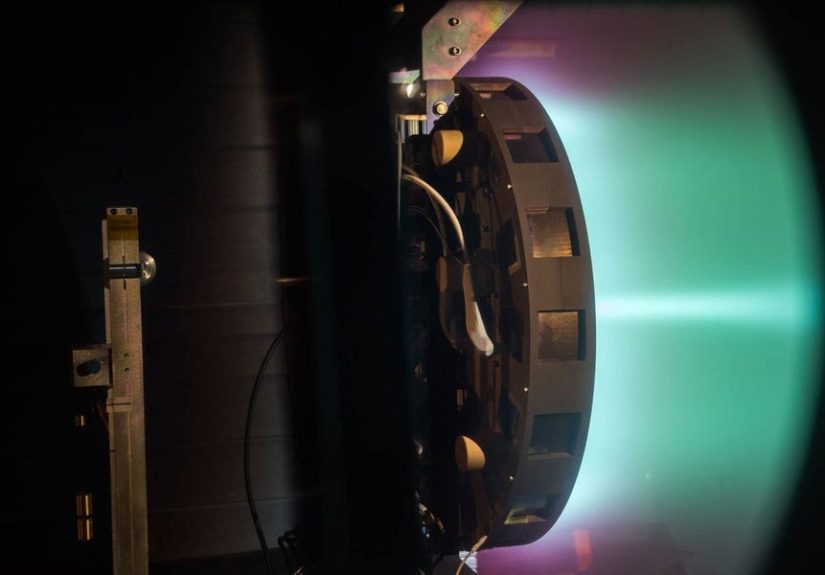
The record-breaking “Mars engine” is best known as X3, a high-power Hall thruster.
Hall thrusters are a type of electric (ion/plasma) propulsion that accelerates charged particles to create thrust.
Instead of burning fuel the way chemical rockets do, they use electricity to fling ions out the back at extremely high
speeds. The result is a gentle push that can run for a long timedays, months, even yearsuntil “gentle” turns into
“you just changed your orbit by a lot.”
X3 is especially interesting because it’s a nested-channel Hall thruster: think of multiple concentric
acceleration channels packaged together like a set of high-tech Russian dolls. That design approach aims to scale up
power and thrust without simply building one giant channel that becomes difficult to control, cool, and keep from
eroding itself into an expensive cloud of regret.
The Record-Breaking Numbers (and Why They Matter)
Records are only impressive if you know what the old world looked like. For electric propulsion, “world-changing”
often comes in the form of newtons, kilowatts, amperes, and other units that sound like villains from a math textbook.
Here’s the scoreboard-style version of what made X3 headline-worthy:
- Thrust: about 5.4 newtonsroughly the weight of a small apple-to-grapefruit-sized object on Earth, but sustained for a very long time.
- Power: up to roughly 100+ kilowatts during testingan “electric engine” that drinks electricity the way a data center drinks coffee.
- Operating current: pushing into the 200+ amp rangebecause when you scale up electric propulsion, the electrons don’t politely queue up; they show up as a crowd.
Why does that matter? Because the classic drawback of ion propulsion is low thrust. Traditional electric
thrusters are incredible for efficiency, but they’re not exactly going to pin you to your seat. By raising thrust while
maintaining electric propulsion’s propellant efficiency, you get a tool that can move heavier spacecraft faster
without carrying a mountain of chemical propellant.
Put another way: chemical rockets are great at the first part of the journeyescaping Earth’s gravity well. Electric
propulsion is great at the long middle partrearranging your trajectory once you’re already in space. A higher-thrust
electric option helps shrink the “slow middle,” especially for cargo, tugging big stacks, or repositioning massive infrastructure.
Ion Propulsion 101: The “Fuel Efficiency” Rocket
How ion engines push without “burning”
Most electric thrusters start with a neutral gas (often xenon). The engine ionizes that gasknocking electrons freethen
uses electric and magnetic fields to accelerate the positively charged ions out the back. Newton’s third law does the rest:
ions go one way, spacecraft nudges the other.
The magic isn’t more force; it’s more exhaust velocity. Electric thrusters can toss propellant out much faster
than chemical exhaust, which means you get more momentum change per unit of propellant. In rocket terms, that’s higher
specific impulse (often written as Isp), which is basically “how far can you stretch your propellant budget?”
Hall thrusters vs. “classic” gridded ion engines
People often say “ion engines” as a catch-all, but there are different families. Gridded ion thrusters use electrostatic
grids to accelerate ions like a tiny particle accelerator. Hall thrusterslike X3use a clever setup of crossed electric and
magnetic fields to trap electrons and ionize propellant efficiently, then accelerate ions through an electric potential.
Hall thrusters tend to be a popular choice for satellites and higher-power systems because they can deliver useful thrust
with good efficiency, and they scale well into the kilowatt range. They’re also the kind of engine you can point at a big
mission concept and say, “Yes, that could realistically move a very large object over time,” which is the nicest compliment
aerospace engineers know how to give.
Why “Shattering Records” Matters for Mars Missions
Because Mars is a logistics problem wearing a space-suit
The romantic version of a Mars mission is footprints in red dust. The real version is a shipping manifest: habitats, power
systems, spare parts, food, water processing, radiation shielding, return propellant, and about a million things nobody wants
to realize they forgot after leaving Earth.
High-power electric propulsion shines for cargo. You can launch heavy equipment, then let an electric tug gently
but continuously accelerate it on an efficient trajectory. If the trip takes longer, that’s often finecargo doesn’t get bored,
it doesn’t need snacks, and it rarely complains about legroom.
Power is the real “rocket fuel” for electric propulsion
Bigger Hall thrusters demand bigger power sources. For solar electric propulsion, that means huge solar arrays; for nuclear electric
concepts, it means reactors (and all the engineering complexity that comes with them). Either way, high-power electric propulsion
forces mission designers to think like systems engineers: thrusters, power generation, thermal control, power processing electronics,
propellant storage, and long-duration reliability all have to cooperate.
X3’s record-level performance matters because it demonstrates that the thruster side of the equation can scale. It’s a proof point that
“high-power Hall thruster” isn’t just a slide-deck fantasyit’s hardware that can light up in a vacuum chamber and behave.
From Lab to Space: The Hard Parts Nobody Brags About
Testing a giant electric thruster is its own adventure
Running a high-power Hall thruster on Earth means dealing with something space provides for free: a great vacuum. You need a massive test
chamber and vacuum pumps strong enough to keep the environment “space-like” even while you’re blasting propellant into it.
With X3, that challenge is extreme. If the chamber can’t pump fast enough, expelled xenon can drift back toward the plume and contaminate the
data. That’s not just annoyingit can change measured performance and make the test results less trustworthy. The point of a record is that it
holds up when everyone tries to poke holes in it.
Lifetime and erosion are the long-game villains
Electric propulsion isn’t usually limited by “can it run today?” but “can it run for years without wearing itself down?” Hall thrusters have
to manage plasma interactions with internal components, especially channel walls. Modern designs and techniqueslike magnetic shielding in some
thruster familiesaim to reduce erosion and extend service life.
That’s why record-breaking thrust alone isn’t the finish line. The finish line is: high thrust + high efficiency + long life + stable operation.
That’s when mission planners stop saying “interesting” and start saying “baseline.”
How NASA Is Scaling Electric Propulsion Right Now
NEXT: the endurance champion of ion engines
If X3 is the “power and thrust” headline, NASA’s NEXT program is the “stamina” headline. In long-duration ground testing, the NEXT
ion propulsion system ran for more than five years, demonstrating the kind of operational endurance that deep-space missions crave.
Endurance records matter because electric propulsion is all about accumulating small pushes into huge trajectory changes. If your engine can’t keep
going, the efficiency advantages don’t matteryou’re stuck halfway through your grand tour with an expensive paperweight.
Solar Electric Propulsion and the push toward operational high power
NASA’s solar electric propulsion roadmap isn’t just a research story; it’s increasingly an operations story. Higher-power Hall thrusters are being developed
and qualified for real missions, including systems designed to move large spacecraft around the Moon and beyond as part of cislunar infrastructure.
The big idea is straightforward: if you can generate lots of electricity in spaceespecially with large solar arraysyou can use that energy to move
important things without carrying huge amounts of chemical propellant. Over time, that can lower mission mass, reduce launch costs, and enable mission
architectures that would otherwise be too propellant-hungry to be practical.
So… Will Ion Propulsion Send Humans to Mars?
Here’s the honest, not-overhyped answer: ion propulsion is a Mars enabler, not a single-solution miracle. It’s especially powerful for
cargo delivery, reusable tugs, station-keeping for deep-space infrastructure, and long-haul transfers where efficiency beats brute force.
For crewed Mars missions, electric propulsion could play major rolespre-positioning habitats and supplies, moving stages, even supporting hybrid architectures
where chemical engines handle the big “fast” moments and electric engines handle the long “economical” moments. The technology trend is clear: electric
propulsion is growing up from “satellite housekeeping” to “serious exploration transportation.”
And when a thruster like X3 posts record numbers, it’s not just bragging rightsit’s one more piece of evidence that high-power electric propulsion can be built,
tested, and scaled toward the kinds of missions that used to belong only to science fiction.
500-Word Experience Add-On: Living With the Blue Plume
If you want to understand why electric propulsion is both thrilling and maddening, don’t start with the equationsstart with the test day. A high-power Hall
thruster test is part space exploration, part endurance sport, and part “please don’t let that connector be loose.”
First comes the vacuum. You can’t just flip a switch and call it space. A large facility has to pump down for hours to reach a space-like environment, and once
you finally get there, you treat every decision like it costs moneybecause it does. If something breaks, you can’t simply walk in and tighten a bolt. You may
have to bring air back into the chamber, open it safely, repair the hardware, then pump it back down again. That cycle is slow, labor-intensive, and humbling.
Suddenly, the phrase “tiny crack in a fitting” feels like a plot twist in a thriller.
Then comes the setup choreography. A large thruster isn’t a dainty lab toy. Heavy hardware needs custom mounts and thrust stands built to handle both its mass and
its force without flexing in ways that ruin your measurements. Power supplies, propellant lines, instrumentation, and safety checks pile up fast. Each subsystem is
a potential source of noise in your dataor drama in your schedule.
When the engine finally fires, the experience is almost the opposite of a Hollywood rocket launch. There’s no deafening roar. What you get instead is a steady,
eerie glowoften a vivid blue plume in photosplus a stream of telemetry that tells you whether the thruster is behaving or plotting against you. Engineers learn
to read that data the way musicians read sheet music: current levels, voltage stability, oscillations, temperatures, and plume diagnostics all have their own
“this is normal” ranges. Deviations don’t always mean catastrophe, but they always mean attention.
A surprising part of the “experience” is patience. Electric propulsion rewards slow thinking. You don’t rush a high-power test because rushing is how you end up
with confusing data or damaged hardware. Teams often work long daysbecause test windows are preciousand yet still move methodically, step by step, to avoid
mistakes that cost days.
And the emotional arc is real. There’s the high of a stable ignition and the low of a stubborn leak. There’s the relief when a noisy signal turns out to be a
sensor issue, and the anxiety when it isn’t. Over time, you start to respect the engineering truth behind electric propulsion: the thrust may be small, but the
complexity is not. What looks like “a gentle push” from space is backed by years of material science, plasma physics, power electronics, vacuum engineering, and
relentless troubleshooting.
The best part? When the numbers land where they shouldand especially when they exceed expectationsyou get a quiet kind of victory. Not a boom. Not a fireball.
Just a steady plume and a dataset that whispers, “Yeah… this could take us somewhere far.”
Conclusion
The “Mars engine” headline is catchy, but the real story is bigger than a nickname. High-power Hall thrusters like X3 show that electric propulsion can climb
into performance regimes that matter for heavy, ambitious missions. Pair that with NASA’s ongoing work in solar electric propulsion and long-duration ion engine
endurance, and you get a clear trend: electric propulsion is becoming a foundational tool for building, moving, and sustaining space infrastructureon the way to
Mars and well beyond it.