Table of Contents >> Show >> Hide
Every family has that one couple everyone quietly studies at Thanksgiving. You know the pair: one person sighs dramatically while the other passive-aggressively refills the gravy boat, and somehow they still manage to coordinate car insurance, mortgage payments, and a Costco run. By comparison, fictional couples often operate like they were assembled in a lab dedicated to bad boundaries, catastrophic communication, and romantic decisions made at 2:13 a.m. under the influence of plot armor.
That is exactly why audiences cannot stop watching them. Dysfunctional fictional relationships give us drama, memes, screaming matches in couture, and the occasional grand gesture that really should have ended with a restraining order instead of a swelling soundtrack. The healthiest idea in modern relationship advice is interdependence: two people support each other without swallowing each other’s identity whole. Fiction, however, often prefers obsession, manipulation, secrecy, jealousy, and the kind of emotional whiplash that would make a licensed therapist reach for a stress ball.
So this article is not a ranking of the “most romantic” couples. Quite the opposite. It is a guided tour through 34 unhealthy, exhausting, manipulative, or flat-out cringeworthy fictional relationships that somehow convinced viewers to keep pressing play. Some are iconic because they are genuinely toxic. Others are less dangerous and more deeply embarrassing, powered by bad timing, worse choices, and dialogue that sounds like it was written by Cupid after three espressos and a concussion.
If your parents occasionally bicker about how to load the dishwasher, congratulations: next to these fictional disasters, they look like the gold standard of mature, mutually supportive attachment.
Why We Keep Falling for Fictional Train Wrecks
There is a reason toxic fictional couples keep getting framed as epic. Conflict is good for storytelling. Stability is good for real life, but it is not always great television. Writers know that emotional inconsistency keeps viewers hooked. If one person is hot, cold, unavailable, mysterious, rich, immortal, or emotionally constipated in a very expensive coat, the audience is primed to read chaos as chemistry. Add longing glances, one memorable kiss in the rain, and a soundtrack that sounds like heartbreak wrapped in violins, and suddenly people are calling manipulation “fate.”
But once you step back, the patterns get obvious. A lot of these pairings run on control, secrecy, idealization, blurred power dynamics, and the classic “I can fix them” fantasy. Others are simply built on incompatibility so extreme that every reunion feels less like destiny and more like a clerical error. That mix of unhealthy attachment and performative passion is exactly what makes these fictional relationships so fascinatingand so bad.
34 Dysfunctional or Cringeworthy Fictional Relationships
TV Couples Who Turned Red Flags Into Interior Decor
- Ross Geller and Rachel Green (Friends) They are the patron saints of bad timing, jealousy, and weaponized nostalgia. If your relationship requires a decade of “were we on a break?” litigation, maybe the universe is filing paperwork for a reason.
- Carrie Bradshaw and Mr. Big (Sex and the City) This relationship helped normalize emotional unavailability as a luxury lifestyle. Carrie keeps mistaking inconsistency for depth, while Big treats commitment like a pop quiz he did not study for.
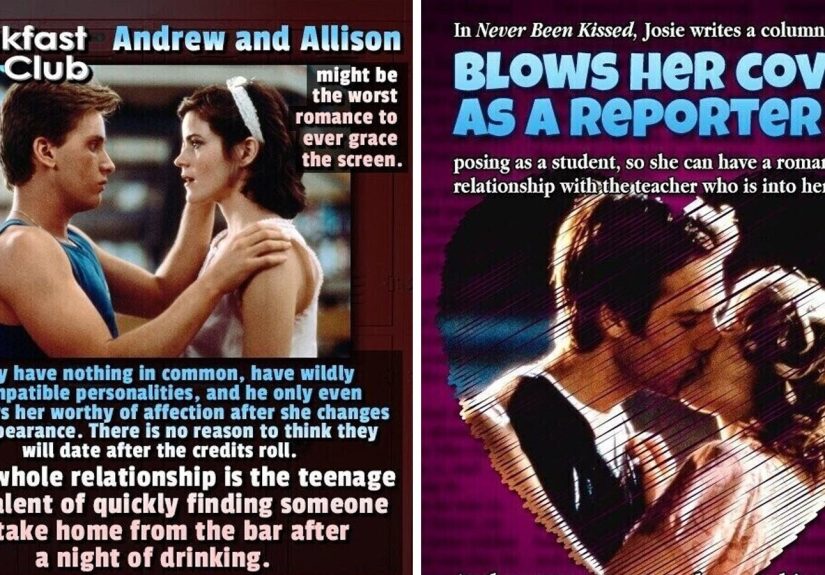
- Aria Montgomery and Ezra Fitz (Pretty Little Liars) The chemistry was framed as forbidden and swoony, but the power imbalance never stopped being a giant flashing siren. A student-teacher romance is not edgy; it is a red flag in a cardigan.
- Serena van der Woodsen and Dan Humphrey (Gossip Girl) They began as opposites-attract and ended as a case study in secrecy, hypocrisy, and wildly uneven self-awareness. By the end, the relationship felt less romantic than algorithmically chaotic.
- Blair Waldorf and Chuck Bass (Gossip Girl) Stylish? Absolutely. Healthy? Not even a little. Their entire love language seems to be manipulation, public humiliation, and the belief that emotional damage counts as foreplay.
- Ted Mosby and Robin Scherbatsky (How I Met Your Mother) Sometimes two people care about each other and are still wrong for each other. Ted spends years treating incompatibility like a puzzle he can solve with speeches and blue French horn energy.
- Dawson Leery and Joey Potter (Dawson’s Creek) This pairing survives mostly on history and vibes. Joey grows, Dawson sulks, and the whole dynamic often feels like a custody battle over nostalgia.
- Elena Gilbert and Damon Salvatore (The Vampire Diaries) The chemistry is undeniable, but so is the emotional wreckage. Damon is sold as the passionate bad boy, yet his volatility often turns romance into a full-contact sport.
- Joe Goldberg and Love Quinn (You) “Murderous soulmates” is not actually a healthy relationship category. They understand each other on a terrifying level, but mutual obsession is not the same thing as emotional safety.
- Cersei and Jaime Lannister (Game of Thrones) Few fictional relationships scream “please unpack this in therapy” louder than this one. It is built on codependence, power, secrecy, and the complete collapse of every healthy boundary on Earth.
- Rebecca Bunch and Josh Chan (Crazy Ex-Girlfriend) The genius of this show is that it knows the fantasy is broken. Rebecca projects a whole cinematic destiny onto Josh, and the result is not romance but a cautionary musical about obsession.
- Coach Beard and Jane Payne (Ted Lasso) Even within a feel-good show, this relationship radiates “friends are worried but exhausted.” It is one of television’s clearest examples of chaos disguised as intensity.
- Don Draper and Betty Draper (Mad Men) Gorgeous people in a beautiful house can still be spectacularly miserable. Their marriage runs on deception, repression, resentment, and enough emotional frost to preserve leftovers indefinitely.
- Rory Gilmore and Dean Forester (Gilmore Girls) Early sweetness gives way to possessiveness, insecurity, and a mismatch in maturity. It is one of those relationships that seems adorable until adulthood walks in and turns on the lights.
- Piper Chapman and Alex Vause (Orange Is the New Black) Their chemistry is real, but so are the lies, betrayals, and endless cycles of damage. This is the kind of relationship that makes “it’s complicated” sound hilariously insufficient.
- Meredith Grey and Derek Shepherd (Grey’s Anatomy) They are iconic, yes, but also powered by mixed signals, hierarchy issues, vanishing acts, and enough melodrama to require a trauma surgeon and a couples counselor on standby.
Movie Couples Who Confused Drama With Romance
- Harley Quinn and the Joker (DC) This is one of pop culture’s most notorious toxic relationships, full stop. The style is unforgettable, but the dynamic is manipulation, cruelty, and abuse dressed up in neon.
- Bella Swan and Edward Cullen (Twilight) Intensity is not the same as health. Surveillance, overprotection, extreme dependency, and the total eclipse of Bella’s individual identity make this romance a very shiny codependency machine.
- Christian Grey and Anastasia Steele (Fifty Shades) The franchise sells control as seduction, but a lot of the discomfort comes from blurred consent, emotional imbalance, and a man who treats vulnerability like a software bug.
- Noah Calhoun and Allie Hamilton (The Notebook) This couple is often presented as peak romance, but underneath the iconic rain scene is a whole lot of volatility, pressure, and conflict mistaken for passion.
- Hardin Scott and Tessa Young (After) If emotional whiplash were a franchise, it would look like this. Their relationship is fueled by deception, cruelty, possessiveness, and the idea that a man being wounded excuses him being awful.
- Massimo Torricelli and Laura Biel (365 Days) This is not a misunderstood love story. It is coercion wrapped in luxury branding, the kind of movie relationship that makes every healthy-couple checklist burst into flames.
- Amy Dunne and Nick Dunne (Gone Girl) Marriage is about teamwork, unless you two are these lunatics. Their relationship is an exquisitely toxic duel of lies, image management, and mutually assured destruction.
- Malcolm and Marie (Malcolm & Marie) This pair spends one long night turning every insecurity into a weapon. It is less a conversation than a beautifully shot emotional cage match.
- Cathy Earnshaw and Heathcliff (Wuthering Heights) Gothic literature really said, “What if longing ruined everyone?” Their connection is passionate, yes, but it is also destructive, obsessive, and powered by generational emotional fallout.
- Daisy Buchanan and Tom Buchanan (The Great Gatsby) Money cannot buy love, but it can apparently fund denial on an industrial scale. Their relationship is shallow, cruel, selfish, and held together by privilege and avoidance.
- Scarlett O’Hara and Rhett Butler (Gone with the Wind) Whatever seductive myth surrounds them, their relationship is full of ego, manipulation, emotional games, and pain treated as proof of connection.
- Tom Hansen and Summer Finn (500 Days of Summer) This one is less toxic than painfully instructive. Tom falls in love with a projection, ignores what Summer actually says, and mistakes his fantasy for a mutual contract.
- Elle Evans and Noah Flynn (The Kissing Booth) The franchise packages jealousy and double standards in a bright teen-romance wrapper. Strip away the carnival colors and you get a relationship that is controlling, immature, and exhausting.
Fantasy, Anime, and Other Relationships Built in the Red-Flag Factory
- Light Yagami and Misa Amane (Death Note) This is not a romance so much as an exploitation loop. Misa is devoted; Light mostly treats her like a convenient accessory with excellent hair and poor boundaries.
- Sasuke Uchiha and Sakura Haruno (Naruto) Fans have debated this one for years, and for good reason. Sakura’s devotion far exceeds what Sasuke gives back for a very long time, creating a dynamic that often feels painfully one-sided.
- Yuno Gasai and Yukiteru Amano (Future Diary) If somebody says “I’d do anything for you,” there should be limits. Yuno turns obsession into an Olympic event, and the result is one of anime’s most famous nightmare romances.
- Makoto Ito and Sekai Saionji (School Days) Calling this relationship dysfunctional is generous. It is a domino chain of bad choices, betrayal, emotional irresponsibility, and consequences so extreme they became internet legend.
- Yuki Cross and Kaname Kuran (Vampire Knight) The show leans hard on forbidden-gothic allure, but the emotional power imbalance and deeply uncomfortable dynamics keep this romance firmly in the “absolutely not” file.
What These Bad Relationships Actually Reveal
Put these couples side by side and a few patterns jump out immediately. First, many of them confuse unpredictability with passion. If a character is emotionally unavailable, secretive, or outright dangerous, fiction often treats that as irresistible magnetism. Second, a lot of these stories flatten one partner into a caretaker, fixer, admirer, or emotional hostage. That is not interdependence; that is enmeshment wearing a nice soundtrack.
The third pattern is cringeworthy idealization. Some couples are not toxic because they are overtly cruel. They are cringeworthy because they are built on projection. One person loves the fantasy version of the other, not the reality standing in front of them. When that gap widens, the relationship turns into a performance of what love is supposed to look like rather than a connection between two actual people.
In other words, the lesson is not “never enjoy messy fiction.” Please do. Messy fiction is delicious. The lesson is simply that viewers are smarter when they stop mistaking drama for devotion. A partner who respects your boundaries, tells the truth, supports your individuality, and does not stalk you, test you, manipulate you, or blow up your life for character development is not boring. That partner is just not written by a room full of people chasing season-finale ratings.
Final Thoughts
The weird beauty of dysfunctional fictional relationships is that they can be entertaining while still being terrible models for real life. We laugh at them, quote them, argue about them online, and occasionally defend them with the irrational confidence of a person who has forgotten every warning sign in the previous six episodes. But once the glitter settles, most of these couples are not relationship goals. They are relationship caution tape.
So yes, your parents may squabble over thermostats, text in all caps, or retell the same disagreement from 1998 every Christmas. But if they communicate decently, respect each other’s autonomy, and do not routinely fake deaths, weaponize trauma, publish anonymous gossip blasts, or turn obsession into a lifestyle brand, they are doing just fine. Compared with these fictional couples, they are not dysfunctional. They are downright interdependent.
Viewer Experience: Why These Relationships Hit So Hard
Part of the reason people remember dysfunctional fictional relationships so vividly is that many of us met them at exactly the wrong age. We watched them as teenagers, college students, or hopeless romantics who still believed one intense stare across a room could cancel out seven episodes of alarming behavior. We did not always have the language for boundary issues, manipulation, emotional inconsistency, or codependency. We just knew a couple was “electric,” and that was often enough to keep us rooting for them even when the relationship itself looked like an HR incident waiting to happen.
There is also a shared cultural experience in revisiting these couples years later and realizing, with a full-body cringe, that our original take was deeply unserious. The pair we once described as passionate now looks exhausting. The brooding love interest we thought was mysterious now reads as emotionally unavailable with premium lighting. The heroine we called loyal suddenly seems trapped in a one-sided arrangement where she is doing all the emotional labor while the other person contributes cheekbones and problems. Growing up often means watching an old favorite and realizing that what once felt romantic now feels like a cautionary slideshow.
That shift can be strangely funny and weirdly personal. People revisit Friends, Gossip Girl, Twilight, or The Notebook and discover they are no longer impressed by intensity for intensity’s sake. Instead, they start noticing the little things: who listens, who lies, who apologizes, who punishes vulnerability, who turns every argument into a power contest, and who seems to have mistaken surveillance for affection. Suddenly the flashy grand gesture matters less than whether two characters can hold one honest conversation without detonating the room.
There is a social angle, too. Entire online communities now bond over re-evaluating fictional couples. The internet has become one big group chat where people say, “Wait, why did we all think this was cute?” That collective reassessment is part of what makes these relationships endure. They are not just stories anymore; they are shared benchmarks in how audiences evolve. A couple that once defined romance for one generation may become a meme about emotional unavailability for the next.
And maybe that is the real experience behind all of this: fictional relationships are often mirrors for changing expectations. As audiences get better at recognizing healthy love, they also get better at spotting manipulation wrapped in charisma. We still enjoy the mess, because fiction without conflict would be bland oatmeal in human form. But now more viewers can separate “compelling to watch” from “good to want.” That is progress. That is growth. And honestly, that is how you know your standards are improvingwhen you can enjoy the drama on screen while quietly thanking the universe that your own relationship does not require secret identities, trauma-bond flirting, three breakups per semester, and a monologue in the rain to function.