Table of Contents >> Show >> Hide
- The Meta Quest 4 Rumor Snapshot
- Release Date Rumors: 2026 Once Looked Likely, 2027 Now Feels Safer
- Meta Quest 4 Price Rumors: The Most Interesting Guessing Game
- Specs Rumors: What the Meta Quest 4 Could Actually Upgrade
- What Meta’s Bigger Strategy Tells Us
- Should You Wait for the Meta Quest 4?
- Experience Watch: What Following the Meta Quest 4 Rumors Feels Like Right Now
- Final Verdict
- SEO Tags
If you love VR, you already know the drill: the moment one headset ships, the rumor mill starts building the next one out of thin air, leaked codenames, and enough speculation to power a small city. That brings us to the Meta Quest 4. It is not official. It is not announced. It is not sitting in a store waiting for your credit card. But it is one of the most talked-about future headsets in mixed reality right now.
So what is actually believable? As of now, the Quest 4 rumor story looks less like a clean product roadmap and more like a whiteboard that got rewritten three times during a strong espresso break. Early reports pointed to a 2026 release with two versions. Later reporting suggested those specific plans were sidelined while Meta shifted attention to lighter, more experimental hardware. Then came newer commentary implying that a future Quest headset is still very much alive. In other words: the Quest 4 rumor cycle is messy, but not empty.
This article breaks down the most realistic expectations for the Meta Quest 4, including rumored pricing, likely release timing, possible specs, and what Meta’s recent moves say about the headset’s future. The goal here is simple: separate the good rumors from the ones that sound like they were typed by a sleep-deprived goblin on a forum at 2 a.m.
The Meta Quest 4 Rumor Snapshot
The broadest reading of the current rumor landscape is this: Meta almost certainly has future Quest hardware in development, but the exact form, timing, and branding appear to have shifted over time. Earlier reporting suggested that two Quest 4 variants, often referred to as “Pismo Low” and “Pismo High,” were planned for 2026. Later reports indicated those particular candidates may have been canceled or delayed, while Meta put more energy into a lighter, puck-powered mixed reality device. More recent commentary from Meta leadership has been interpreted as a signal that at least two future devices remain on the roadmap.
That matters because it changes how readers should interpret every “Quest 4 is coming next year” headline. The more accurate takeaway is not that one exact headset has been steadily marching toward launch. It is that Meta appears to be iterating aggressively, changing priorities, and keeping multiple paths open. That is not unusual in consumer hardware, but it does make rumor reporting feel like trying to read a treasure map while someone keeps moving the island.
Release Date Rumors: 2026 Once Looked Likely, 2027 Now Feels Safer
For a while, the cleanest Quest 4 rumor was a 2026 launch. That estimate made intuitive sense. Meta launched the Quest 2 in 2020 and the Quest 3 in 2023, so a 2026 successor would fit a roughly three-year cadence. It also matched the idea of Meta keeping its gaming-first headset lineup fresh while continuing to push mixed reality into the mainstream.
But the rumor picture changed. Mid-cycle reports suggested that Meta had started prioritizing a lighter headset concept over the original Quest 4 candidates. Instead of rushing out a traditional follow-up to the Quest 3, Meta reportedly began focusing on a slimmer device with compute and battery moved to an external puck. That kind of design sounds exciting on paper, though it also sounds like the sort of thing that creates at least twelve new engineering headaches before lunch.
That shift is why 2027 now feels like the safer estimate for a traditional Quest 4. It does not mean 2026 rumors were invented out of thin air. It means the specific 2026 plan may no longer be the plan. And if Meta’s current hardware strategy is being shaped by AI glasses, partner devices, and lighter spatial computing products, a later Quest 4 would actually fit the company’s recent behavior pretty well.
Another clue: Meta Connect 2025 came and went without an official Quest 4 announcement. That does not kill the product, but it does make an immediate release look less likely. If there had been a near-term launch on a firm schedule, Connect would have been the obvious moment to start the hype train.
Best current estimate: a traditional Meta Quest 4 looks more likely in late 2027 than in 2026, though the exact timing remains unconfirmed and subject to change.
Meta Quest 4 Price Rumors: The Most Interesting Guessing Game
Pricing is where rumors stop being fun and start becoming personal. Everyone wants the next headset to be lighter, faster, sharper, and somehow cheaper. Sadly, physics and accounting are both buzzkills.
Meta’s current lineup gives us a useful frame of reference. The Quest 3S opened the door at a much more approachable price, while the Quest 3 positioned itself as the more premium mainstream option. That split tells us Meta still cares deeply about affordability, but it also wants room to sell a better experience at a higher tier.
If the Quest 4 remains a gaming-focused all-in-one headset, the most realistic base price rumor is somewhere in the $499 to $699 range. That would place it above the entry-level Quest 3S while still leaving breathing room below the ultra-premium spatial computing category. A launch at $499 would be the crowd-pleaser. A launch around $649 would be more believable if Meta adds meaningful upgrades in display, comfort, and tracking.
There is also a wilder pricing possibility. Some reporting has described a future gaming-focused headset as a “large upgrade” that may not be subsidized the way earlier Quest hardware was. If that turns out to be true, the Quest 4 could land closer to $699 to $899, especially if Meta reserves the cheaper end of the market for the Quest 3S or a future “S” model. That kind of move would not be shocking if Meta wants better margins and less pressure to sell premium hardware at a near-miraculous price.
Still, Meta has already seen what happens when a headset drifts too far away from mainstream pricing. The broader market has shown interest in premium spatial computing, but not endless enthusiasm for stratospheric prices. That is why a true four-digit Quest 4 price feels unlikely for a mainstream gaming headset. Meta knows it can win more hearts with “surprisingly affordable” than with “financially adventurous.”
Most Plausible Price Scenarios
- $499 to $599: aggressive mainstream price, likely if Meta sticks close to the Quest formula.
- $649 to $699: the sweet spot if the headset gets major upgrades without going fully premium.
- $799 and above: possible only if Meta pushes a more ambitious, less subsidized model.
Specs Rumors: What the Meta Quest 4 Could Actually Upgrade
1. A Faster Chipset
The safest bet is a stronger processor. The Quest 3 family already uses Qualcomm’s XR2 Gen 2 platform class, so the Quest 4 would almost certainly need to move beyond that, either with a newer Snapdragon XR chip or a meaningfully boosted configuration. This is the least controversial rumor because every new headset needs a performance story, and “same chip, new box” is not the kind of slogan that gets applause.
A more powerful chip would improve frame rates, mixed reality rendering, on-device AI features, and overall app complexity. It could also help Meta push more advanced passthrough and spatial interfaces without turning the headset into a face-worn space heater.
2. Better Displays
Display rumors are where things get spicy. The Quest 3 already pushed clarity forward with a 2064 x 2208 resolution per eye, so the Quest 4 will likely aim higher. That does not automatically mean a huge jump to luxury-grade micro-OLED. It could, but cost matters, and Meta usually has one eye on price even while the other eye is busy imagining the metaverse.
The most realistic display upgrade would be sharper panels, better brightness, improved contrast, and cleaner passthrough. If Meta wants to preserve a mainstream price, improved LCD with better optics may be more practical than a dramatic leap to very expensive display tech. If there are multiple models, a premium tier could be where eye-catching display upgrades show up first.
3. Slimmer, More Comfortable Design
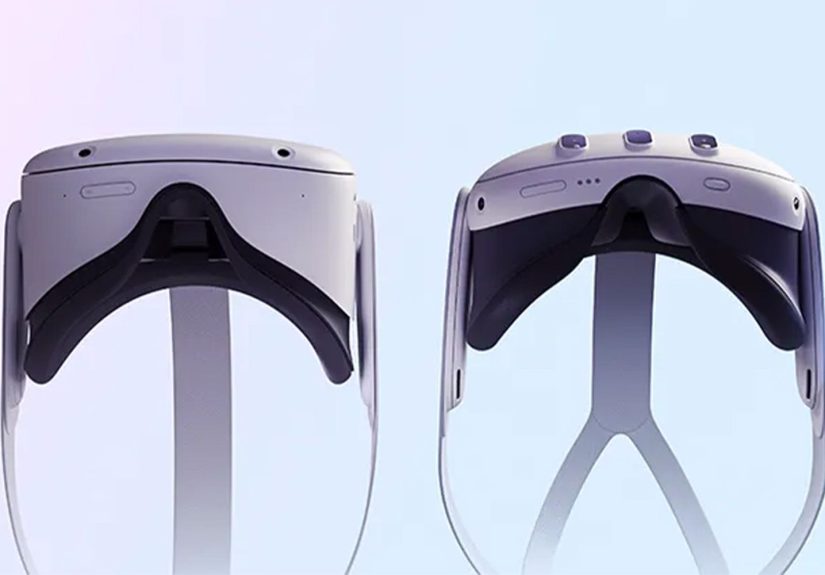
Comfort is one of the loudest wishlist items in every Quest conversation, and rumor reporting has consistently pointed to Meta experimenting with thinner hardware. Whether the final Quest 4 is a true goggles-style device or just a refined version of the Quest 3 shape, it would be shocking if Meta did not try to reduce front-heaviness and improve long-session comfort.
This is especially true because Meta’s recent product thinking seems obsessed with wearability. Smart glasses, lightweight mixed reality concepts, and slimmer optics all suggest that the company is trying to make face computers feel less like ski gear from the future.
4. Better Passthrough and Mixed Reality
If Quest 3 introduced mixed reality as a mainstream feature, Quest 4 will need to make it feel less like a cool extra and more like the default. That likely means better color passthrough, lower latency, cleaner edge handling, and more natural room mapping. The improvement may sound technical, but users feel it instantly. Better passthrough is the difference between “wow, neat” and “I might actually use this every day.”
5. Eye Tracking, Hand Tracking, and Smarter Input
Eye tracking feels like one of the most reasonable rumored upgrades, especially on a premium variant. It could help with foveated rendering, avatar realism, and more intuitive interface control. Hand tracking will almost certainly improve as well, because Meta keeps pushing toward more natural input across its hardware ecosystem.
That said, the idea that controllers are about to disappear entirely from a gaming-first Quest 4 feels premature. For productivity-focused hardware, maybe. For action games, rhythm games, and anything involving precise button input? Controllers are not dead. They are very much employed.
6. AI Features That Actually Matter
Meta is leaning hard into AI across its product portfolio, so the Quest 4 will almost certainly arrive with more AI-driven features than the Quest 3. The important question is whether those features improve the headset or just appear in keynote slides next to glowing blue icons.
The useful version of AI in Quest 4 would include smarter scene understanding, better voice interaction, easier multitasking, and more helpful mixed reality setup. If Meta gets this right, AI becomes invisible glue. If not, it becomes another bullet point that users ignore while launching Beat Saber.
What Meta’s Bigger Strategy Tells Us
To understand the Quest 4, you have to look beyond the headset itself. Meta is no longer acting like a company with one simple VR roadmap. It is juggling consumer Quest hardware, smart glasses, Horizon OS partnerships, mixed reality productivity ideas, and AI-first wearables. That broader strategy helps explain why Quest 4 rumors have looked unstable.
In plain English, Meta may be trying to avoid making the Quest 4 carry the full weight of its future vision. Instead, it can let glasses push wearability, partner devices explore new categories, and future Quest hardware stay focused on immersive gaming and mainstream mixed reality. That would make the Quest 4 less of a moonshot and more of a careful, strategic upgrade.
That is probably good news for buyers. When a company stops trying to make one device do everything, the product often gets better. The dream scenario is a Quest 4 that knows exactly what it is: a better gaming and mixed reality headset, not a Swiss Army knife that also wants to replace your laptop, sunglasses, and personality.
Should You Wait for the Meta Quest 4?
This depends on what you already own.
If you are still using a Quest 2 and feel the hardware’s age every time you fire up a newer mixed reality experience, waiting for a maybe-2027 headset is a very long time. The Quest 3 or Quest 3S makes more sense today. You get access to the current software ecosystem, better performance, and actual products that exist outside rumor articles such as this one.
If you already own a Quest 3, waiting is easier. You are not missing the current generation. In that case, the Quest 4 is worth watching because the rumored jump could be more about comfort, clarity, and polish than basic capability. A thinner design and better mixed reality might feel meaningful enough to justify an eventual upgrade.
If you are a pure spec hunter who enjoys living one leak away from emotional chaos, then yes, keep watching the Quest 4. Just keep your expectations realistic. Rumors are useful for direction, not certainty.
Experience Watch: What Following the Meta Quest 4 Rumors Feels Like Right Now
Following the Meta Quest 4 rumor cycle in 2026 feels a little like standing in line for a roller coaster that keeps changing its track while the park announcer insists everything is going great. One week, the story is that Quest 4 will arrive as a straightforward successor with a normal upgrade path. The next week, it is apparently being overshadowed by a futuristic goggles device with a pocket puck. Then a company executive says future devices are still on the roadmap, and suddenly everyone is back to drawing renderings and arguing about pancake lenses like it is a constitutional issue.
For current Quest owners, the experience is oddly familiar. Meta’s hardware always lives in two worlds at once: the product you can buy today and the product that might exist tomorrow. If you own a Quest 3, watching Quest 4 rumors is mostly exciting. You already have a capable headset, so every leak feels like a sneak peek rather than a personal crisis. A thinner frame? Nice. Better displays? Excellent. Eye tracking? Finally. You can sit back, enjoy your current hardware, and let the rumor machine entertain you without ruining your week.
For Quest 2 owners, the feeling is different. The experience becomes a tug-of-war between patience and practicality. You read about possible 2027 timing and think, “That is a long wait.” Then you read about a potential large upgrade and think, “But what if the next one is the real leap?” This is the classic tech-buyer dilemma: buy the thing that exists, or keep waiting for the magical future device that might launch later, cost more, and still somehow disappoint your inner perfectionist.
There is also the emotional whiplash created by Meta’s broader strategy. The company is clearly fascinated by smart glasses, lightweight wearables, AI-first interfaces, and more natural input methods. That makes Quest 4 rumors feel bigger than a normal headset refresh. People are not just asking whether the next Quest will be faster. They are asking what kind of device Meta even wants the Quest family to become. Is it still a gaming-first headset line? A mixed reality workspace? A stepping stone toward something that eventually looks more like glasses than a visor? That uncertainty creates buzz, but it also makes every rumor feel more dramatic than it probably is.
And yet, for all the noise, there is a fun side to this experience. Quest 4 rumors are exciting because the current VR market is finally starting to branch out. Buyers are no longer choosing between “expensive” and “more expensive.” They are watching companies test different shapes, different input ideas, different display strategies, and different definitions of what spatial computing should be. Meta Quest 4 sits right in the middle of that shift. So even if the final product lands later than expected, the rumor journey tells us something useful: the next Quest probably will not just be a faster Quest 3. It will be Meta’s answer to a new era of VR and mixed reality, and that makes the waiting a little more interesting.
Final Verdict
The Meta Quest 4 is still more rumor than reality, but the rumors are now strong enough to outline a believable direction. The old idea of a neat 2026 launch has weakened. A 2027 window for a traditional Quest 4 looks more realistic. Pricing will likely stay well below ultra-premium headsets, though a meaningful upgrade could push it into the upper midrange. As for specs, expect better performance, improved displays, stronger mixed reality, and a lighter design to be at the center of the pitch.
The smartest way to read all this is with cautious optimism. Meta almost certainly has something brewing for the future of Quest hardware. The hard part is figuring out which prototype, which codename, and which idea survives the company’s tendency to redraw its own future. Until then, the Quest 4 remains what every good gadget rumor should be: plausible, exciting, slightly chaotic, and just mysterious enough to keep us clicking.