Table of Contents >> Show >> Hide
- Key takeaways (for people who were elected to lead, not to read)
- Quick refresher: Who is Rainier Wolfcastle, really?
- The episode that did it: “Bart Star” and the “Fit or Fat” gauntlet
- The real-life spark: a producer overhears Arnold on a hike
- Why Schwarzenegger was the perfect target (and the perfect shortcut)
- Satire vs. cruelty: what the joke is trying to do
- …And why it still makes viewers uncomfortable
- How writers turn awkward reality into Springfield canon
- What this moment teaches us about comedy (and about updating the playbook)
- Conclusion: a joke with a paper trail (and a lesson)
- Experiences related to this topic (the extra , served with a side of self-awareness)
When satire borrows from real life, sometimes the joke has a pulse… and sometimes it has a body-fat percentage sticker.
The Simpsons has spent decades doing what it does best: holding up a funhouse mirror to American culture and letting us laugh at the reflection
(even when the reflection is wearing a mullet and holding a donut like it’s a tiny trophy). One of the show’s most enduring mirror-tricks is the celebrity parody:
familiar enough to instantly “get,” exaggerated enough to feel cartoonishly safe, and sharp enough to sting just a little.
Few parodies are as instantly recognizable as Rainier Wolfcastle Springfield’s musclebound action star, “McBain” face-punching through windows,
grunting his way through movie trailers, and generally existing as a loving roast of a very specific kind of 1980s–1990s superstar. And yes, it’s hard to miss:
Rainier is basically Arnold Schwarzenegger with the serial numbers filed off.
But one particular Wolfcastle moment a blatantly mean jab that crosses into fat-shaming didn’t come from a writer’s room dartboard labeled “Stereotypes.”
It came from something much more mundane and, frankly, more awkward: a real-world experience a Simpsons producer had while hiking behind
Arnold Schwarzenegger… and overhearing the way he talked to his kids.
Key takeaways (for people who were elected to lead, not to read)
- Wolfcastle is a broad parody of Schwarzenegger’s image: bodybuilding icon, action hero, larger-than-life public figure.
- The “Fit or Fat” gag in “Bart Star” leans into 1990s fitness culture including Arnold’s real role promoting youth fitness.
- A producer’s anecdote about hearing Schwarzenegger say something like “Move it, fatty!” helped shape Wolfcastle’s fat-shaming line.
- The joke works as satire of toxic motivation but it also shows how easily comedy can normalize cruelty.
Quick refresher: Who is Rainier Wolfcastle, really?
Rainier Wolfcastle is the fictional action star behind Springfield’s ultra-cheesy McBain franchise a parody playground built from
every explosion-happy action cliché of its era. If the 1980s taught Hollywood anything, it’s that plot is optional as long as the biceps are mandatory.
Wolfcastle is the embodiment of that lesson: an Austrian accent, a granite jawline, and the emotional range of a hydraulic press.
The writers used Wolfcastle to spoof more than just one actor. He’s also a satire of an entire entertainment ecosystem: the merch, the branding,
the celebrity “business ventures,” and the way fame gets repackaged into family-friendly inspiration. Wolfcastle is both the punchline and the delivery system.
That’s why Wolfcastle pops up in so many different contexts movie sets, restaurants, political jokes, even children’s fitness initiatives.
He’s a Swiss Army knife of parody: open the blade you need, slice the culture accordingly.
The episode that did it: “Bart Star” and the “Fit or Fat” gauntlet
The fat-shaming moment fans point to comes from Season 9’s “Bart Star”, a football-themed episode that begins with Springfield’s kids
being labeled overweight after a health convention. The town’s solution is peak Springfield: not nuanced public health policy, but pee-wee football,
panic, and grown-ups projecting their anxieties onto children.
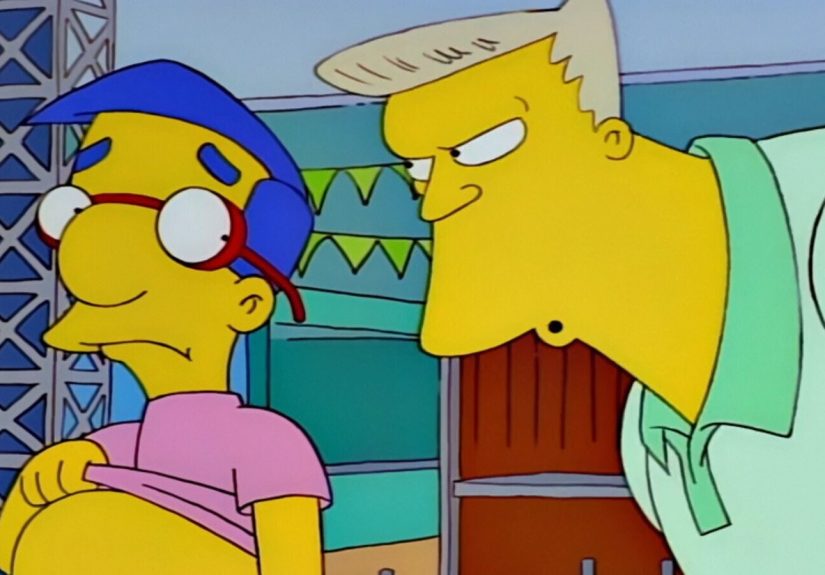
In the middle of that convention chaos sits the infamous booth: “Fit or Fat”, run by Rainier Wolfcastle. Kids line up to be evaluated,
poked, tested, and branded with a label like they’re luggage at an airport except the destination is shame.
When Üter struggles and tries to charm Wolfcastle with fandom (“I loved your last movie…”), Wolfcastle snaps back with the line that still makes viewers wince:
“Quit stalling, fatty.”
It’s short. It’s cruel. And it’s played as a throwaway gag which is exactly why it sticks. Comedy often sneaks its sharpest edges into “quick” jokes,
because the speed discourages reflection. By the time your brain catches up, the show is already on the next punchline, smiling innocently like,
“Who, me? I’m just a cartoon.”
The real-life spark: a producer overhears Arnold on a hike
Here’s where the story shifts from satire to the messy notebook of real life. According to an anecdote shared by producer and writer
George Meyer, the inspiration for Wolfcastle’s harsh fitness-talk came from something Meyer personally witnessed:
he was hiking behind Arnold Schwarzenegger in the canyons and overheard Arnold urging his kids along with a line along the lines of
“Move it, fatty!”
In other words: the “Wolfcastle is mean to kids” bit wasn’t purely an exaggerated cartoon invention. It was an exaggerated cartoon echo.
The writers’ room didn’t pull that tone from thin air it pulled it from a real, uncomfortable moment that sounded like a movie stereotype,
except it was happening outdoors, with actual children and actual gravity.
And that’s what makes the anecdote so revealing about how The Simpsons works at its best (and occasionally at its most questionable).
The show is famously observational. Writers notice something odd, funny, or unsettling, then crank it through Springfield’s comedy engine
until it becomes a recognizable, shareable scene.
Sometimes that engine produces brilliant satire. Other times it produces a joke that ages like milk in the trunk of a car.
The Wolfcastle fat-shaming line sits right on that border.
Why Schwarzenegger was the perfect target (and the perfect shortcut)
To understand why this parody worked so quickly, you have to remember what Arnold Schwarzenegger represented in American pop culture:
not just an action star, but a walking symbol of discipline, fitness, and “tough love” motivation.
That image wasn’t just cinematic it was political and institutional, too. Schwarzenegger was appointed as
Chairman of the President’s Council on Physical Fitness and Sports in 1990, and his role included promoting health and fitness,
particularly among young people. That made him an easy cultural reference point for a 1990s joke about fitness messaging aimed at kids.
In “Bart Star,” Wolfcastle is basically that public-facing image, dialed up to parody: the celebrity fitness authority who shows up, barks orders,
and treats children like tiny recruits in a boot camp. It’s a satire of the idea that you can bully people into wellness
and that “motivation” becomes respectable when it’s delivered by someone famous enough to sell it.
Satire vs. cruelty: what the joke is trying to do
1) It mocks performative fitness culture
The “Fit or Fat” booth isn’t just about kids’ bodies it’s about adult panic. The episode treats the health convention like a carnival of anxiety:
quick tests, simplistic labels, and the illusion that complicated health issues can be solved with a sticker and a pep talk.
2) It skewers “tough love” as a personality brand
Wolfcastle’s insult isn’t framed as helpful. It’s framed as absurd. The humor comes from the mismatch:
a movie star treating a child like he’s yelling at a rival in an action film. It’s not “helpful coaching” it’s cosplay authority.
3) It reveals how easily adults normalize shaming
The darkest joke in the scene is how quickly everyone accepts it. No gasps. No “sir, this is a Wendy’s.”
Just a steady flow of children moving through a system that labels them publicly. That’s classic Simpsons satire:
the town’s moral compass spins like a fidget spinner whenever a trend shows up.
…And why it still makes viewers uncomfortable
Even if the satire target is “toxic fitness culture,” the delivery mechanism is still a fat-shaming insult aimed at a child.
And there’s the rub: satire can critique cruelty while accidentally reproducing it.
In the late 1990s, mainstream TV jokes about weight especially kids’ weight were everywhere. They were treated as harmless shorthand,
like sitcom seasoning you sprinkle on a scene to make it “relatable.” But the cultural context has shifted.
Today we’re more aware of how body-shaming contributes to stigma, disordered eating, and lifelong insecurity.
That doesn’t mean the episode becomes “forbidden.” It means it becomes interesting a snapshot of what comedy thought it could get away with,
and what audiences were expected to shrug off.
If anything, the story behind the joke that it was inspired by something a producer heard in real life makes it hit harder.
Because now it’s not just a cartoon being mean. It’s a cartoon reflecting a kind of real-world meanness that people can recognize.
How writers turn awkward reality into Springfield canon
Comedy writing often works like a recycling bin with a microphone. A writer hears something bizarre, files it away, and later reshapes it
into a moment that feels “truer” because it’s rooted in reality. The hike anecdote is a textbook example:
a tiny moment, overheard in passing, becomes a line that encapsulates an entire stereotype.
Here’s the twist: once that line is on TV, it starts influencing our culture, too. People repeat it. Meme it.
The parody becomes the reference point. Even Schwarzenegger jokes in The Simpsons Movie (like the famous “leader, not a reader” gag)
helped cement a pop-cultural Arnold archetype that lives independently from the real person.
That feedback loop is why small writing choices matter. A single throwaway insult can outlive the scene, outlive the episode,
and become part of how audiences talk to each other, about themselves, and sometimes about their kids.
What this moment teaches us about comedy (and about updating the playbook)
Make the target unmistakable
If the joke’s target is “toxic motivation,” you want the punchline aimed at the toxic behavior not at the kid who’s already being judged.
Some modern shows solve this by letting the victim react, or by clearly positioning the cruel character as the butt of the joke.
The faster and cleaner the framing, the less likely satire will be mistaken for endorsement.
Don’t confuse “recognizable” with “harmless”
Comedy often picks the most recognizable stereotype because it lands quickly. But recognizable doesn’t mean harmless
especially when it’s built from shame. If you’ve ever laughed at a joke and then immediately felt guilty,
congratulations: you’ve discovered the difference between “efficient” and “good.”
Real life is not always a great script supervisor
The hike anecdote is a reminder that real people can say ugly things casually and those ugly things can feel “true” in a way writers love.
The question becomes: do you translate that moment as-is, or do you reshape it to punch upward?
That’s where craft meets ethics.
Conclusion: a joke with a paper trail (and a lesson)
Rainier Wolfcastle is funny because he’s a perfect, exaggerated distillation of a cultural icon: the blockbuster action hero who also sells “fitness”
as a worldview. In “Bart Star,” that worldview turns into a harsh little insult one that lands because it’s blunt, and lingers because it’s mean.
The fact that the fat-shaming moment was reportedly inspired by a producer overhearing Schwarzenegger on a hike adds a strange layer of realism to the satire.
It’s not just a cartoon writer imagining how a tough guy might talk. It’s a cartoon writer replaying a moment that sounded like parody in real time.
If you revisit the scene today, it can still be funny but it’s also a reminder of how comedy evolves.
Jokes don’t only reveal what we laugh at. They reveal what we tolerate. And sometimes, they show us exactly what needs updating.
Experiences related to this topic (the extra , served with a side of self-awareness)
If you watched “Bart Star” when you were younger, there’s a decent chance the “Fit or Fat” booth didn’t feel like satire at all
it felt like an exaggerated version of something you’d already seen. Not in a canyon behind a celebrity, but in a school gym,
a pediatrician’s office, or a “wellness week” assembly where an adult with a whistle explained health like it was a moral test.
A lot of people have some variation of the same memory: standing in a line while someone measures, weighs, or evaluates you,
and realizing you’re not just being assessed you’re being compared. Even when nobody says something explicitly cruel,
the process itself can feel like a spotlight aimed at your body. You learn quickly that the numbers don’t just describe you;
they rank you. And once your brain learns “body = scoreboard,” it’s hard to unlearn.
That’s why Wolfcastle’s insult hits a nerve. It compresses a whole social dynamic into three words: the idea that bigger bodies are fair game,
that shaming is “motivation,” and that the person delivering the insult gets to frame it as help. Plenty of viewers recognize the tone instantly,
because they’ve heard it in everyday life from a coach, a parent, a peer, or even an inner voice that learned to imitate authority.
On the flip side, people also recognize the other experience the episode captures: the way adults latch onto simple solutions
when they’re anxious. The 1990s were full of “do this one trick” health messaging, and we still do it now. Diet fads become identity.
Fitness slogans become virtue. Corporate wellness programs hand out step challenges like they’re handing out meaning.
The tools change, but the vibe stays the same: if you’re not optimizing your body, you’re failing a class you didn’t remember enrolling in.
And then there’s the weirdest experience of all: watching a show you love roast something harmful… while also accidentally repeating it.
Many fans describe that split-second reaction: laugh first, flinch second. It’s not because you’ve “become too sensitive.”
It’s because you’ve gotten better at noticing where the joke lands. You can appreciate the satire of macho fitness culture
and still feel protective of the kid who’s being shamed because you’ve been that kid, or you’ve known that kid, or you’ve worked hard not to become
the adult who creates that kid.
In a strange way, that’s part of what keeps The Simpsons relevant: it doesn’t just preserve jokes, it preserves the culture that produced them.
Rewatching “Bart Star” can feel like opening a time capsule labeled “Casual Cruelty, Do Not Shake.” But it can also be clarifying.
You see what used to pass as normal. You see how far the conversation has moved. And you get a chance to keep the humor
while dropping the harm which might be the most “fit” outcome of all.