Table of Contents >> Show >> Hide
- What Were Radio Shack P-Box Kits?
- The Radio Shack World That Made P-Box Kits Possible
- Why the P-Box Design Was So Smart
- Popular P-Box Kit Projects
- P-Box Kits vs. Big Electronic Project Labs
- Why These Kits Still Matter Today
- The Collector Appeal of Radio Shack P-Box Kits
- Radio Shack’s Educational Legacy
- What Modern Makers Can Learn from P-Box Kits
- A Personal-Style Reflection: The Experience of Building a P-Box Kit
- Conclusion: A Small Box with a Big Signal
Before smartphones became pocket-sized attention goblins and before “maker culture” had a hashtag, there was a magical place where a kid could buy a resistor, a soldering iron, a shortwave radio kit, and probably a battery-powered whoopee cushion in the same afternoon. That place was Radio Shack. And tucked inside its glorious universe of blinking LEDs, tiny drawers, batteries, and mysterious parts was one of the most charming learning tools of the hobby-electronics era: the Radio Shack P-Box kit.
Radio Shack P-Box kits were not just boxes of parts. They were small invitations to curiosity. They said, “Here are some components, a plastic perfboard case, a diagram, and just enough danger to make you feel like a junior engineer.” For many people who grew up in the late 1960s and 1970s, these kits were the first real step beyond toy electronics. They helped beginners build radios, alarms, metronomes, amplifiers, sound circuits, and other useful little gadgets. They also taught a deeper lesson: electronics is not magic. It is magic that can be explained with a schematic.
What Were Radio Shack P-Box Kits?
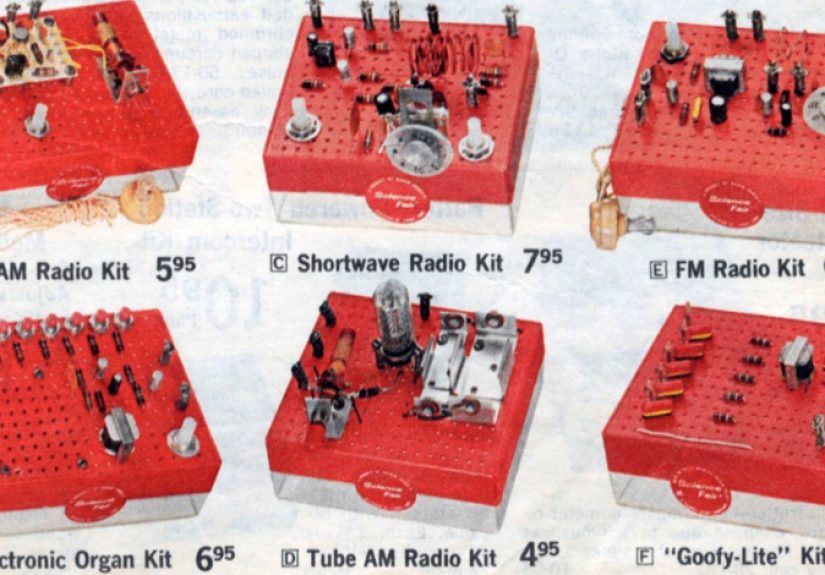
The term “P-Box” came from “perf-box,” a clever hybrid of plastic enclosure and perforated construction board. Instead of giving builders only a bare circuit board or a loose pile of parts, Radio Shack packaged the project in a small plastic case that became part of the finished device. One side of the box served as the mounting surface, with a grid of holes arranged like a simplified perfboard. Components were inserted into the holes and wired according to the manual.
That design was the genius of the P-Box system. The box was not packaging to be thrown away; it was the chassis. The parts did not disappear into a black plastic shell after assembly. They remained visible, understandable, and slightly proud of themselves. A completed P-Box project looked like something built by hand because it was built by hand. The red-and-clear plastic cases, the visible resistors, the hand-routed wires, and the tiny switches all gave the finished kit a homemade personality.
Radio Shack sold these kits under its Science Fair branding, a name that perfectly captured the feeling. This was not sleek consumer electronics. This was a weekend experiment, a bedroom workbench adventure, and occasionally a kitchen-table negotiation with a parent who wanted to know why there were wire clippings in the carpet.
The Radio Shack World That Made P-Box Kits Possible
To understand why P-Box kits mattered, you have to remember what Radio Shack represented. Founded in Boston in the early 20th century as a supplier for radio operators and electronics enthusiasts, Radio Shack grew into one of America’s most recognizable electronics retailers. Under Tandy Corporation, the company expanded aggressively and became a familiar stop for hobbyists, students, ham radio operators, repair people, audio fans, and anyone who needed a weird little adapter immediately.
Radio Shack’s strength was not that it had everything. It was that it had the thing you needed when no other store even understood the question. Need a 9-volt battery clip? Radio Shack. Need a replacement knob? Radio Shack. Need a solderless breadboard, a spool of hookup wire, a transistor, and a strange sense of confidence? Radio Shack again.
In that environment, P-Box kits made perfect sense. They sat at the intersection of education, hobby electronics, and practical tinkering. They were more focused than the big 100-in-1 electronic project labs, but less intimidating than designing a circuit from scratch. Each kit had a specific purpose, which made the final build feel useful. When you finished, you did not just say, “I learned about oscillation.” You said, “I built a metronome, and it clicks like a tiny robot woodpecker.”
Why the P-Box Design Was So Smart
The beauty of the Radio Shack P-Box kit was its physical simplicity. Modern electronics often hide the interesting parts behind sealed cases, surface-mount components, and software layers. P-Box kits did the opposite. They put the circuit where the learner could see it.
The Box Was the Workbench
Because the enclosure doubled as the build platform, beginners did not need a fancy bench, custom case, or printed circuit board. The project arrived with a home already waiting for it. That made the kit feel complete and approachable. You could spread the parts on a table, follow the manual, mount the components, connect the wiring, and end up with something that looked finished enough to show off.
The Grid Made Circuits Less Scary
The perforated layout helped turn abstract schematics into physical reality. A beginner could match parts to positions, follow the wiring, and begin to see how an electrical diagram became a working device. That conversionfrom paper symbols to real partsis one of the hardest mental jumps in electronics. P-Box kits made the jump smaller.
The Projects Were Real, Not Just Demonstrations
Many educational kits show principles, but P-Box kits often produced devices with a purpose: radios, alarms, amplifiers, electronic organs, timers, and signal circuits. That usefulness mattered. A working shortwave radio or burglar alarm gave the builder a feeling of ownership that no worksheet could match. It was learning with bragging rights.
Popular P-Box Kit Projects
Radio Shack’s P-Box lineup included a range of small electronic projects. Collectors and vintage electronics fans often mention kits such as the three-transistor shortwave radio, one-tube AM radio, electronic metronome, electronic organ, amplifiers, and alarm circuits. Not every kit was glamorous, but each had its own charm. Even a simple oscillator could feel like a scientific breakthrough when it made noise for the first time.
The Three-Transistor Shortwave Radio
The three-transistor shortwave radio is one of the best-remembered P-Box-style kits because it connected young builders to the world beyond their neighborhood. Shortwave listening in the pre-internet era had a special magic. With a modest circuit, a battery, and a wire antenna, you might hear distant stations, foreign languages, music, Morse code, or mysterious fading voices from the ionosphere. It was like opening a browser tab to the planet, except the loading animation was static.
Technically, these radios were simple compared with commercial receivers, but that was part of the appeal. They demonstrated tuning, amplification, feedback, detection, and audio output in a way that could be touched and adjusted. The builder learned not only that radio waves existed, but that a handful of components could capture them.
The Electronic Metronome
The electronic metronome was another classic beginner project. It used a timing circuit to produce steady clicks for musicians. On paper, that sounds modest. In practice, it was a perfect lesson in oscillation, capacitors, resistors, and timing behavior. Adjust a component value or a control, and the rhythm changed. Suddenly, electronics was not just invisible current; it was time itself being bossed around by a few humble parts.
Alarms, Sirens, and Sound Circuits
Alarm and siren kits had obvious kid appeal. They made noise. They could protect a drawer, startle a sibling, or announce that a bedroom had become a restricted laboratory. More importantly, they taught switching, sensors, relays, transistors, and power control. These were practical ideas used in real devices, presented in a form that was playful enough to keep beginners interested.
P-Box Kits vs. Big Electronic Project Labs
Radio Shack also sold larger Science Fair electronic project labs: 10-in-1, 50-in-1, 100-in-1, 150-in-1, 200-in-1, and even larger sets over the years. Those kits usually came with components mounted on a board and spring terminals for temporary connections. They were excellent for experimenting because builders could assemble many circuits without soldering or permanent wiring.
P-Box kits had a different personality. They were not reusable experiment boards. They were single-purpose builds. That meant the final product felt more permanent. The builder committed to the project, assembled it carefully, and ended up with a device that could live on a shelf. In a large project lab, the radio circuit might be disassembled tomorrow to build a rain alarm. In a P-Box kit, the radio stayed a radio.
Both formats taught electronics, but they taught different kinds of confidence. Project labs encouraged exploration. P-Box kits encouraged completion. One said, “Try this circuit.” The other said, “Build this instrument.” For many beginners, finishing a dedicated kit was the moment they stopped feeling like a spectator and started feeling like a maker.
Why These Kits Still Matter Today
Modern electronics education has incredible tools: Arduino boards, Raspberry Pi computers, simulation software, affordable sensors, 3D printers, and online tutorials. A beginner today can build projects that would have seemed like science fiction in the P-Box era. Yet something important has been lost when everything becomes modular, software-driven, and prepackaged.
P-Box kits forced builders to meet the circuit at component level. You had to know which part was a resistor. You had to bend leads, route wire, check polarity, and understand that a transistor was not just “that black thing with three legs.” Mistakes were part of the process. Put something in backward, and the circuit might refuse to work. Make a bad connection, and you learned the ancient debugging ritual of staring at your project while whispering, “But I followed the instructions.”
That hands-on frustration created durable knowledge. It taught patience, troubleshooting, and respect for details. It also taught that electronics is a physical craft. Electrons may be invisible, but bad connections are very real.
The Collector Appeal of Radio Shack P-Box Kits
Vintage Radio Shack P-Box kits have become collectible because they represent a specific moment in American electronics culture. They are small, colorful, educational, and strongly tied to the era when hobby electronics lived in retail stores rather than online carts. Original unbuilt kits are especially interesting to collectors because they preserve the complete experience: manual, parts, enclosure, labels, and packaging.
Built examples are also valuable in a different way. A completed P-Box kit carries the fingerprints of its builder. Wire routing, solder joints, labels, repairs, and modifications all tell a story. Some look neat enough for a museum case. Others look like they survived a science fair, a basement flood, and three decades in a shoebox. Both types have charm.
Collectors also appreciate the manuals. Radio Shack manuals were often clearer than people remember, with step-by-step instructions and plain-language explanations. They were written for learners, not just technicians. A good manual could make a beginner feel capable, which is the secret ingredient in any great educational product.
Radio Shack’s Educational Legacy
The P-Box kits were part of a much larger Radio Shack learning ecosystem. The company sold books, components, soldering tools, test meters, project boards, Science Fair labs, Archer kits, and later personal computers such as the TRS-80. For generations of hobbyists, Radio Shack was the bridge between curiosity and capability.
The store’s educational role was informal but powerful. A student could wander in with allowance money and leave with a project that explained radio, sound, timing, logic, or amplification. A helpful employee might suggest the missing diode, the right battery, or a replacement capacitor. Sometimes that advice was brilliant. Sometimes it was confidently weird. Either way, the store created a culture where asking technical questions in public felt normal.
That matters because electronics can be intimidating. The language is full of volts, ohms, farads, gain, impedance, and other words that sound like they should require safety goggles just to pronounce. Radio Shack made electronics retail-level approachable. P-Box kits condensed that approach into a box small enough to carry home.
What Modern Makers Can Learn from P-Box Kits
Modern STEM education can learn several lessons from the P-Box era. First, packaging matters. A project that ends in a usable object feels more rewarding than a loose demonstration. Second, visibility matters. When learners can see the circuit, they understand more. Third, constraints matter. P-Box kits did not offer infinite options, and that was a strength. A focused project reduces confusion and helps beginners finish.
Today’s maker kits are often more powerful, but not always more memorable. A microcontroller project can blink an LED with three lines of code, but the learner may not understand the circuit behind it. A P-Box-style kit makes the physical relationship harder to ignore. The resistor is there. The capacitor is there. The battery is there. The mistake is probably there too, hiding under a suspiciously shiny solder blob.
A modern revival of P-Box kits could be wonderful. Imagine updated perf-box projects for simple radios, audio amplifiers, light sensors, Morse code oscillators, environmental monitors, and tiny synthesizers. Add better safety notes, modern components, and optional online explanations, but keep the tactile experience. Let the box become the project again.
A Personal-Style Reflection: The Experience of Building a P-Box Kit
The experience of building a Radio Shack P-Box kit began before the box was even opened. You would stand in the store, probably under fluorescent lights, staring at the shelves as if one small package might decide your future career. The artwork promised possibility. The parts list hinted at complexity. The finished gadget on the package looked both achievable and slightly heroic. For a young electronics fan, that was enough. The kit went home like treasure.
Opening it was its own ceremony. Out came the manual, the plastic case, the small bags of components, the hardware, the switch, the speaker or coil or transformer, and the mysterious parts whose names you only half understood. A resistor was easy enough. A capacitor felt more serious. A transistor seemed important in the way a tiny black beetle wearing metal legs can seem important.
The first emotional stage was confidence. The second was confusion. The third was sorting parts by color bands and pretending this was normal behavior. Then came assembly. You learned quickly that real electronics was not as tidy as the diagram. Component leads bent at odd angles. Wires had opinions. The case never sat still. If soldering was involved, the solder either refused to melt or melted everywhere except the joint. It was a humbling art, like trying to frost a cake with liquid metal.
But then something changed. The circuit began to look like the drawing. The battery clip found its place. The switch clicked with purpose. The last connection was made. You checked the manual again, because even brave builders know fear. Then came the moment of truth: power on.
When the kit worked, the feeling was enormous. A radio hissed to life. A metronome clicked. An alarm squealed. A tiny amplifier made sound louder than it had any right to be. The device might have been simple, but it felt like proof that the universe had rules and you had successfully borrowed a few of them.
When the kit did not work, the lesson was different but just as valuable. You learned to inspect connections, compare the build to the schematic, test batteries, look for reversed parts, and resist the urge to declare the manual personally responsible. Debugging was not a separate skill; it was the other half of building. Every silent speaker and stubborn oscillator taught persistence.
The best part was that the finished P-Box project had character. It was not factory-perfect. It had your bends, your solder joints, your fingerprints, your tiny mistakes, and your triumphant corrections. It could sit on a desk as a badge of effort. Maybe it looked a little crooked. Maybe the label was not straight. Maybe one wire took the scenic route. That did not matter. It worked, and you built it.
That is why P-Box kits remain so memorable. They were not just educational products; they were confidence machines. They turned beginners into experimenters. They made electronics feel possible. And for many people, they created the first spark that led to ham radio, audio repair, computer programming, engineering, or a lifelong habit of saving “useful” parts in drawers that no family member is allowed to reorganize.
Conclusion: A Small Box with a Big Signal
Radio Shack P-Box kits deserve their retrotechtacular reputation because they captured the best parts of hobby electronics: curiosity, usefulness, affordability, and hands-on discovery. They were simple enough for beginners but real enough to matter. They turned plastic boxes into radios, alarms, metronomes, and memories. In an age when technology often arrives sealed, updated, and untouchable, the P-Box reminds us that learning happens best when people can open things, build things, and occasionally wonder why smoke is not considered a successful output signal.
The world has better tools now, but the spirit of the P-Box kit is still worth preserving. Give learners real components. Give them clear instructions. Give them a project that becomes an object. Most of all, give them the joy of saying, “I made this.” That sentence has powered more future engineers than any advertisement ever could.
Note: This article is original, written in standard American English, and based on publicly documented history of Radio Shack, Tandy/Science Fair electronics kits, vintage kit-building culture, and collector discussions around P-Box projects.