Table of Contents >> Show >> Hide
- Why Leto’s Joker Was a Big Deal Before He Even Spoke
- The Look That Made the Internet Go “Huh?”
- Method Acting Headlines, Gift Stories, and the Myth Machine
- The Movie Problem: Tons of Hype, Limited Joker
- The “Ayer Cut” Conversation and Why It Keeps Coming Back
- The Snyder Cut Cameo: A Second Joker, A Different Vibe
- So Why Is Jared Leto Still the Most “Huh?” Movie Joker?
- Audience Experiences: Why This Joker Still Feels So Weird Years Later
- Conclusion
Some movie performances are loved. Some are hated. And then there’s the rare third category: the one that makes people squint at the screen and say, “Wait… what exactly is happening here?” Jared Leto’s Joker in Suicide Squad lives in that category like it pays rent there.
This is not a simple “good vs. bad” story. It’s weirder than that. Leto’s Joker arrived with massive hype, a wild visual redesign, stories about intense on-set behavior, and the kind of marketing push that made audiences expect a major villain role. Then the movie came out, and many viewers felt like they got a trailer version of the Joker instead of a full performance. Years later, the character returned in Zack Snyder’s Justice League in a very different form, which somehow made the whole saga even more confusing.
So let’s unpack the chaos: the casting, the tattoos, the “method acting” headlines, the deleted scenes drama, the Snyder Cut comeback, and why Jared Leto’s Joker still feels like one of the strangest detours in modern comic-book movie history.
Why Leto’s Joker Was a Big Deal Before He Even Spoke
When Warner Bros. assembled the Suicide Squad cast in 2014, it was a serious headline-grabber: Will Smith, Margot Robbie, Viola Davis, and Jared Leto as the Joker. That last name especially carried extra weight because the role had become iconic in modern film culture. Any new Joker was going to be compared to every version that came before him, and the shadow of Heath Ledger’s performance was still huge.
Leto also wasn’t just “some guy from a casting announcement.” He was already an Oscar winner, which gave the studio a prestige angle and gave fans a reason to believe this version might be bold, strange, and maybe even brilliant. In other words: expectations were sky-high before the first neon-green hair strand even appeared.
The Problem With Playing a Character Everyone Already Owns in Their Head
The Joker is one of those characters audiences don’t just watch they carry a personal version of him in their brain. Some want gangster chaos. Some want theatrical madness. Some want psychological horror. Some want comic-book camp. If you play the Joker, you’re not stepping into a role. You’re stepping into an argument.
Leto understood that. In interviews around the time, he talked openly about the challenge of taking on a character with such a long performance history. He also made it clear he respected prior portrayals, which raised expectations even more. Fans weren’t just waiting for “a Joker.” They were waiting for his thesis on the Joker.
The Look That Made the Internet Go “Huh?”
Let’s be honest: a huge part of the conversation around Jared Leto’s Joker had nothing to do with acting at first. It was the look.
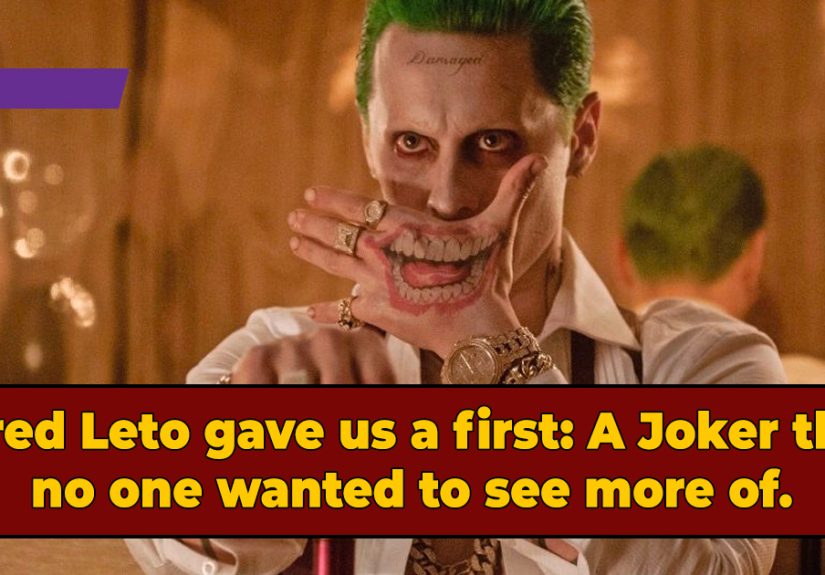
This Joker showed up with slick green hair, metal grills, heavy tattoos, and the now-infamous forehead tattoo that read “Damaged.” It was less “gothic nightmare clown” and more “chaotic crime boss who owns three nightclubs and a very loud sports car.” For some viewers, it felt fresh and comic-booky. For many others, it felt like the design team spun a wheel labeled “edgy” and refused to stop.
The “Damaged” tattoo became the symbol of the backlash. It was memed, mocked, and debated for years. Eventually, director David Ayer publicly admitted the idea was his, not Leto’s, and later said he regretted it. That admission mattered because it reminded people that the look wasn’t just an actor choice it was a broader creative direction that came from the top.
Why the Look Became the Whole Story
The design landed so loudly that it swallowed almost every other conversation. Before audiences could evaluate the performance, they were already reacting to screenshots. That’s a dangerous setup for any actor, especially with a character as culturally loaded as the Joker.
In a weird way, Leto’s Joker became a branding event before he became a character. The image arrived first, the jokes arrived second, and the actual screen time came much later.
Method Acting Headlines, Gift Stories, and the Myth Machine
Then came the behind-the-scenes stories and this is where the Jared Leto Joker saga really entered “what am I reading?” territory.
During the Suicide Squad press cycle, stories spread about Leto sending bizarre gifts to castmates while staying in character. Reports included rodents, prank-style presents, and generally unsettling “Joker behavior.” The stories were repeated so often that they became part of the movie’s identity. For a while, the performance was less famous than the lore surrounding it.
Years later, Leto told Entertainment Weekly that many of the most shocking stories had been exaggerated or told jokingly, saying his earlier comments were “in jest” and that internet retellings got out of hand. He framed the gifts that were given as playful, not malicious, and pushed back on the way the story had hardened into myth.
That correction didn’t erase the original headlines nothing ever really does but it added an important layer to the “confusing” reputation. Leto’s Joker wasn’t just a performance. It was a media narrative, and media narratives tend to get louder than nuance.
When the Press Tour Becomes the Character
This is one reason Leto’s Joker still feels so bizarre in hindsight: a lot of people remember the press stories more vividly than the actual scenes in the movie. Usually, actors promote a film. In this case, the promotion almost became a parallel movie of its own, starring rumors, reactions, and increasingly dramatic retellings.
By the time people bought tickets, they weren’t just judging a Joker performance. They were judging the Joker discourse and that’s a much messier thing to deliver on.
The Movie Problem: Tons of Hype, Limited Joker
Here’s the core reason the whole thing felt off: Jared Leto’s Joker was marketed like a major event, but in the theatrical cut of Suicide Squad, he’s more of a chaotic side presence than a full-blown central villain.
A lot of viewers expected a bigger role, especially because trailers and promo materials leaned heavily into the Joker/Harley Quinn dynamic. Instead, the movie mostly focused on the squad mission, Amanda Waller, and Enchantress, with Joker appearing in short bursts. The result was a weird mismatch between what audiences were sold and what the film actually prioritized.
Leto himself talked about how much footage was left out, even suggesting there was enough material for a Joker-focused movie. Whether you agree with that or not, the comment helped explain why the final performance felt fragmented. If a role is built from pieces, the audience can usually feel the seams.
Box Office Success, Critical Shrug, Audience Split
To make things even more “huh?”, Suicide Squad was a box-office hit. It earned big money worldwide and had a strong opening. But critical reception was rough, with many reviews calling out the film’s structure, tone, and editing. Audience reaction was more mixed than unified.
That contradiction mattered for Leto’s Joker. In a better-reviewed movie, his version might have been re-evaluated as a bold supporting swing. In a cleaner, more focused cut, it might have felt more coherent. Instead, it got trapped in a movie that was already fighting ten different battles at once.
The “Ayer Cut” Conversation and Why It Keeps Coming Back
If you want to understand why people still argue about Jared Leto’s Joker, you have to understand the long tail of the “Ayer Cut” conversation.
David Ayer has repeatedly suggested the theatrical version of Suicide Squad was significantly reshaped from what he originally made. Over time, he also described the released film as something that didn’t fully represent his intended tone. That matters because Leto’s Joker is one of the biggest “what got changed?” questions in the entire movie.
Fans who dislike the theatrical Joker often assume they saw the full concept and rejected it. Fans who defend Leto often argue they only saw a chopped-up version of it. And because a clean public side-by-side comparison doesn’t exist, the debate never really ends. It just respawns every few months like a comic-book rumor with Wi-Fi.
Even Ayer’s later public regret over the “Damaged” tattoo added to this strange legacy. It showed some self-reflection, yes, but it also confirmed what many viewers suspected: not every big creative choice around this Joker landed as intended.
The Snyder Cut Cameo: A Second Joker, A Different Vibe
Just when the story seemed done, Zack Snyder brought Leto’s Joker back for Zack Snyder’s Justice League and suddenly we got a second version of the same version.
In Snyder’s film, Leto appears in the Knightmare epilogue, and the design is noticeably different. The look is less flashy-gangster and more worn-down apocalypse creep. Snyder also talked about wanting a more road-weary Joker in that setting, which made sense for the scene’s bleak future-world energy.
The cameo was short, but it changed the conversation. Some viewers felt Leto worked better in Snyder’s more mythic, theatrical style. Others still weren’t sold. But almost everyone agreed on one thing: it was fascinating that this Joker needed a second movie to clarify what the first movie was even trying to do.
Yes, the “We Live in a Society” Line Happened
The Snyder Cut version also gave us the now-famous “we live in a society” moment, which became a meme before the movie even arrived. Snyder later said the line was ad-libbed, which is somehow the most perfect detail in this entire saga. Of course it was.
That one line captures the full Jared Leto Joker experience: half performance, half internet event, all chaos.
So Why Is Jared Leto Still the Most “Huh?” Movie Joker?
Because no other big-screen Joker in recent memory has been this tangled.
Leto’s version is a mash-up of huge expectations, a divisive design, a noisy press tour, conflicting stories about “method acting,” obvious editing gaps, a director’s-cut debate, and a surprise second-life cameo in a totally different tone. That’s not just a performance arc. That’s a cinematic group project where everyone submitted a different file format.
And yet, that’s exactly why the role remains interesting. Even people who dislike the performance can’t stop talking about it. Even people who defend it usually admit it’s hard to pin down. The character exists in a weird space between what was filmed, what was released, what was marketed, and what fans imagine is still sitting in a vault somewhere.
In other words, Jared Leto’s Joker is less a finished answer and more a very expensive question mark.
Audience Experiences: Why This Joker Still Feels So Weird Years Later
One of the most interesting things about Jared Leto’s Joker is how many people remember their experience around the character more clearly than the character’s actual scenes. That’s rare. Usually, a performance sticks because of what happened on screen. Here, the memories are often: the first reveal photo, the tattoo jokes, the headlines, the debates, the trailer cuts, the “wasn’t he in this more?” feeling after the credits rolled.
A lot of viewers describe the same timeline. First came curiosity: “Oscar-winning actor playing the Joker? Okay, I’m listening.” Then came surprise at the design. Then came the online reactions. Then came the strange set stories. By the time the movie arrived, many fans felt like they had already consumed a full season of content before seeing a single finished scene in context.
That creates a very unusual viewing experience. Instead of meeting a character cleanly inside a movie, audiences met Jared Leto’s Joker through fragments. A still image here. A quote there. A rumor. A trailer shot. A cast anecdote. Another rumor. By the time the theatrical performance finally appeared, some viewers were disappointed simply because the movie could never compete with the chaotic mythology that had formed around it.
There’s also the “expectation whiplash” factor. The marketing suggested a larger Joker presence, so many moviegoers watched the film waiting for him to become central. When he stayed mostly on the edges, it left a weird empty feeling not because every scene was terrible, but because the audience had been trained to expect a different movie. That mismatch is a huge reason the Joker discourse stayed alive. People weren’t only debating the performance; they were debating the version of the movie they thought they were getting.
Then the Snyder Cut cameo arrived and reopened the case file. For some fans, it felt like vindication: “See? This actor can work as Joker if the tone fits.” For others, it felt like further proof that the original Suicide Squad version had never settled on a clear identity. Either way, it turned Leto’s Joker into a multi-stage experience: theatrical confusion first, alternate-universe reappraisal later.
And that’s why the character remains such a lasting conversation piece. Jared Leto’s Joker is not just remembered as a performance. He’s remembered as a pop-culture puzzle. Fans experienced him through marketing, memes, criticism, edits, director comments, and later reinterpretation all layered together. Love it or hate it, that is a genuinely unique movie-villain legacy.
Most Jokers are judged by a single film. This one got judged by the internet, the marketing department, the edit bay, and two different directors all at once. No wonder people still react with the same word years later: “Huh?”
Conclusion
Jared Leto’s Joker remains one of the strangest cases in superhero movie history because the role never had one clear identity. It had several and they collided in public. There was the heavily promoted Joker, the theatrical-cut Joker, the rumored “more footage” Joker, the director’s-cut debate Joker, and the Snyder epilogue Joker. That’s a lot of Jokers for one actor.
Was it a misunderstood swing? A studio-era casualty? A design experiment that overwhelmed the performance? Probably a little of all three. But one thing is certain: when people talk about the most confusing modern comic-book villain arcs, Jared Leto’s Joker is always near the top grinning, tattooed, and somehow still causing debates years later.