Table of Contents >> Show >> Hide
- Meet the Austin Restaurant That Turned a Marquee into a Daily Punchline
- Why a Funny Restaurant Sign Works (Even If You’re “Just Looking”)
- The Anatomy of a Return-Worthy Sign
- From Sidewalk to Social: The Sign That Markets Itself
- How Restaurants Keep It Funny Without Getting Themselves in Trouble
- Want to Steal This Idea? Here’s a Playbook That Won’t Feel Like a Playbook
- The Secret Ingredient: The Food Has to Back Up the Fun
- Conclusion: The Sign Is the Appetizer, and You’ll Keep Coming Back for the Next Bite
- Extra: of “You Had to Be There” Experiences (Because the Sign Really Is That Good)
Some restaurants lure you in with a scent. Others do it with a happy hour. And then there are the rare legends that stop you on the sidewalk with nothing but letters on a board and an extremely committed sense of humor.
If you’ve ever found yourself taking a photo of a restaurant sign like it’s a celebrity sighting (“No, no, zoom inthis is the good part”), you already understand the magic. A funny sign doesn’t just advertise food. It advertises a vibe. It says, “Relax. You’re safe here. We take tacos seriously, but not ourselves.”
Today we’re digging into one of the best examples of the genre: an Austin, Texas Tex-Mex institution whose marquee is basically a daily comedy showone that’s so reliable people genuinely swing by just to see what it says next.
Meet the Austin Restaurant That Turned a Marquee into a Daily Punchline
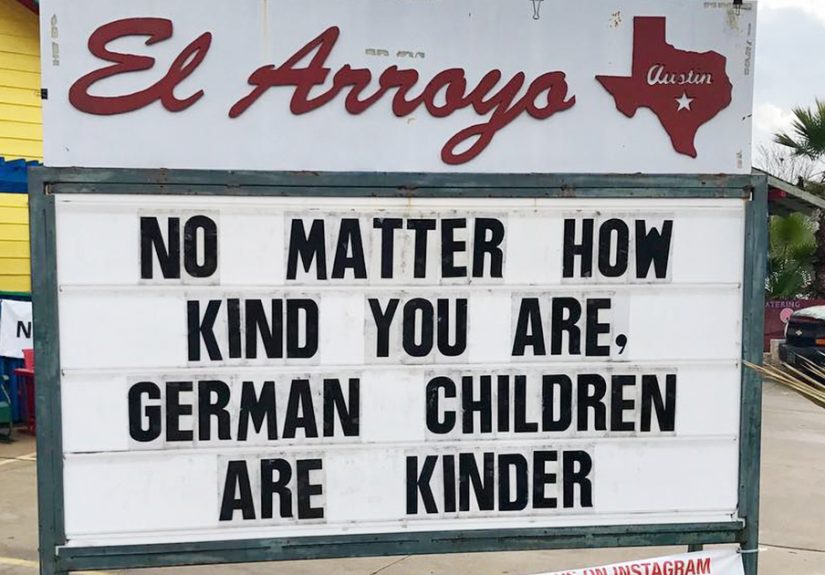
In Austin, there’s a long-running Tex-Mex spot called El Arroyo that serves margaritas, salsa, andmost importantly for this storya rotating marquee message out front that has become a local rite of passage.
The sign is simple: big black letters, bright background, and a short line that lands somewhere between pun, observation, and “how is this so true?” The restaurant leans into it so hard they’ve made the sign part of the brand identity, with people stopping to snap photos and share them like souvenirs.
The best part: it’s not just a one-off gimmick. It’s a habit. A tradition. A daily reason to look up from your phoneironically, to take out your phone and post the sign.
And because the internet loves a feedback loop, the sign doesn’t just entertain. It recruits. El Arroyo even invites people to submit sign ideas, which means the marquee has the energy of a writers’ roomif a writers’ room also served queso.
What the signs are like (without copying anyone’s homework)
The comedy style is approachable, quick, and built for drive-by reading. Think: short lines, everyday frustrations, pop culture nods, and the occasional self-own. A few real examples have become famous over the yearslike the time the sign responded to a mishap with the extremely modern phrase: “New Sign Who Dis.”
The broader point isn’t the exact joke. It’s the rhythm: the sign feels alive, current, and oddly personallike a friend who’s always online, but in a healthy way.
Why a Funny Restaurant Sign Works (Even If You’re “Just Looking”)
Humor is not decoration. It’s a strategysometimes an accidental one, sometimes a deeply intentional one. Here’s why funny restaurant signs can turn passersby into customers and customers into regulars.
1) Humor is a “pattern interrupt” for your eyeballs
On a typical street, your brain is filtering a thousand cues: traffic, sidewalks, storefronts, signs that scream “OPEN” in neon like they’re trying to wake the dead. A joke cuts through because it changes the task from navigation to entertainment. You don’t just notice ityou process it.
2) Laughter builds comfort fast
Eating out is social. Even when you’re ordering solo, you’re still stepping into a room with strangers, rules, and vibes you can’t fully predict. A well-placed joke lowers the stakes. It signals warmth, friendliness, and confidence.
A restaurant that can make you smile before you even touch a menu is quietly telling you, “We understand people.”
3) The sign becomes a tiny “experience” you can take home
A funny line is portable. You can quote it, text it, photograph it, repost it, and tag a friend who needs it. That’s the secret: the sign isn’t just advertising food. It’s creating a shareable momentsomething customers do for you, for free, because it makes them look funny and observant online.
The Anatomy of a Return-Worthy Sign
Not all humor hits. Some jokes land like a wet napkin. Others create a loyal following that checks your sign like it’s a daily horoscope. Here’s what the best ones tend to have in common.
Short enough to read at 25 mph (or while herding children)
Brevity matters. A marquee or sidewalk board is not the place for your experimental comedy novella. The goal is instant understanding: the reader should “get it” before they pass it.
Relatable, not exclusive
The funniest signs usually tap into universal things: Monday energy, traffic, group chats, laundry guilt, the eternal question of why you opened the fridge again. You want a broad smile, not a niche inside joke that requires three podcasts and a spreadsheet to understand.
Human voice, not corporate voice
People don’t want to be marketed at. They want to be spoken to. A sign works when it sounds like a clever friend, not a press release in a trench coat. If your joke could be followed by “Limited time offer, terms and conditions apply,” you’ve already lost.
Safe edges, not sharp ones
The best humor punches up (or inward), not down. Restaurants can absolutely be snarky, but there’s a difference between playful and mean. It’s a fine lineand social media is basically a high-powered microscope pointed directly at your line.
Freshness
Updating your sign regularly makes it feel alive. Even a weekly rotation can work if it’s consistent. The point is to teach customers a habit: “It’s probably new today,” which becomes a reason to look again.
From Sidewalk to Social: The Sign That Markets Itself
The funniest restaurant signs thrive because they’re designed for two audiences at once: the person walking by and the person who will see it on Instagram later.
This is why a simple physical sign can punch far above its weight. A photo of a marquee travels. A laugh travels. And if the restaurant name is in the shotor the location is recognizableyou’ve just turned a random passerby into a micro-influencer for your queso.
How to make a sign “postable” without trying too hard
- Legibility: high contrast, clean spacing, no fancy script that looks like haunted cursive.
- Consistency: same sign style, same spot, so people know where to look and what to photograph.
- Personality: a recognizable voicedry, dad-joke, wholesome, absurdjust pick a lane and drive it well.
- A gentle nudge: a simple hashtag or “tag us” can help, but the joke should still be the star.
How Restaurants Keep It Funny Without Getting Themselves in Trouble
If you’re thinking, “Humor sounds risky,” you’re not wrong. The internet is not exactly known for reading intent generously. But restaurants that do this well tend to follow a few common-sense guardrails.
Use the “mom test” (or the “group chat” test)
Before a sign goes up, ask: Would I be comfortable explaining this joke to my mom, my boss, and a stranger who just woke up angry? If the answer is no, maybe save it for your private notes app.
Be careful with current events
Timely jokes can be gold, but they can also turn into “too soon” territory fast. Some restaurants stick to evergreen humor (food, weather, dating, technology, feelings) and save the news commentary for… literally anyone else.
Make the restaurant the butt of the joke
Self-deprecation is the cheat code. “We tried,” “We’re doing our best,” “Yes, we also forgot our password.” It makes the brand feel humanbecause humans are, famously, a bit of a mess.
Want to Steal This Idea? Here’s a Playbook That Won’t Feel Like a Playbook
You don’t need a famous marquee to do this. A sidewalk chalkboard, a small letter board by the register, even a digital menu screen can carry the same energy. The key is consistency and voice.
A simple weekly workflow
- Collect: let staff drop ideas into a shared note all week (the funnier the staff, the better the sign).
- Filter: pick 3–5 finalists, read them out loud, and keep the one that gets an actual reaction.
- Check: run the “kindness test” and the “confusing test.” If you have to explain it, it’s not ready.
- Post: put it up at the same time on the same days so people learn your rhythm.
- Amplify: take a quick photo and share it on your own social channels (then let customers do the rest).
Fresh sign ideas that feel human (original examples)
- “Today’s special: whatever you were craving at 2 a.m.”
- “Yes, we have Wi-Fi. No, it won’t fix your life.”
- “If you read this sign, you’re legally obligated to treat yourself.”
- “We’re not saying tacos are therapy… but we’re not not saying it.”
- “Come for the food. Stay because your friend is taking 47 photos.”
Notice the pattern: short, friendly, and relatable. No dunking on customers. No complicated references. Just a small laugh with a side of welcome.
The Secret Ingredient: The Food Has to Back Up the Fun
A funny sign can get someone through the door once. But the thing that makes them come back (besides the next joke) is the experience inside: good service, consistent food, and a place that feels like it likes having people there.
The best “sign restaurants” understand this. The humor is the handshake. The meal is the relationship. When both are strong, you don’t just get customersyou get fans.