Table of Contents >> Show >> Hide
- What Exactly Is a Relic of Christ?
- 10. The Seamless Robe of Christ
- 9. The Holy Lance
- 8. The Crown of Thorns
- 7. The True Cross
- 6. The Shroud of Turin
- 5. The Iron Crown of Lombardy
- 4. The Veil of Veronica
- 3. The Scala Sancta – Holy Stairs
- 2. The Mandylion – Image of Edessa
- 1. The Holy Grail – The Chalice of the Last Supper
- Why Relics of Jesus Still Capture Our Imagination
- Modern Experiences with the Relics of Jesus Christ
- Conclusion
For more than two thousand years, Christians have tried to get closer to Jesus Christ not only through Scripture and prayer, but also through objects believed to have brushed up against his life: a blood-stained cloth, a battered spear, a crown woven with thorns. These relics of Jesus Christ sit at the crossroads of faith, history, and a little bit of holy mystery. Some are revered in hushed chapels; others are debated in scientific journals; a few star in conspiracy-theory bestsellers and late-night documentaries.
This list dives into ten of the most famous relics traditionally linked to Jesus, following the classic Listverse style: part history lesson, part armchair travel guide, and part “wait, seriously?” moment. Whether you’re a believer, a skeptic, or just here for fascinating stories, these relics show how one first-century life still shapes pilgrimages, lab experiments, and tourist itineraries today.
What Exactly Is a Relic of Christ?
In Christian tradition, a relic is usually a physical object connected to a holy person: a fragment of bone, a strand of hair, or something that touched their body, like clothing or tools. When it comes to Jesus, things get more intense. His Passion – the arrest, trial, crucifixion, and burial – inspired a whole category of Passion relics: the True Cross, the Holy Nails, the Crown of Thorns, the spear that pierced his side, and the cloths that wrapped his body.
By the Middle Ages, these relics multiplied across Europe. Emperors collected them, popes guarded them, and pilgrims crossed continents to see them. Modern historians, archaeologists, and scientists have since tested some of these objects, often with controversial and conflicting results. Many relics can’t be authenticated beyond doubt; others are almost certainly medieval creations. But whether you treat them as historical artifacts, devotional objects, or a bit of both, they tell us a lot about how Christians across the centuries tried to make the story of Jesus physically present in their own time.
10. The Seamless Robe of Christ
Our countdown starts with a garment: the Seamless Robe of Christ, also known as the Holy Tunic or Holy Coat. According to the Gospel of John, Roman soldiers cast lots for Jesus’s tunic at the crucifixion because it was woven “without seam, from top to bottom.” Medieval tradition claims that this very tunic ended up in Trier, Germany, where it’s still preserved and occasionally displayed to huge crowds of pilgrims.
Legend says Empress Helena, mother of Constantine the Great and the greatest fourth-century relic-hunter of all time, discovered the robe in the Holy Land and sent it to Trier. The documented history of the garment is much later – it’s clearly recorded only from the 12th century onward – which leaves plenty of room for debate about how old it really is. Over the years it has been repaired, covered, and conserved so often that scientists can’t easily test the original fabric without damaging it.
Still, for many visitors, the power of the Seamless Robe has less to do with lab reports and more to do with imagination. Standing in a packed cathedral, it’s hard not to picture a real person who once walked dusty roads in a simple woven tunic and was stripped of it on the cross. The robe makes that scene feel a little less like a painting and a little more like someone’s clothes left hanging in the closet.
9. The Holy Lance
Next is a weapon that launched a thousand legends: the Holy Lance, also called the Spear of Longinus or the Spear of Destiny. The Gospel of John tells us that a Roman soldier pierced Jesus’s side with a spear to confirm he was dead. Later tradition gives that soldier the name Longinus and claims his weapon survived the centuries.
The problem? Several lances across Europe have been venerated as the Holy Lance. One famous candidate is kept in Vienna; another is preserved in the Vatican; a third has long been associated with the city of Antioch. Medieval emperors and kings swore oaths on these lances, marched to war with them, and treated them as talismans of divine backing for their rule.
Modern scholarship tends to be cautious. None of the surviving lances can be traced reliably back to first-century Judea. But as symbols, they’re powerful: each one reminds pilgrims that the Passion story includes a very human question – “Is he really dead?” – and a very physical answer, written in blood and water. The Holy Lance crystallizes that brutal moment into metal.
8. The Crown of Thorns
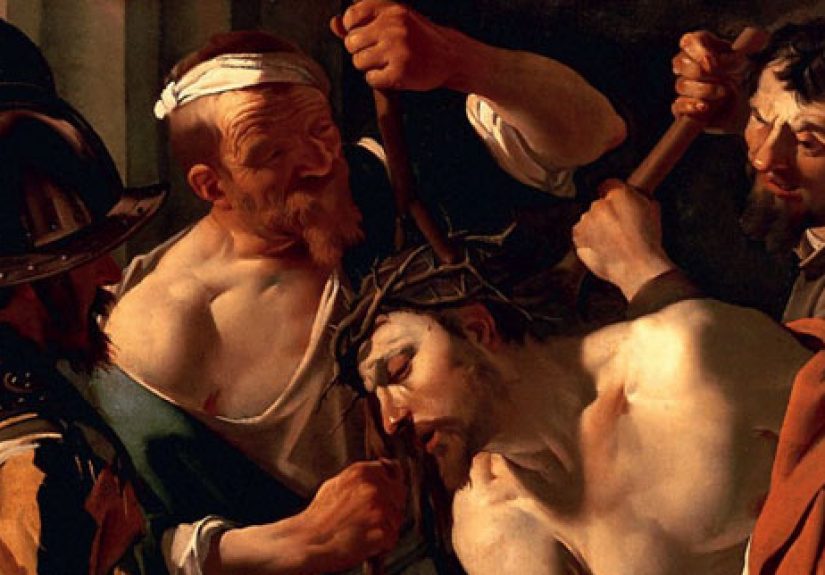
Of all the relics of Christ’s Passion, few are as visually striking as the Crown of Thorns. The Gospels describe Roman soldiers mocking Jesus as “King of the Jews” by dressing him in a robe, handing him a reed like a scepter, and pressing a crown made of thorns onto his head. Today, the most famous Crown of Thorns relic is housed at Notre-Dame Cathedral in Paris.
The Paris relic is actually a braided circlet of rushes, encased in gold and displayed in an ornate reliquary. The individual thorns, according to tradition, were distributed to monarchs and churches centuries ago. The crown itself arrived in France in the 13th century, when King Louis IX (later Saint Louis) bought it at enormous cost and built the stunning Sainte-Chapelle specifically to house it. In modern times, it was rescued during the 2019 Notre-Dame fire and solemnly carried in procession back to the restored cathedral.
Can we prove it was really pressed into Jesus’s scalp? No. Even church officials tend to say that while the relic can’t be fully authenticated, it’s still an object of intense devotion. For the faithful, the Crown of Thorns turns a theological phrase – “he suffered for us” – into something painfully concrete: sharp, twisted, and impossible to ignore.
7. The True Cross
The True Cross may be the most famous – and most contested – relic of Christianity. Tradition holds that Helena discovered the actual cross on which Jesus was crucified during her fourth-century trip to Jerusalem. Over time, fragments of that cross were sent to churches throughout the Roman Empire and beyond. Today, tiny pieces of wood attributed to the True Cross can be found in reliquaries from Rome to Jerusalem to rural parishes that might otherwise never see a tourist.
Skeptics like to joke that if you gathered every alleged fragment of the True Cross, you could build a whole forest. Modern historians are more nuanced: many fragments are clearly later; others may be from very old devotional objects, even if their exact origin is unclear. Some large pieces, such as those in the Basilica of Santa Croce in Gerusalemme in Rome, have long, well-documented histories but still can’t be tied scientifically to the first century.
Yet when pilgrims kneel before a sliver of darkened wood, they’re not usually doing math on cubic volume. They’re contemplating the idea that God’s love might be expressed through a rough timber and iron nails. Whether or not any particular splinter once stood on Golgotha, the True Cross relics keep that symbol at the center of Christian imagination.
6. The Shroud of Turin
If there were a celebrity among relics of Jesus, it would be the Shroud of Turin. This long linen cloth, preserved in the Cathedral of Saint John the Baptist in Turin, Italy, bears the faint front-and-back image of a crucified man. Devotees see it as the burial shroud of Christ himself; scientists see one of the most puzzling artifacts ever studied.
In 1978, a major scientific team examined the Shroud, using photography, microscopy, and chemical analysis. They concluded the image wasn’t created by paint, dye, or ordinary scorching, and that it contains subtle details (like three-dimensional information) that defy easy explanation. A 1988 radiocarbon dating test, however, suggested the cloth was made between 1260 and 1390 – more than a millennium after Jesus’s death – sparking headlines that it was a medieval forgery. Later researchers argued that the sample used may have come from a repaired section of the cloth, keeping the debate alive.
Regardless of where you land, the Shroud of Turin is undeniably gripping. Up close, the image is almost invisible; on a photographic negative, a haunting face suddenly emerges. For many Christians, that face has become the “Holy Face of Jesus,” a visual focus for prayer. For others, the Shroud is a mystery in linen form – a reminder that even in an age of high-tech tools, not everything about the past can be neatly solved.
5. The Iron Crown of Lombardy
At first glance, the Iron Crown of Lombardy looks like royal jewelry, not a religious relic. This small golden circlet, set with gems and enamels, was used for centuries to crown kings of Italy and Holy Roman Emperors. Hidden inside, though, is a narrow band of metal that tradition says was forged from one of the nails that pinned Jesus to the cross.
The crown is kept in the cathedral of Monza in northern Italy. Historically, it has done double duty: a symbol of political authority and a reliquary of Christ’s Passion. Medieval chroniclers claimed that Helena discovered a nail from the crucifixion and had it worked into a diadem for her son Constantine. Later generations connected that story to the Iron Crown, giving it both imperial swagger and sacred aura.
Modern analysis suggests the crown took shape over several centuries, with elements added and altered along the way. Whether or not the inner band really comes from a crucifixion nail, the Iron Crown shows how deeply woven Christian relics became in European politics. When Napoleon crowned himself with it in 1805, he reportedly declared, “God gave it to me, woe to him who touches it” – part prayer, part power move.
4. The Veil of Veronica
If you’ve ever prayed the Stations of the Cross, you’ve probably encountered the story of Veronica’s veil. According to later Christian tradition, a woman named Veronica stepped out of the crowd as Jesus carried his cross and wiped his face with a cloth. Miraculously, his image appeared on the fabric. That cloth – the Veil of Veronica – became one of the most cherished relics of Christendom.
Today, the most prominent candidate is kept in St. Peter’s Basilica in Vatican City. It’s rarely shown, and when it is, it’s displayed from a distance. Other images in Rome, Spain, and elsewhere also claim a link to the story, each bearing a mysterious face that looks strikingly similar. Some historians suspect that over time, copies of one original icon came to be venerated as relics in their own right.
Theologically, the Veil of Veronica ties into a broader fascination with icons “not made by human hands” – acheiropoieta – that supposedly bear a direct imprint of Christ’s features. Whether the veil began as a relic, an icon, or a legend woven out of both, it helped generations of believers imagine Jesus not just as a distant figure, but as someone with a specific, visible face.
3. The Scala Sancta – Holy Stairs
Most relics fit in a reliquary; the Scala Sancta (“Holy Stairs”) in Rome is big enough to climb. According to tradition, these 28 marble steps once led to the praetorium of Pontius Pilate in Jerusalem and were the very stairs Jesus ascended during his trial. In the fourth century, Helena supposedly had them transported to Rome, where they now stand across from the Basilica of St. John Lateran.
Today, the original marble is covered with wooden slats to protect it, and pilgrims ascend the staircase on their knees in prayer. It’s a vivid, physical act of devotion: you feel every step, every creak of the wood, and every pair of knees ahead of you inching upwards. The site is also connected to important moments in Christian history; tradition says Martin Luther climbed the Scala Sancta before his theological break with Rome.
As archaeology, the stairs are hard to prove or disprove. As an experience, they’re unforgettable. The Scala Sancta turns the Passion from a story you read into a movement your own body performs, one step (and one wince) at a time.
2. The Mandylion – Image of Edessa
In Eastern Christian tradition, the Mandylion, or Image of Edessa, may be the most celebrated “portrait” of Christ. Legend says that King Abgar of Edessa, stricken with illness, sent a messenger to Jesus asking for healing. Jesus declined the invitation to visit in person but sent back a cloth miraculously imprinted with his face. The king was healed, and the cloth became a treasured relic, later transferred to Constantinople with great ceremony.
Today, several icons – notably the Holy Face of Genoa and the Holy Face of San Silvestro – are associated with the Mandylion story. Art historians generally date these images to the Middle Ages and treat them as copies rather than the original cloth. Some researchers once speculated that the Mandylion and the Shroud of Turin were actually the same object folded differently, but that theory has fallen out of favor.
The Mandylion is a reminder that relics aren’t just about blood and wood; they’re also about visibility. For believers, the idea that Christ himself provided his own “selfie” – a face miraculously impressed on cloth – offered a powerful answer to the question “What did Jesus really look like?” long before artists began painting him with specific features.
1. The Holy Grail – The Chalice of the Last Supper
Finally, we arrive at the most legendary relic of all: the Holy Grail, often identified with the chalice Jesus used at the Last Supper. In medieval romances, the Grail becomes a mystical object searched for by knights like Perceval and Galahad, surrounded by visions, miracles, and terrifying moral tests. In modern pop culture, it’s starred in everything from Indiana Jones to quirky conspiracy thrillers.
Historically, at least two major artifacts have claimed to be the chalice of the Last Supper. The most prominent is the Santo Cáliz in Valencia Cathedral, Spain – a dark red agate cup mounted on a later base, revered for centuries and even used by recent popes when celebrating Mass there. Another candidate, the Sacro Catino in Genoa, is a green glass dish that once had Grail associations but is now generally treated as a precious medieval object rather than a first-century cup.
Can any of these be proven to have sat on a table in Jerusalem around the year 30? Realistically, no. But the Holy Grail remains compelling because it knits together three themes: a real shared meal among friends, the Christian Eucharist, and the human thirst (pun absolutely intended) for a perfect, transcendent object. Whether in a Spanish chapel or an Arthurian legend, the Grail is a reminder that the simplest everyday items – a cup, a loaf of bread – can acquire extraordinary spiritual weight.
Why Relics of Jesus Still Capture Our Imagination
Looking at this top-ten list, a pattern emerges. The relics of Jesus Christ are not simply dusty antiques; they are physical anchors for stories people continue to tell. Each object – robe, spear, crown, cloth, staircase, chalice – connects the cosmic claims of Christianity to very ordinary materials: linen, wood, iron, stone. That mix of the divine and the everyday is part of why these relics continue to fascinate believers and skeptics alike.
From a historical standpoint, most of these relics can’t be tied to the first century with scientific certainty. Some are almost certainly later devotional creations. Yet their impact is real. They have shaped architecture (think Sainte-Chapelle), inspired pilgrimages, fueled artistic masterpieces, and prompted waves of scientific research. Even the debates – carbon dating vs. tradition, archaeology vs. legend – show how seriously people take the possibility that matter itself might tell us something about the life and death of Jesus.
Modern Experiences with the Relics of Jesus Christ
So what is it actually like to encounter these relics today? Let’s imagine you’re on a whirlwind “Top 10 Relics of Jesus Christ” tour with a very patient travel agent and good walking shoes.
You might start in Paris on a First Friday, when the Crown of Thorns is occasionally brought out for veneration. The cathedral lights dim, incense drifts through the air, and a small circle of braided rushes and gold is lifted high above the congregation. Even if you’re not sure it ever touched Jesus’s head, you can sense the emotion in the room: people who have carried their own “crowns” of grief or illness silently linking their pain to that ancient story.
A few days later, you’re in Rome at the Scala Sancta. The staircase looks ordinary at first, framed by frescoes and soft lighting. Then you notice that the central flight is reserved for people on their knees. One by one, pilgrims climb, pausing at each step to pray. It’s not glamorous; your knees protest; the line moves slowly. But something about the deliberate discomfort makes the Gospel scenes feel closer, less like stained-glass and more like a real, grueling walk toward judgment.
In Turin, you might not even see the Shroud of Turin itself (it’s only displayed occasionally), but you can visit the chapel where it’s kept and explore detailed replicas and exhibits. Panels explain the science – the carbon dating, the pollen tests, the forensic reconstructions – alongside testimonies of faith. You realize that for many people, the Shroud has become a kind of “visual sermon”: not a mandatory object of belief, but a powerful representation of a tortured, crucified body that invites reflection on suffering, justice, and resurrection.
In Valencia, you step into a side chapel to see the Santo Cáliz, the chalice long associated with the Holy Grail. It’s small, more modest than movie props would have you believe, quietly displayed behind glass. During Mass, you watch as the priest lifts it during the consecration. Whether you see it as the chalice of the Last Supper or simply a very old cup, you’re witnessing the way relics are meant to function: not as magic objects, but as focal points that direct attention beyond themselves, toward the mysteries they represent.
And then there are the small moments that never make it into guidebooks: the hush when a group of tourists suddenly falls silent in front of the Seamless Robe; the way a tired parent whispers a quick prayer on the Holy Stairs while juggling a squirming toddler; the skeptical visitor who came for the art but finds themselves unexpectedly moved by a worn piece of wood labeled “fragment of the True Cross.” These experiences don’t prove authenticity, but they do reveal what these relics are really about: connecting human hearts, across centuries and continents, to one particular life story in Roman-occupied Judea.
Whether you personally venerate relics or simply appreciate them as part of Christian heritage, they invite the same question Jesus once asked his followers: “Who do you say that I am?” The answer isn’t written in stone or carbon-dated linen. It’s written, slowly and imperfectly, in the lives of the people who keep traveling, kneeling, studying, and wondering in their presence.
Conclusion
The top 10 relics of Jesus Christ are, in many ways, mirrors. When medieval emperors looked at the Iron Crown or the Holy Lance, they saw confirmation of their right to rule. When modern pilgrims climb the Scala Sancta or gaze at the Shroud of Turin, they often see their own suffering reflected in Christ’s. Scientists see challenging data; artists see inspiration; skeptics see the fascinating ways humans construct meaning around objects.
Absolute proof may be out of reach – and for many people of faith, that’s not the point. Relics are not meant to replace the Gospel, but to nudge the imagination: “What if this wood, this cloth, this stone, really did brush against the life of Jesus?” Even if the answer is ultimately “we don’t know,” the question itself has shaped cities, cultures, and personal lives for centuries. And that enduring impact might be the most remarkable relic of all.
SEO JSON