Table of Contents >> Show >> Hide
- Why 1900 to 2000 Feels Like a Time-Lapse Video
- Home Life Got Rewritten: Light Switches, Faucets, and Cold Food
- Health and Survival: The Century That Added Decades
- Moving Faster and Farther: From Horses to Jet Bridges
- Information and Media: From Broadcast to Browse
- Rights and Roles: Who Got to Live “Modern Life”
- The Trade-Offs: Progress Comes With a Shadow
- What This Century-Long Glow-Up Teaches Us
- Shared Experiences: What People Notice Most When They Compare 1900 and 2000
Every once in a while, the internet does something genuinely useful: it reminds us that the past is not “a slightly grainier version of today.”
It’s another planet with different rules, smells, risks, and daily rhythms. One popular online thread (later recapped by Bored Panda) had Twitter
users zooming out and realizing just how wild the 20th century washow a person born in 1900 could have started life in a world lit by kerosene
and ended it with people emailing, flying cross-country for weekend trips, and watching humans walk on the Moon.
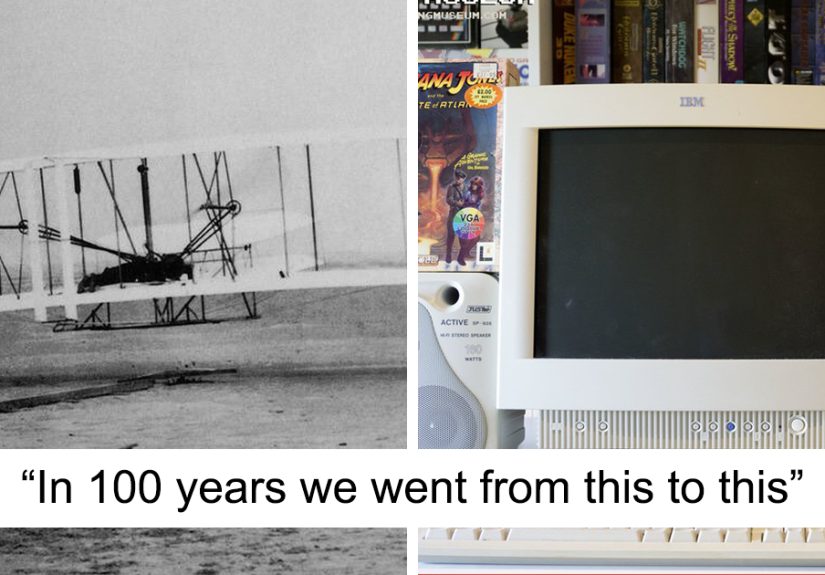
The reason this hits so hard is that 1900 to 2000 isn’t just “a hundred years.” It’s a hundred years where change came in stackselectricity,
sanitation, antibiotics, vaccines, cars, airplanes, civil rights, computers, and the early interneteach one amplifying the next. If progress were
a TV show, the 20th century would be the season where the writers went a little unhinged.
Why 1900 to 2000 Feels Like a Time-Lapse Video
In 1900, huge parts of daily life were defined by limits: limited light, limited clean water, limited medical options, limited mobility, limited
real-time communication, and limited political participation for many Americans. By 2000, those limits weren’t gonebut they had shifted. The new
problems often came from abundance, speed, and complexity: chronic disease, information overload, environmental strain, and a world that can change
by lunchtime.
So when people online compare 1900 to 2000, they’re reacting to a rare historical compression. You don’t get many centuries where “I remember the
first time my house had electricity” can share a calendar with “my grandkid taught me how to use email.” That’s not just change. That’s whiplash
with a side of dial-up.
Home Life Got Rewritten: Light Switches, Faucets, and Cold Food
Electricity: The End of the “Dark After Dark” Era
In 1900, “after sunset” was a real boundary. Lighting meant flamesoil lamps, candles, gas. Electricity existed, but it was far from universal,
especially outside cities. One of the most dramatic shifts of the century was simply flipping a switch and getting reliable light (and then, soon
enough, fans, radios, irons, and the first wave of household appliances).
Rural electrification is the plot twist people forget. City life was changing fast, but rural communities could lag for decades. In the early 1930s,
only a small slice of rural America had electricity. Then New Deal-era policy and cooperative building projects helped wire huge stretches of the
country. Once power arrived, it wasn’t just “brighter evenings.” It changed farm productivity, home labor, education, safety, and even what families
could reasonably expect a house to do for them.
Plumbing and Sanitation: A Quiet Revolution With Loud Impact
Nothing screams “progress” like not having to carry buckets of water or keep a nervous eye on the outhouse during a thunderstorm.
Modern plumbing and sanitation are so normal by 2000 that it’s easy to forget how recent they are at scale. Mid-century America still had enormous
gaps: in 1940, nearly half of U.S. homes lacked complete plumbing facilities. Over the next decades, that share dropped sharply, and by 1990 it was
down to about 1%. By 2000, incomplete plumbing was rarer still, though not completely eliminated everywhere.
This matters because sanitation isn’t just convenienceit’s disease prevention. Clean water, wastewater systems, and basic hygiene infrastructure
are some of the biggest, least glamorous reasons people stopped dying from things that once swept through communities like a bad rumor.
Refrigeration: Goodbye Icebox, Hello Weekly Grocery Run
If you want a single household object that symbolizes the “before and after” of the 20th century, it might be the refrigerator. Early in the century,
many families relied on ice deliveries and insulated boxes. By the late 1900s, refrigerators were near-universal in American homes, enabling safer food
storage, different diets, fewer daily trips to markets, and the rise of a “cold chain” that reshaped how food moves from farm to table.
The ripple effects are underrated. Refrigeration helped make supermarkets possible at scale, expanded what foods people could access year-round,
reduced some foodborne risks, and changed family routines. It also helped normalize the idea that a household could stock upturning “daily survival logistics”
into “I’ll just grab groceries on Saturday.”
The Telephone to the Pocket: Communication Stops Waiting
In 1900, communication over distance mostly moved at the speed of paper: letters, telegrams, newspapers. The telephone existed, but it wasn’t a given
in every household. Over the century, landlines spread, and by the late 1900s, phone access was becoming the norm rather than the exception.
Census housing data show that by 2000, only about 2.4% of occupied U.S. housing units had no telephone service availablea number already influenced
by the rise of cell phones.
The real milestone by 2000 wasn’t just “phones everywhere.” It was the expectation of instant coordination. Plans no longer had to be locked in at breakfast.
You could call if you were late. You could reroute. You could find someone in real time. That seems smalluntil you realize it changes how cities run,
how jobs schedule labor, and how relationships maintain contact across distance.
Health and Survival: The Century That Added Decades
Life Expectancy: From the 40s to the 70s (and Beyond)
If you want the headline statistic for “life changed,” here it is: U.S. life expectancy at birth was about 47.3 years in 1900. In 2000, it was
about 76.9 years. That’s not a small improvement; it’s a new human experience.
Important nuance: this doesn’t mean most adults dropped dead at 47 in 1900. A big driver was high infant and child mortality. When more children
survive, average life expectancy rises dramatically. Over time, medicine and public health also reduced deaths across many ages, turning survival into
something more people could assume rather than hope for.
Infant and Maternal Mortality: Declines That Changed Families
The early 20th century was harsh on babies and mothers. Over the century, the U.S. saw dramatic declines in infant mortality and maternal mortality,
thanks to sanitation, nutrition, safer childbirth practices, antibiotics, and better medical care. Public health reporting highlights that infant mortality
dropped by more than 90% across much of the 20th century, and maternal mortality fell by roughly 99% from 1900 to the late 1990s.
These aren’t just medical stats. They changed how many children families had, how parents planned for the future, and how communities experienced grief.
When survival becomes more reliable, people invest differentlyin education, careers, home ownership, and long-term health.
Vaccines: Turning Fear Into Memory
By 2000, many Americans had never seen the diseases that once defined childhood fear. Polio outbreaks shaped the mid-century experienceclosed pools,
anxious summers, and worried parents. Vaccination changed that. The polio vaccine era began in the 1950s, and vaccines for measles (1963), mumps (1967),
and rubella (1969) followed, later combined into the MMR vaccine in 1971.
The broader point is bigger than any single shot: vaccines shifted the baseline. They turned once-common tragedies into preventable events, and they did it
so well that later generations sometimes forgot why the fear existed in the first place. (Public health’s greatest compliment is being taken for granted.)
Antibiotics: When “This Infection Might Kill You” Stopped Being Normal
Another 20th-century superpower was antibiotics. Penicillin was discovered in 1928, and mass production accelerated during World War II. By mid-century,
bacterial infections that once meant serious disability or death became treatable in many cases.
But progress comes with a warning label: antibiotic resistance emerged as overuse and misuse gave bacteria evolutionary reasons to get stubborn.
The 20th century delivered antibioticsand the 21st is now tasked with using them wisely enough to keep them.
Moving Faster and Farther: From Horses to Jet Bridges
Cars and Roads: The Geography of Daily Life Changed
In 1900, cars existed but were not a normal part of daily transportation for most people. Over the century, motor vehicles became central to American life,
reshaping cities, suburbs, commerce, and work commutes. Once cars became common, “distance” got redefined. People could live farther from work, shop in
different neighborhoods, and treat weekend travel as ordinary instead of epic.
That shift created winners and trade-offs: convenience and economic growth on one hand; congestion, pollution, and sprawl on the other. The modern American
landscapestrip malls, highways, suburbsmakes a lot more sense once you realize it’s basically an architectural love letter to the internal combustion engine.
Air Travel: The World Shrunk Without Getting Smaller
Early flight in the 1900s was experimental and risky. Commercial aviation took shape through mail routes, early airlines, and rapid advances in aircraft design.
By the late 20th century, jet travel turned cross-country movement into a day trip and international travel into a realistic option for far more people than
ever before.
One human generation could go from “seeing an airplane is an event” to “my luggage is in the wrong airport again.” That’s progressplus a small tax paid to
the gods of baggage claims.
Information and Media: From Broadcast to Browse
The 20th century didn’t just change what people could do; it changed what people could know, and how quickly. Newspapers, radio, and television created a
national shared experiencemillions consuming the same headlines, the same broadcasts, the same breaking news voice.
Then came personal computing and, by the late 1990s, the early internet era. By early 2000, about half of U.S. adults were already online. That number
didn’t just represent a new tool; it represented a new default. Information became searchable. Communities formed around niche interests. Communication
became cheaper, faster, and more frequent. And yes, people began arguing with strangers at scale, whichdepending on your optimismmight be the internet’s
most consistent feature.
Rights and Roles: Who Got to Live “Modern Life”
Technological change can be dramatic, but social change decides who benefits. Between 1900 and 2000, the United States saw major expansions of legal rights
and public participationthough the pace and reality varied widely across communities and regions.
Women’s Suffrage: The Ballot Box Opens (1920)
The 19th Amendment, ratified in 1920, granted women the right to vote. This didn’t instantly erase barriers for all women (especially women of color facing
voter suppression), but it marked a major shift in political power and public identity. It’s hard to overstate how much this changed the “default citizen”
assumptions of the country.
Civil Rights: Law and the Long Fight Toward Equal Access
The Civil Rights Act of 1964 prohibited discrimination in public places, supported school integration, and made employment discrimination illegal.
Like many landmark laws, it was both a turning point and the start of more battlesbecause enforcement, culture, and lived reality don’t update automatically
just because legislation exists. Still, it reshaped American institutions and expanded who could participate more fully in work, education, and public life.
The Trade-Offs: Progress Comes With a Shadow
The online reactions that inspired this topic often carry two emotions at once: awe and unease. For every “we eradicated or controlled major diseases,” there’s
“we created new ones” (or new ways to spread them). For every “instant communication,” there’s “privacy is complicated now.” For every “mass production,”
there’s “mass waste.”
The 20th century included world wars and the nuclear age. It industrialized food systems and medicine. It built cities upward and outward. It made life longer,
but also more sedentary. It reduced many old dangers and introduced new, quieter riskslike chronic disease, environmental stress, and an always-on culture
that treats rest like a suspicious hobby.
What This Century-Long Glow-Up Teaches Us
The point of comparing 1900 to 2000 isn’t to say, “Wow, we’re so advanced,” and then go back to scrolling. It’s to remember that modern life is a collection
of decisionspolicy decisions, scientific breakthroughs, public health investments, infrastructure projects, and social movements.
It’s also a reminder that the people who lived through the century weren’t watching a highlight reel. They were adapting in real timelearning new tools,
absorbing new norms, surviving new risks. If you’ve ever felt exhausted by how fast the world changes, congratulations: you have something in common with
almost every human who ever lived through a major transition. The difference is that the 20th century made “major transition” feel like a recurring subscription.
Shared Experiences: What People Notice Most When They Compare 1900 and 2000
This section is intentionally experience-focusedbuilt from common stories people share about older relatives, community histories, and generational memory.
Think of it as a set of “human snapshots” that match the big trends.
1) The first time the night stopped being scary.
People who grew up without reliable electricity often describe darkness as a real presence, not a mood. Night meant limited visibility, limited activity, and
a sense that the world shrank after sunset. When electric light arrivedespecially in rural areasit wasn’t just convenient. It changed how kids did homework,
how adults read, how families gathered, and how safe a home felt. A switch replaced a ritual: trimming wicks, cleaning soot, and watching flames like a
part-time job.
2) The moment medicine stopped being mostly “hope.”
Many families have a story about an infection that “used to be deadly.” A cut that turned dangerous. A fever that wouldn’t break. Pneumonia that took someone
quickly. When antibiotics and vaccines became widely available, the emotional background of life changed. Parents still worried (parents always worry), but
the fear moved from “this could take my child” to “we should call the doctor.” That differencebetween helplessness and treatmentshows up in the way older
generations talk about sickness with a kind of stunned gratitude.
3) Food stopped being a daily logistics puzzle.
Without modern refrigeration, families shopped differently, cooked differently, and wasted differently. People remember ice deliveries, pantries packed with
shelf-stable staples, and meals designed around what would keep. When refrigerators became common, it changed the calendar of eating. Leftovers became safer.
Weekly grocery trips became normal. The idea of having strawberries in winter stopped sounding like science fiction. It also shifted family laborless time
spent preserving, re-shopping, and constantly managing spoilage.
4) Distance collapsedand people’s lives expanded with it.
Older travel stories often sound like endurance tests: long train rides, multi-day drives on slower roads, or simply never leaving one’s region because it was
expensive and complicated. By 2000, air travel and the car-centric landscape made mobility feel more like a choice than a barrier. That changed everything from
job opportunities to family relationships. When you can visit relatives across the country in hours instead of days, “moving away” doesn’t mean “vanishing.”
It means “see you at the holidays”plus a few frantic airport sprints.
5) Communication became immediate, and waiting became optional.
People raised on letters and scheduled phone calls often describe modern communication as both magical and overwhelming. The shift isn’t just speed; it’s the
expectation of responsiveness. In earlier decades, silence could simply mean “mail is slow” or “they’re not home.” By 2000, email and mobile phones were
already teaching society a new habit: availability. Some people love it because it keeps families close. Others miss the breathing room, when being unreachable
was normal and not a cause for concern.
6) The biggest emotional takeaway: awe, plus a little grief.
The most consistent “experience” in generational comparisons is the mixed feeling. Awe at what became possiblelight, medicine, travel, knowledge. And grief
for what got displacedslower community rhythms, privacy, a sense of “enough.” People tend to describe the 20th century not as a straight upgrade, but as a
trade: less physical hardship for more mental noise; less isolation for more pressure; fewer deadly diseases for more chronic ones. That doesn’t mean progress
wasn’t real. It means progress was humanmessy, uneven, and always asking us to learn a new way to live.
If Twitter threads like this feel addictive, it’s because they offer something rare: perspective. They let us step outside our normal assumptions and see modern
life as a temporary arrangement, not a permanent fact. And once you see that, a new question appears: if 1900 to 2000 changed this much, what will people in
2100 be laughing (or crying) about when they look back at us?