Table of Contents >> Show >> Hide
- What Is the Purkinje Effect?
- Rods, Cones, and Why Your Eyes Become Tiny Lighting Critics
- Why Solar Eclipse Colors Look So Strange
- Is the Purkinje Effect Stronger During a Total Solar Eclipse?
- What You See During Totality That Is Not the Purkinje Effect
- The Science Behind the Color Shift
- Examples of the Purkinje Effect During an Eclipse
- Can You See the Purkinje Effect During a Partial Eclipse?
- How to Watch Safely Without Ruining the Magic
- What the Purkinje Effect Teaches Us About Human Vision
- Experience Section: What It Feels Like to See the Purkinje Effect During an Eclipse
- Conclusion
A total solar eclipse already feels like the universe is showing off. Daylight collapses, birds get confused, the horizon glows like a 360-degree sunset, and suddenly your familiar backyard looks like it wandered into a dream sequence. Then something even stranger happens: colors stop behaving. Reds seem to lose their swagger, greens and blues feel oddly alive, and the whole world can take on an eerie bluish-purple cast. No, your eyes are not broken. They are being very dramatic, but for a scientifically respectable reason.
That reason is the Purkinje effect, also called the Purkinje shift. It is a change in how human vision ranks brightness as light levels fall. In plain English, your eyes do not judge colors the same way in dim light as they do in bright daylight. During a solar eclipse, especially in the fast, surreal slide into totality, that shift can become startlingly obvious.
This article breaks down what the Purkinje effect is, why solar eclipse colors can look so weird, what is happening inside your retina, and why totality is not just an astronomy event but also a full-on sensory plot twist. We will also cover what color changes belong to your eyes, what changes belong to the atmosphere, and how to enjoy the show safely.
What Is the Purkinje Effect?
The Purkinje effect is a change in perceived brightness that happens as lighting moves from bright to dim. In full daylight, your vision relies mostly on cones, the photoreceptors that give you sharp detail and rich color. In dimmer conditions, rods start taking over. Rods are excellent at detecting low light, but they are not nearly as good at delivering the vivid color experience you get in sunshine.
Here is the key twist: rods are more sensitive to shorter wavelengths of visible light than long, red-heavy wavelengths. So when illumination drops, colors do not simply get darker across the board. Instead, the whole brightness ranking changes. Reds, oranges, and warm tones tend to look darker or duller. Blues, blue-greens, and some greens can seem relatively brighter.
That is why a red flower that looked bold at noon can look nearly black at dusk, while a blue flower nearby seems to hang on to its brightness. The world has not changed. Your visual system has changed the rules.
Why It Is Called a “Shift”
The word “shift” matters. The Purkinje effect is not just about losing color. It is about the eye changing its sensitivity profile as lighting conditions move through the mesopic range, the in-between zone where rods and cones both contribute. That transition zone is where things get weird in the best possible way. During an eclipse, the light can plummet so quickly that you get a front-row seat to your own visual system changing modes in real time.
Rods, Cones, and Why Your Eyes Become Tiny Lighting Critics
To understand the Purkinje effect, think of your retina as a team with two specialists.
Cones: The Day Shift
Cones handle daylight and detail. They help you read signs, admire a bright red jacket, and decide whether a paint sample is “cool white” or “aggressively dentist office.” Humans have three cone classes that respond to different parts of the visible spectrum, which is how color vision works in normal bright conditions.
Rods: The Night Shift
Rods are the low-light pros. They are far more sensitive to dim illumination than cones, which makes them crucial when the world gets dark. But rods come with trade-offs. They do not deliver crisp detail the way cones do, and they do not support normal full-color vision. They are better at telling your brain, “Something is there,” than “Something is there and it is wearing tomato red.”
The Handover During an Eclipse
A total solar eclipse compresses a twilight-like transition into a remarkably short window. Instead of a long sunset, where your eyes slowly adapt, totality can force a rapid lighting change. That fast drop makes the handoff between cones and rods more obvious than usual. It is one reason eclipse observers often describe colors as otherworldly, unnatural, or even slightly theatrical.
If that sounds like your eyeballs are improvising, that is not far off. They are performing exactly as designed, but the lighting situation is so unusual that the result feels uncanny.
Why Solar Eclipse Colors Look So Strange
When people talk about eclipse colors, they are often describing several different effects at once. The Purkinje effect is one part of the story, but not the only part. Think of a total eclipse as a weird collaboration between your retina, Earth’s atmosphere, and the Sun’s disappearing light source.
1. Warm Colors Lose Their Punch
As daylight drains away, reds and oranges may appear muddy, subdued, or shadowy. A red shirt that looked bright minutes earlier can suddenly look muted, almost brownish or charcoal-toned. This is classic Purkinje behavior. Long-wavelength colors stop winning the brightness contest.
2. Blues and Greens Can Stand Out More
Shorter-wavelength colors often seem to hold their brightness better. Blue clothing, green leaves, and cool-toned surfaces may appear unusually noticeable compared with nearby warm colors. Some observers even report a violet or lavender mood over the landscape just before or during totality.
3. The Horizon Glows Like Sunset in Every Direction
This is not mainly the Purkinje effect. During totality, the area inside the Moon’s darkest shadow experiences deep twilight, but regions farther away are still sunlit. That produces yellow, orange, and pink tones around the horizon in all directions. In other words, the atmosphere is giving you a ring of distant dawn and dusk while your eyes are simultaneously shifting into dim-light mode. Subtle? Not exactly. Memorable? Extremely.
4. The Sky Near Totality Can Look Deep Blue, Indigo, or Purple
Observers often describe a deep twilight blue overhead, sometimes with a purplish quality. Part of that impression comes from reduced illumination, part comes from how your eyes process color as rods become more important, and part comes from the unusual atmospheric lighting during the eclipse. Translation: the sky is doing weird science, and your brain is trying its best.
Is the Purkinje Effect Stronger During a Total Solar Eclipse?
Yes, or at least it is often more noticeable. The effect itself is not unique to eclipses. You can experience it at dusk, in a dim garden, or when stepping from bright sun into a dark room. What makes a total solar eclipse special is the speed and drama of the lighting change.
In a normal sunset, your eyes have time to adapt gradually. During an eclipse, the light level can drop quickly enough that the visual transition feels abrupt and theatrical. That suddenness makes the Purkinje effect feel amplified, even if the underlying biology is the same phenomenon your eyes use every evening.
Many experienced eclipse watchers recommend wearing or holding objects with distinct red and green or red and blue colors before totality. The shift can be surprisingly obvious when you have a direct before-and-after comparison. It is one of those rare moments when science rewards you for dressing like a color chart.
What You See During Totality That Is Not the Purkinje Effect
Eclipses are generous. They do not stop at one optical wonder.
The Corona
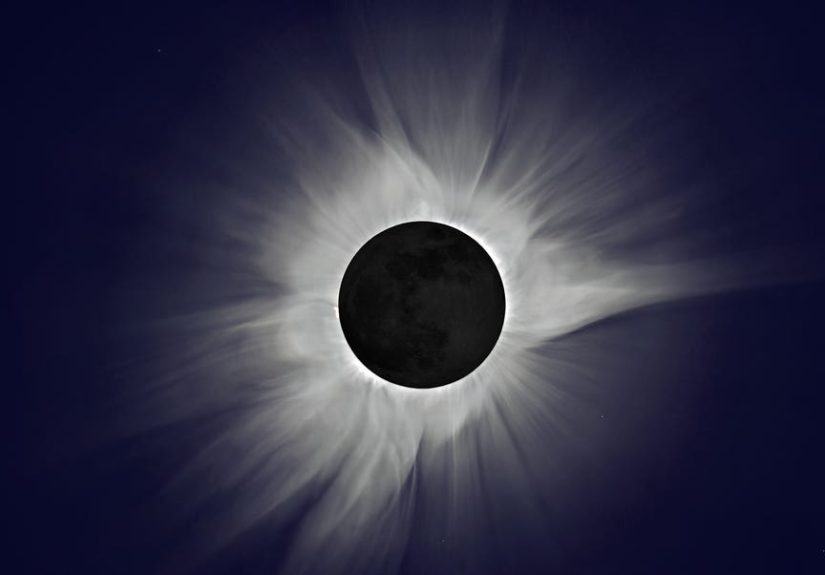
During totality, the Sun’s outer atmosphere, the corona, becomes visible as a pale, silvery halo around the dark disk of the Moon. It is normally washed out by the Sun’s bright surface, but totality dims the photosphere enough for the corona to emerge.
Prominences and the Chromosphere
At the edge of totality, you may see vivid pink or ruby-red features. These come from the Sun’s chromosphere and solar prominences. Their color is real, but how intense it looks can still be influenced by contrast, dark adaptation, and the overall eclipse lighting environment.
Shadow Bands
Just before and after totality, faint rippling bands of light and shadow may race across pale surfaces. These shadow bands are caused by atmospheric turbulence distorting the last sliver of sunlight. They are subtle, fleeting, and exactly the kind of thing that makes people say, “Did you see that?” while everyone else is still staring open-mouthed at the sky.
Baily’s Beads and the Diamond Ring
As the last bright points of sunlight peek through valleys along the Moon’s edge, you can see Baily’s beads. When one bright point remains alongside the faint corona, it creates the famous diamond ring effect. These are not Purkinje phenomena either, but they happen in the same breathless stretch of time and add to the total sensory overload.
The Science Behind the Color Shift
In bright conditions, human visual brightness peaks in a region associated with cone-dominated daytime vision. In dim conditions, peak sensitivity shifts toward shorter wavelengths because rod-dominated vision has a different spectral response. That is the formal, laboratory-friendly description of the Purkinje shift.
What does that mean in the real world? It means your brain is not receiving the same balance of information from the same colors as light fades. The “brightness map” changes. A red object and a blue object that looked similarly eye-catching in daylight may separate dramatically as the scene darkens. The red one fades; the blue one hangs on.
Importantly, this does not mean rods suddenly create colorful night vision. Human night vision is still poor for color. Instead, in the transition zone, rods influence perceived brightness strongly enough to reshape the scene. That is why the world can feel color-shifted and strange before becoming flatter and less saturated in very low light.
Examples of the Purkinje Effect During an Eclipse
Let us put the science into practical terms.
- A red picnic blanket may look much darker than you expect a few minutes before totality.
- Green grass can appear unexpectedly alive compared with nearby warm-toned clothing.
- Blue jackets, teal signs, or cool-gray pavement may seem to “pop” more than they did moments earlier.
- Faces can look oddly pale, cool-toned, or theatrical as the lighting slides into eclipse twilight.
- The overall scene may feel purple, indigo, or slate-blue, even when you cannot point to one single object causing that impression.
In other words, the eclipse does not just dim the world. It remixes it.
Can You See the Purkinje Effect During a Partial Eclipse?
Sometimes, but it is usually much less impressive. Outside the path of totality, even a very deep partial eclipse does not recreate the full plunge into eclipse darkness. The Sun is so bright that a tiny uncovered fraction still delivers a surprising amount of light. As a result, the most dramatic Purkinje-style color changes are usually reported close to or during totality, where ambient illumination drops far more sharply.
That is one reason eclipse veterans keep repeating the same message: 99% is not 100%. In eclipse terms, that last 1% is a diva.
How to Watch Safely Without Ruining the Magic
Here comes the serious part, because your retinas deserve better than reckless enthusiasm.
You should only look directly at the Sun without eclipse glasses during the brief period of totality, when the Sun’s bright surface is completely covered. During all partial phases, and during annular eclipses, proper solar filters are required. Regular sunglasses are not remotely enough. Not even fancy ones. Not even the ones that make you feel like a movie star.
If you are planning to observe solar eclipse colors, set out a few colored objects in advance and check them during the minutes leading up to totality. Then spend most of totality actually looking around and taking it in. The point is not to become an unpaid laboratory technician. The point is to notice how gloriously weird the world becomes.
What the Purkinje Effect Teaches Us About Human Vision
The Purkinje effect is a reminder that vision is not a passive recording of reality. Your eyes and brain are always interpreting, prioritizing, compressing, and adapting. What looks “true” at noon is not what looks “true” at dusk, and a total eclipse exposes that truth with almost rude clarity.
It also shows how elegant the human visual system is. We can function across an enormous range of brightness levels, from glaring daylight to near darkness, because rods and cones specialize in different tasks. The strange colors of an eclipse are not a bug. They are evidence that your visual system is flexing its adaptive superpowers under one of nature’s most dramatic lighting cues.
Experience Section: What It Feels Like to See the Purkinje Effect During an Eclipse
If you have never seen a total solar eclipse, it is easy to imagine the event as mostly about the sky. The Sun disappears, the corona appears, everybody gasps, end scene. But people who have stood in the path of totality often come back talking just as much about the world around them as the eclipsed Sun itself. That is where the Purkinje effect becomes unforgettable.
The strangest part is not simply that things get darker. It is that the darkness does not behave like a storm cloud, sunset, or evening. It feels selective. Familiar colors stop acting familiar. Red objects seem to lose social status immediately. A cheerful crimson shirt can go from “main character energy” to “background prop” in minutes. Meanwhile, cooler tones start stepping forward like they have been waiting all year for this audition.
Observers often describe the landscape as silvery, bluish, purple, or metallic. Trees can look less green in the cozy daylight sense and more green in a surreal, sharpened, almost stage-lit sense. Pavement may turn cool and steely. Skin tones can look ghostly, muted, or theatrical. Even shadows seem less ordinary, as though they have been edited by an art director who is very into suspense.
One reason the moment hits so hard is contrast. Your brain knows what noon is supposed to look like. It knows what your backyard, your hands, your clothes, and the faces around you are supposed to look like in daytime. During an eclipse, that internal expectation collides with a lighting environment that resembles twilight, sunset, and dim indoor light all at once. The result is not just visual change. It is cognitive surprise.
Then there is the horizon. While the overhead sky deepens, the edge of the world can glow with orange, yellow, and pink in every direction. You look up and your rods and cones are renegotiating reality. You look out and the planet seems ringed by sunset. The combination can feel emotionally bigger than the science words used to describe it. It is not uncommon for people to laugh, cry, forget every camera setting they carefully planned, or say something deeply profound like, “Whoa.”
That emotional response is part of the experience too. The Purkinje effect during a solar eclipse is not merely an item on a checklist. It is one of the reasons totality feels alien without feeling hostile, beautiful without feeling soft, and unforgettable without needing special effects. Nature already brought the effects team.
So if you ever get the chance to stand in the path of totality, do yourself a favor. Bring safe eclipse glasses, yes. Check the forecast, yes. But also bring attention. Look at the grass. Look at your hands. Look at a red jacket, a blue bag, a green tree. Notice the moment when the world stops looking like daytime and starts looking like a memory from a place you have never been. That strange, shifting, blue-leaning transformation is the Purkinje effect turning an eclipse from a sight into an experience.
Conclusion
So, what is the Purkinje effect? It is the visual shift that happens when your eyes move from bright-light, cone-dominant vision toward dim-light, rod-dominant vision. In that transition, reds and warm tones lose brightness, while blues and greens can seem relatively stronger. During a total solar eclipse, the sudden collapse of daylight makes that shift unusually vivid, which is why eclipse colors can look eerie, purple, cool-toned, and unforgettable.
But the full eclipse palette is bigger than one visual trick. Atmospheric scattering creates sunset colors around the horizon, totality reveals the corona and prominences, and shadow bands can ripple across the ground. Put it all together, and a total eclipse becomes one of the rare moments when astronomy, weather, biology, and human emotion all share the same stage.
If you ever witness totality, you will not just be watching the Sun disappear. You will be watching your own vision change how it interprets the world. And honestly, that is a pretty spectacular side quest for a Monday afternoon.