Table of Contents >> Show >> Hide
- The Submarine That Looked Like the Future
- What Happened on April 10, 1963?
- What the Declassified Documents Actually Reveal
- Was It Really One Failed Silver-Brazed Joint?
- Why the Declassified Records Matter
- The Legacy: SUBSAFE
- What the Truth Really Is
- Experiences That Still Echo From the Thresher Story
- Conclusion
The loss of the USS Thresher is one of those Cold War tragedies that still feels oddly modern. A cutting-edge submarine goes out for trials. A few garbled words come back over the water. Then silence. No villain in a black turtleneck. No cinematic explosion. Just a horrifying chain of failures deep below the Atlantic.
For decades, the USS Thresher sinking lived in that uncomfortable zone between official explanation and unanswered questions. Then came a slow release of once-classified material, renewed public scrutiny, and a closer look at the Court of Inquiry, Navy records, later naval analysis, and technical commentary. The result is not a flashy conspiracy reveal. It is something more sobering and more useful: a clearer picture of how a brilliant war machine was undone by ordinary engineering weaknesses, imperfect procedures, and terrible timing.
So, why did the USS Thresher sink? The best answer from the declassified record is this: the submarine was likely overwhelmed by a cascading systems casualty near test depth. A probable seawater leak in the engine room, likely involving a silver-brazed joint or related piping weakness, appears to have triggered electrical problems, a reactor shutdown, loss of propulsion, and a failed attempt to blow ballast tanks quickly enough to recover. In other words, the Thresher did not die from one dramatic failure. It was dragged under by a sequence of smaller failures that lined up with lethal precision.
The Submarine That Looked Like the Future
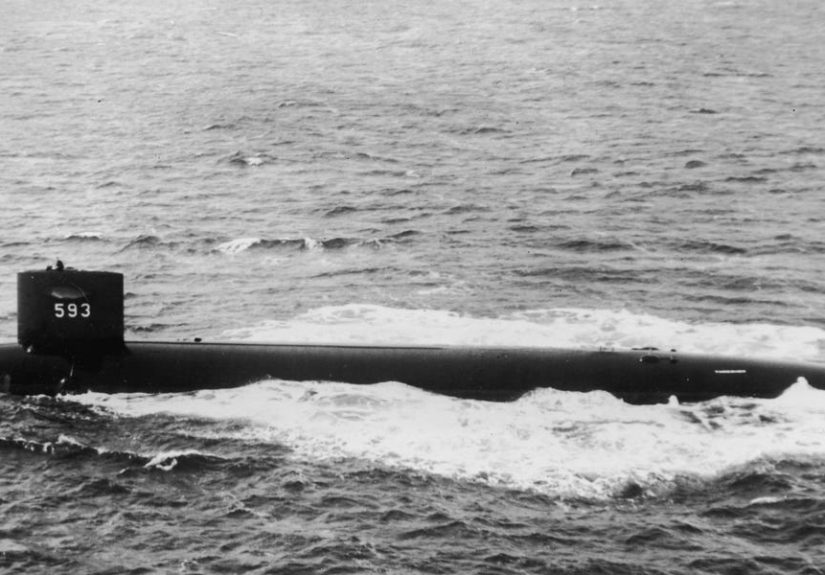
When the USS Thresher entered service, she represented the future of undersea warfare. She was fast, quiet, deep-diving, and built to hunt Soviet submarines in the kind of shadowy contest where hearing first usually mattered more than shooting first. The boat was the lead ship of a new class and a showcase of American naval technology. That made her loss even more shocking. This was not an old rust bucket limping toward retirement. It was the Navy’s shiny new proof that modern engineering had everything under control. History, as usual, was not impressed.
By April 1963, Thresher had completed a lengthy post-shakedown availability at Portsmouth Naval Shipyard. She left for sea trials with 129 people aboard, including Navy crew and civilian shipyard personnel. The mission was routine in the way only very dangerous naval missions can be called routine. The submarine would conduct deep-diving tests east of Cape Cod with the rescue ship Skylark nearby.
What Happened on April 10, 1963?
The Last Messages
On the morning of April 10, Thresher descended in stages toward test depth. Communications with Skylark were limited and often garbled, which is not unusual for underwater telephone traffic. But then came the line that has haunted naval history ever since: “Minor difficulties, have positive up-angle, attempting to blow.” A final broken transmission followed, often associated with the number “900.” Then the communications ended.
That message tells us a lot. The submarine had a positive up-angle, meaning the crew was trying to bring the bow upward. They were also attempting to blow ballast, an emergency action meant to force high-pressure air into ballast tanks and make the submarine more buoyant. In plain English, the boat was in trouble, trying to climb, and not climbing fast enough.
Search and recovery efforts later found the wreck in deep water. The debris pattern indicated that Thresher had descended beyond her safe limit and suffered catastrophic implosion. The ocean, never known for mercy, finished the job in an instant.
What the Declassified Documents Actually Reveal
The most important thing the declassified documents reveal is that the Thresher disaster was not really a mystery in the movie-script sense. The official Navy position has long been careful: the Court of Inquiry did not conclusively determine the single initiating cause from the evidence then available. But the documents and later Navy summaries do identify a highly probable chain of contributing failures. Think less “whodunit,” more “how-many-things-can-go-wrong-before-gravity wins.”
1. A Likely Flooding Casualty Started the Chain
The leading explanation centers on a failure in a seawater piping system, especially a silver-brazed joint. Before Thresher’s loss, many small-diameter submarine pipes used silver brazing rather than full welding. That process worked well enough in theory, but post-accident inspections found troubling evidence that some joints in similar systems were substandard. Later Navy and SUBSAFE summaries repeatedly point to the likely failure of a salt-water piping joint as the key casualty that set events in motion.
That matters because a leak at extreme depth is not like a drip under your kitchen sink. It is a violent, high-pressure jet of seawater entering a space packed with electrical gear and machinery. Once that begins, the crew does not have the luxury of a committee meeting and coffee refill. They have seconds and rapidly shrinking options.
2. Salt Water and Electricity Make a Terrible Team
The next link in the chain was probably electrical. Seawater spray likely caused short circuits in electrical equipment. That, in turn, appears to have contributed to a reactor scram, an automatic shutdown designed to protect the nuclear plant. The cruel irony is that the reactor likely did what it was designed to do. The problem is that saving the reactor did not save the ship.
Once Thresher lost propulsion near test depth, the situation became far more dangerous. At those depths, a submarine depends heavily on forward motion and control to recover from a casualty. A deep-diving boat is not a cork. It cannot simply decide to float harder.
3. The Emergency Blow Was Not Enough
This is the part that turns the Thresher story from bad to devastating. The crew attempted to blow the main ballast tanks, but the system did not provide enough rapid recovery. The post-loss analysis and later safety studies point to moisture and restrictions in the high-pressure air system that likely caused ice formation and reduced airflow. In other words, the emergency blow system did not fail in a theatrical bang. It failed in the most frustrating way possible: not completely dead, just not effective enough when effectiveness was the only thing that mattered.
That detail shaped submarine history. After Thresher, the Navy redesigned and improved emergency ballast blow capability. Because when your emergency surfacing system works only on a polite day in ideal conditions, it is not really an emergency system. It is a suggestion.
4. Procedures and Planning Made Recovery Harder
The records also point toward operational and procedural weaknesses. The submarine was conducting deep-diving trials after major yard work. Some later analysts argued the schedule was compressed and the testing profile too ambitious. There were also questions about how quickly propulsion could be recovered after a reactor scram and whether approved procedures at the time left the crew with too little flexibility in a fast-moving casualty.
That does not mean the crew made reckless choices. It means they were operating within a system whose assumptions were too optimistic. The boat was advanced, but parts of the supporting design philosophy had not fully caught up with the realities of deep-submergence risk.
Was It Really One Failed Silver-Brazed Joint?
Here is where the story gets more interesting, and where careful writing matters. Some later analysts, especially those focused on SOSUS acoustic data, have argued that the initial problem may have been electrical rather than flooding. In that version, instability in the electrical bus and coolant pump behavior may have triggered the reactor scram first, with flooding either secondary or not central to the sinking sequence.
That debate is real, and it deserves acknowledgment. But it does not overturn the broader truth that the released record has made clearer. Whether the first domino was a bad joint, an electrical event, or a tightly linked combination of both, Thresher was lost because she could not recover from a deep casualty. The official Navy summaries after declassification still lean toward the flooding-and-piping explanation, while also stating that the Court of Inquiry could not conclusively prove the exact initiating event from the evidence available.
So the honest answer is not, “We finally know every second with total certainty.” The honest answer is better than that: we now understand the disaster as a cascading systems failure, not a random disappearance. That distinction matters enormously for history, engineering, and safety culture.
Why the Declassified Records Matter
The phrase “declassified documents reveal the truth” can sound like clickbait wearing a necktie. In this case, though, the records matter because they move the Thresher story away from rumor and toward documented institutional learning.
Public releases and legal pressure forced the Navy to open more of the record, including portions of the Court of Inquiry material and related historical files. Those releases did not suddenly expose a secret Soviet plot or some buried one-line confession. What they did reveal is more valuable: how the Navy thought about the loss, what it knew, what it could not prove, and which technical failures it considered most important.
That kind of transparency matters because the Thresher disaster was not only a tragedy. It was a turning point. The lessons extracted from it changed submarine construction, inspection, training, and quality assurance for generations. Declassification allows the public to see that those lessons were purchased at a terrible price.
The Legacy: SUBSAFE
If there is one word permanently attached to the Thresher story, it is SUBSAFE. After the sinking, the Navy created the SUBSAFE program to ensure that critical systems related to watertight integrity and recovery from flooding were designed, built, maintained, and documented to a much stricter standard.
SUBSAFE became far more than a checklist. It turned into a culture. Material traceability improved. Standards tightened. Inspection and certification became relentless. Small shortcuts stopped being “practical” and started being treated as future headlines. That shift may be the most important truth to come from the Thresher records. The disaster was not simply mourned. It was translated into discipline.
And the results matter. In the decades since, SUBSAFE has been cited as one of the military’s most effective safety programs. That does not erase the loss of 129 lives, but it does mean their deaths changed how submarines are built and how risk is managed. In naval history, that is as close as tragedy gets to redemption.
What the Truth Really Is
So, why did the USS Thresher sink? Because a world-class submarine met the ocean with a chain of vulnerabilities that should never have been allowed to coexist. The declassified record points toward a likely seawater-system failure, probably involving weak silver-brazed piping, followed by electrical shorting, reactor shutdown, loss of propulsion, and an emergency ballast blow system that could not save the ship at depth. Even where debate remains about the first trigger, the broader cause is no longer blurry. Thresher was defeated by cascading design, maintenance, and procedural weaknesses under extreme conditions.
That is the real truth the documents reveal. Not a glamorous secret. Not a tidy single-cause explanation. Just the brutal lesson that advanced machines do not fail only when one thing breaks. They fail when too many assumptions survive too long without being challenged.
Experiences That Still Echo From the Thresher Story
One reason the USS Thresher disaster still grips people is that it is not only a technical story. It is an experience story. Families experienced the long terror of waiting for certainty that never came in the way they wanted. Sailors experienced the shock of realizing that if Thresher could be lost, any submarine could be lost. Shipyard workers experienced the cruel hindsight of wondering whether one overlooked detail, one rushed inspection, or one accepted standard had helped write the final chapter.
Submariners who came after Thresher often describe learning about the disaster not as a history lesson, but as an initiation. They hear the final message. They study the diagrams. They learn what SUBSAFE means. And somewhere between the piping schematics and the casualty procedures, the lesson becomes personal. The sea is not impressed by rank, intelligence, or patriotism. It responds only to physics, preparation, and margin. That realization tends to humble even the confident people who volunteer to disappear under thousands of feet of water for a living.
There is also a strange experience many historians and museum visitors talk about when they encounter Thresher artifacts or memorials. The wreck photos are not loud. They do not need to be. A twisted piece of structure on the ocean floor can say more than a dozen dramatic documentaries. It reminds viewers that the men aboard were not symbols when they sailed. They were engineers, officers, enlisted sailors, yard workers, husbands, sons, and fathers. They boarded a trial run, not a legend. The legend came later.
For engineers, the Thresher story can feel uncomfortably familiar. Not because most people work on nuclear submarines, thankfully, but because the pattern repeats across industries. A system looks impressive. Deadlines grow teeth. A workaround becomes standard. A known weakness is tolerated because the odds seem manageable. Then a crisis tests every assumption at once. In that sense, Thresher is not locked in 1963. It still walks into design reviews, safety meetings, factory floors, launch rooms, and shipyards whenever someone says, “This should be good enough.”
And for the public, the enduring experience is often a mix of awe and grief. Awe at what submariners were asked to do during the Cold War. Grief that such extraordinary skill and courage could be lost in minutes. The declassified documents deepen that feeling rather than resolve it. They show how smart institutions can still miss what matters, how advanced technology can still be fragile, and how the price of learning is sometimes paid by people who never volunteered to become cautionary tales.
That is why Thresher still matters. It is a story about a submarine, yes. But it is also a story about trust: trust in workmanship, trust in procedure, trust in leadership, trust in the invisible things hidden behind steel walls and technical language. When that trust is justified, nobody notices. When it fails, the ocean writes the audit in permanent ink.
Conclusion
The USS Thresher sinking remains the deadliest submarine disaster in U.S. Navy history, but it should not be remembered as a sealed mystery box. The declassified records, official Navy summaries, and later analysis point to a grimly understandable truth: Thresher was lost to a cascade of engineering and operational failures that overwhelmed her at depth. That truth is painful, but it is also useful. It explains why SUBSAFE exists, why naval quality assurance became almost obsessive, and why Thresher is still studied not as a relic, but as a warning. The ocean kept the submarine. The documents kept the lesson.