Table of Contents >> Show >> Hide
Some homes are built for entertaining. Some are built for showing off. And some homes, usually the dangerous ones, stare at you from the edge of a waterfall and casually say, “You live here now.” That is more or less the story of Yosemite Waterfall House, a mountain retreat near Yosemite that began as a practical plan for a vacation property and evolved into something much more personal: a full-time residence for a couple who wanted their everyday life to feel a little more rooted in the wild.
What makes this house so compelling is not just the location, though the location is absolutely showing off. The real appeal is how the renovation transformed a once-tired cabin into a home that feels deeply connected to its landscape. It is a story about architecture, yes, but also about attachment: the way a house can change when owners stop treating it like a getaway and start shaping it around the rhythms of real life.
Set near Yosemite’s dramatic terrain of granite, trees, and rushing water, the house now feels less like a place to visit and more like a place to belong. The redesign opened views, improved circulation, rebuilt unsafe outdoor structures, and let light pour into spaces that had previously felt boxed in. In the process, it also answered a bigger question that many dreamers toy with but few actually commit to: what happens when a vacation home stops being an escape and becomes the main event?
This is what makes Yosemite Waterfall House so interesting from a design and lifestyle perspective. It is not merely rustic. It is not merely pretty. It is a case study in how thoughtful renovation, biophilic design, and a powerful natural setting can turn a part-time fantasy into a lasting home.
From Weekend Fantasy to Forever Address
Originally, the property was meant to serve a relatively sensible purpose. The plan was to create a durable, welcoming vacation house that could also function as a part-time rental. That is a normal mountain-home strategy: enjoy it when you can, rent it when you cannot, and tell yourself you are making a “lifestyle investment,” which sounds much classier than “I bought a cabin because I wanted to hear birds instead of traffic.”
But Yosemite Waterfall House refused to stay in the neat little box marked occasional use. As the owners, Emily Tharpe and Christopher Gebo, became more involved in the renovation process, the property stopped feeling like a side project and started feeling like home. The deeper they got into restoring it, the more obvious it became that this place deserved daily life, not just holiday weekends.
That shift matters. A vacation home is usually designed around temporary pleasures: scenic views, flexible sleeping arrangements, easy entertaining, maybe a deck that lets guests gasp dramatically into the trees. A full-time residence needs more. It has to support routine, privacy, storage, work, weather, maintenance, and the thousand tiny habits that make life function. A house can be stunning for three days and annoying for three years. Yosemite Waterfall House needed to become beautiful and livable.
That is why the transformation feels so satisfying. The project did not simply make the house more photogenic. It made it more coherent. More useful. More breathable. It became a place where cooking dinner, walking to the deck, moving from bedroom to living room, or sitting quietly with coffee all felt connected to the surrounding landscape instead of cut off from it.
In many ways, the home’s new identity mirrors a broader cultural craving. More homeowners want places that blur the line between shelter and scenery. They want natural light, outdoor access, healthier materials, calmer palettes, and a stronger sense of connection to where they live. Yosemite Waterfall House did not chase that idea as a trend. It landed there because the site practically demanded it.
The Renovation That Let the Landscape In
The redesign by San Francisco–based Red Dot Studio, led on this project by designer Camille Peignet, focused on one core objective: deepen the house’s visual and physical relationship with the land around it. That sounds elegant because it is elegant, but it also translates into a series of very practical design moves.
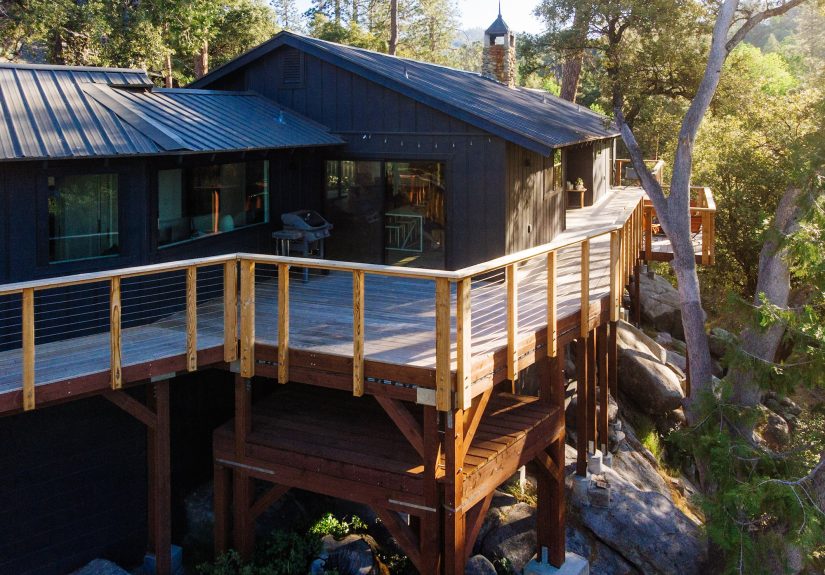
First, the outdoor decks had to be addressed. They were one of the property’s biggest selling points, but they had deteriorated badly enough that romance alone was not going to keep them standing. Because the house sits on a dramatic slope above rocks and water, rebuilding the deck required structural coordination and better anchoring. The result was not only a safer outdoor platform, but an expanded one. The deck now wraps around the cliff-side edge of the house, creating multiple outdoor zones instead of a single perch.
That move alone changed the daily life of the home. Outdoor living became integrated rather than occasional. You do not just “step out for the view.” You circulate through a series of outdoor moments: dining, lingering, listening to water, watching weather roll in, pretending you are too rugged for Wi-Fi while absolutely still using the Wi-Fi.
Then came the windows and doors. To strengthen the indoor-outdoor connection, the team enlarged existing windows, added new ones, and even swapped some windows for glass doors and some doors for windows. The result is not flashy in a nightclub-chandelier way, but it is transformative. The house now gathers light and views from multiple directions, making the surrounding trees and topography feel like an active part of the interior composition.
Inside, the problem was less “not enough charm” and more “too many awkward, boxed-in decisions.” The previous layout was dark, chopped up, and full of unnecessary built-ins and enclosed storage. The renovation removed 13 walled closets and replaced them with fewer, better-positioned storage areas. That consolidation opened the plan and made room for a more logical circulation path linking the bedroom wings. It also allowed for the addition of a second en-suite bathroom, an upgrade that quietly turns a nice retreat into a credible everyday home.
One of the smartest interventions happened overhead. The kitchen and main living area had a low, flat ceiling that dragged the room down visually. Instead of exposing the original trusses, which were not worth admiring, the team inserted new ones and created a vaulted ceiling over the central living zone. Suddenly, the house had vertical generosity. The room reads less like a cramped cabin and more like a true great room.
The kitchen followed the same philosophy. Its layout was reworked to improve access to the deck and outdoor dining area while making space for a substantial table that could anchor the room. The cabinetry stayed simple, but the finishes did not feel cheap. White cabinets were paired with terrazzo countertops, and reclaimed wood shelving added texture and warmth. The palette throughout the house leans neutral, with Japanese and Scandinavian influences that keep the focus on materials, light, and quiet detail rather than decorative clutter.
This is where the project becomes especially compelling from an interior design standpoint. The house does not compete with Yosemite. It edits itself so Yosemite can do the heavy lifting. Stone, wood, soft neutrals, clean shapes, and calm sightlines allow the landscape to remain the star. In an age when too many homes scream for attention like overcaffeinated influencers, this one has the confidence to lower its voice.
Why Yosemite Changes the Meaning of “Home”
Living on the edge of Yosemite is not the same thing as vacationing there. Yosemite National Park is famous for its waterfalls, granite walls, giant sequoias, and sweeping wilderness, but the deeper magic is seasonal. Waterfalls swell with spring snowmelt. Summer opens the door to hiking, swimming, and long evenings outside. Fall clears out crowds and sharpens the air. Winter turns the region into a quieter, moodier version of itself, with snow, chain requirements, and a healthy respect for planning ahead.
That seasonality changes how a home is experienced. A house near Yosemite cannot just be attractive in one month of the year. It has to support changing light, temperature swings, wet conditions, smoke realities, snow logistics, and the emotional texture of living close to a landscape that never stays still for long.
That is part of why the renovation works so well. It was not designed as a sealed-off luxury bubble. It was designed as a lens for experiencing the outdoors. Large windows frame treetops and sky. Glass doors make deck access feel easy and natural. The open living core gives the house a sense of prospect, while warmer materials and cozier corners provide refuge. That balance is central to what good mountain living feels like. You want openness without exposure, coziness without gloom, simplicity without sterility.
Design writers often use the phrase “bringing the outdoors in,” and sometimes that just means placing a fern next to a beige sofa and calling it transformational. Here, the phrase actually applies. The house listens to the site. It uses views as composition, water as atmosphere, and natural textures as emotional grounding.
The Practical Side of Making a Getaway Permanent
Of course, the romantic version of mountain living is only half the story. Anyone turning a vacation property into a primary residence also has to deal with less glamorous realities. Decks need maintenance. Sloped sites need structural caution. Fire-prone areas require defensible-space thinking. Outdoor furniture cannot simply be chosen based on how beautifully it matches your coffee mug.
That makes the rebuilt deck one of the most important parts of the entire project. On a dramatic site, an outdoor platform is not just an accessory. It is a piece of infrastructure. It has to be safe, durable, and worthy of constant use. Likewise, opening the home to views had to be balanced with the kind of material choices and maintenance mindset that long-term mountain living demands.
There is also the emotional practicality of living smaller and smarter. At around 1,600 square feet, Yosemite Waterfall House is not trying to win a square-footage contest against suburban mansions with six guest rooms and a gym nobody uses. Instead, it proves that a compact footprint can feel expansive when circulation is logical, ceilings rise where it counts, storage is intentional, and the outdoors functions as an extension of the interior.
That is a valuable lesson for anyone thinking about a full-time move to a scenic area. The goal is not to build a giant box in the woods and then fill it with anxiety. The goal is to create a house that supports a simpler daily rhythm while still meeting real needs. Yosemite Waterfall House succeeds because it avoids both extremes: it is neither rough-it rustic nor overpolished luxury. It feels warm, capable, and grounded.
What Life in Yosemite Waterfall House Might Actually Feel Like
Now for the part people really want to imagine: the experience. Not the floor plan, not the cabinetry, not the structural engineer heroically saving the deck from gravity’s enthusiasm. The feeling.
Picture a spring morning in the house. Snowmelt is feeding the falls, which means the water is not merely decorative background noise. It is a presence. You wake up, and before coffee has fully negotiated with your brain, the sound of moving water has already entered the day. The light is cool, the air is sharp, and the house does what good architecture should do: it frames the moment instead of interrupting it.
You walk into the main living space and the vaulted ceiling gives the room a lift before you even process it consciously. The kitchen does not feel like a cramped utility zone tucked away from the “real” experience. It is part of the experience. Maybe one person is slicing fruit or standing at the terrazzo counter while the other opens a glass door to the deck. Maybe breakfast becomes an indoor-outdoor negotiation that ends with both people eating where they can hear the water best.
By late morning, the house starts acting like a lookout post. The Observatory nickname makes sense because the home seems built around noticing. Weather. Shadows. Bird movement. The difference between yesterday’s light and today’s. In a typical house, you might forget to look outside for hours. Here, the views keep pulling your attention outward in the gentlest possible way. Nature is not a backdrop hung behind the furniture. It is the other half of the room.
Summer changes the mood. The deck becomes an extra living room, but with better acoustics and fewer obligations. Lunch stretches longer. Even simple tasks feel upgraded. Reading becomes “reading in mountain air.” Sending emails becomes “working remotely while pretending not to be thrilled about the trees.” The beauty of a house like this is that ordinary life gets a scenic accomplice. You are still answering messages, doing dishes, and figuring out what is for dinner, but the setting keeps those tasks from feeling flat.
Then fall arrives, and this may be when the house feels most like a true residence rather than a postcard. The crowds in the broader Yosemite region thin out. The light gets more golden and directional. The air turns brisk enough to make the stone fireplace feel less decorative and more like a trusted member of the household. Inside, the neutral palette begins to make even more sense. It does not fight autumn; it receives it. Wood shelves, soft tones, and textured surfaces seem to deepen as the outside world becomes richer and more dramatic.
Winter, meanwhile, is where the fantasy gets tested and, if the house is designed well, confirmed. A full-time home near Yosemite has to feel protective as well as beautiful. This one likely does. The sense of refuge becomes stronger in cold weather. The same windows that pull in summer green now frame storm light, fog, frost, and snow. You understand why a warm, uncluttered interior matters. You understand why circulation, storage, and light were worth fixing. A vacation house can get away with inconvenience because you leave. A permanent home has to carry you through January.
And maybe that is the biggest experiential truth of Yosemite Waterfall House: it transforms spectacle into routine without letting routine become dull. The falls still fall. The trees still sway. The granite, mist, and mountain weather still set the tone. But instead of arriving for a few precious days and rushing to enjoy it all, the couple gets to live inside that rhythm. The extraordinary becomes familiar, and somehow, if the house is right, it does not become less magical. It becomes more meaningful.
A House That Chose Its Owners Back
Plenty of homes near national parks are marketed on scenery alone. Yosemite Waterfall House offers something richer: scenery translated into daily life through smart renovation. Its success lies in the way structure, layout, materials, and mood all support the same idea. This is a home for people who love nature enough to live with it full time, not merely photograph it and leave on Monday.
By opening the interior, rebuilding the deck, strengthening access to outdoor space, and embracing a warm, restrained material palette, the renovation turned a neglected retreat into a lasting residence. More importantly, it respected the truth of the site. A house on the edge of a waterfall should not feel timid. It should feel observant, grounded, and alive.
In that sense, Yosemite Waterfall House is more than a mountain renovation story. It is a reminder that the best homes do not just shelter people from the environment. They help people participate in it. And sometimes, if the setting is dramatic enough and the design is wise enough, a place that began as a vacation plan ends up becoming the life you were actually meant to build.