Table of Contents >> Show >> Hide
- Why scale weight alone is not enough
- Test 1: The rib test
- Test 2: The top-down waist test
- Test 3: The side-view tummy tuck test
- Test 4: The spine, hips, and fat-pad test
- Test 5: The movement and grooming test
- Test 6: The weigh-in and body condition score test
- How many tests should “fail” before you worry?
- What to do if your cat seems overweight
- When to call the vet sooner rather than later
- Final takeaway
- Real-world owner experiences: what this looks like at home
Some cats are fluffy. Some cats are big-boned. Some cats are simply blessed with the kind of dramatic belly sway that makes them look like they’re wearing tiny pajama pants. But sometimes “adorably round” is actually “quietly overweight,” and that matters more than most cat owners realize.
Extra pounds in cats are linked with real health problems, including diabetes, joint stress, poor grooming, skin issues, and a harder time moving comfortably. The tricky part is that feline weight gain often sneaks up slowly. Because you see your cat every day, the change can be easy to miss. One week your cat is sleek; the next week your cat looks like a decorative ottoman with whiskers.
The good news is that you do not need a veterinary degree, a laser scanner, or a cat-sized tape measure to get a useful first impression. Veterinarians often use a body condition score, which looks at how a cat feels and looks rather than relying only on the number on the scale. That matters because one healthy cat may weigh 8 pounds while another healthy cat may weigh 14, depending on breed, frame, age, sex, and body type.
Below are six simple tests you can do at home to figure out whether your cat may be overweight. Think of these as a smart screening tool, not a substitute for a vet exam. If your cat fails several of these tests, it is time for a conversation with your veterinarian and not with your aunt who insists every cat should look “pleasantly loaf-like.”
Why scale weight alone is not enough
Before we jump into the tests, here is the biggest mistake cat owners make: assuming there is one perfect number for every cat. There is not. A petite female Siamese and a large-framed Maine Coon do not belong in the same weight conversation any more than a bicycle and a pickup truck belong in the same parking space.
That is why feline body condition matters more than a random internet chart. A cat can be “normal” on a household scale and still carry too much fat. Another cat can weigh more than average and still be in great condition because of body size and muscle. In other words, your scale is helpful, but it is not the boss.
Test 1: The rib test
What to do
Place both hands gently on your cat’s rib cage, just behind the front legs. Use light pressure and run your fingers over the ribs. You are not kneading pizza dough. You are checking how easily the ribs can be felt.
What ideal feels like
At an ideal weight, you should be able to feel the ribs easily under a slight fat covering. Many vets compare this to feeling your knuckles when your hand is lying open. The bones are there, but they are not jutting out like coat hooks.
What overweight feels like
If the ribs are difficult to feel, or you have to press through a noticeable padding of fat, your cat may be overweight. If you feel almost nothing but cushion, that is not “extra cuddly.” That is useful information.
Why this test matters
The rib test is one of the fastest and most reliable at-home checks because cats at a healthy body condition carry only a light fat layer over the chest. When that layer thickens, the ribs become harder to detect.
Test 2: The top-down waist test
What to do
Stand above your cat while they are standing naturally. Look straight down at the body. Focus on the area just behind the ribs.
What ideal looks like
A healthy cat should have a visible waist behind the rib cage. It does not need to look dramatic, but the body should narrow a bit before widening again at the hips. Think “gentle hourglass,” not “furry rectangle.”
What overweight looks like
If your cat’s sides run straight from ribs to hips, or the middle looks broad and oval with little waist definition, that is a common sign of excess body fat. In heavier cats, the torso may look more barrel-shaped from above.
Common mistake
Long hair lies. Spectacularly. A fluffy coat can hide a normal waist or disguise a thick middle. If your cat has a full coat, always combine the visual check with the rib test and side-view test instead of judging by fur architecture alone.
Test 3: The side-view tummy tuck test
What to do
Get down to your cat’s eye level and look at the body from the side while your cat is standing. Focus on the line from chest to belly to hind legs.
What ideal looks like
A cat at a healthy weight should have a slight abdominal tuck. That means the belly rises a little from the rib cage toward the back legs. The underside should not hang flat like a hammock between two trees.
What overweight looks like
If the belly is round, droopy, or hangs low with little or no upward tuck, your cat may be overweight. In more obvious cases, the abdomen looks pendulous or generally saggy with fullness throughout the lower body.
Important caveat: the primordial pouch
Yes, cats are allowed to have a primordial pouch. It is a normal flap of skin and fat along the belly, and many healthy cats have one. It often swings when they walk and can look dramatic enough to deserve its own agent. A pouch alone does not prove obesity.
The difference is this: a normal pouch exists on a cat who still has ribs you can feel, a waist from above, and a modest tummy tuck from the side. An overweight cat usually has the pouch plus a generally thick body, hidden ribs, and loss of waist definition. Do not convict the pouch without checking the whole cat.
Test 4: The spine, hips, and fat-pad test
What to do
Run your hands along your cat’s spine, lower back, and hips. Gently feel around the lumbar area and over the base of the tail.
What ideal feels like
You should be able to feel the spine and hip bones without them being sharp or prominent. There should be a light covering over these areas, not a thick mattress of fat.
What overweight feels like
If the spine and hips are hard to feel because of a heavy fat layer, that suggests extra body fat. Overweight cats often develop fat deposits over the lower back and around the abdomen. Some also develop a broad, padded feel over the rib cage and midsection.
Why this test helps
Owners often rely too much on the belly, but fat is not always distributed only there. Feeling the back and hips gives you a more complete sense of body condition, especially in cats with unusual builds or thick coats.
Test 5: The movement and grooming test
What to watch for
This one is less about shape and more about function. Ask yourself:
- Does your cat jump less than they used to?
- Do they hesitate before climbing stairs, furniture, or cat trees?
- Do they groom the back half of their body less thoroughly?
- Do you notice dandruff, greasy fur, or small mats near the tail base?
What it can mean
Overweight cats may move less comfortably because extra weight puts more strain on joints and makes ordinary movement harder. They may also struggle to reach certain areas for grooming. Sometimes owners think their cat is “slowing down with age,” when the real issue is that the cat has become heavier and less agile.
Why this is only one piece of the puzzle
Reduced movement can also happen with arthritis, pain, heart disease, or other illness. So this test is useful, but not diagnostic. If your cat is moving less, avoiding jumping, or grooming poorly, that deserves veterinary attention whether weight is the cause or not.
Test 6: The weigh-in and body condition score test
What to do
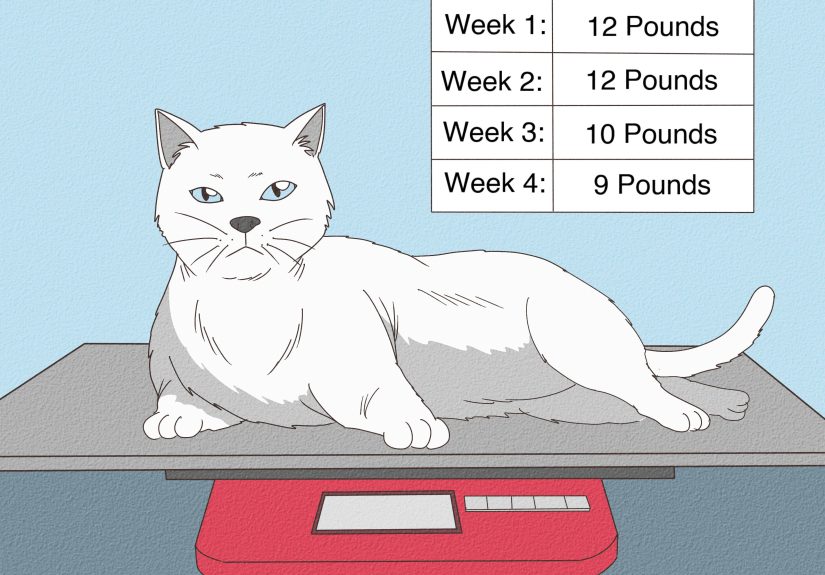
Weigh yourself on a digital scale, then weigh yourself again while holding your cat. Subtract the first number from the second. Repeat a few times for accuracy if your cat is doing the full-body wiggle protest.
Now pair that number with a simple body condition score approach:
- Ideal: ribs easy to feel, waist visible from above, slight tummy tuck
- Overweight: ribs harder to feel, waist reduced, belly rounding or fat pad more obvious
- Obese: ribs difficult or impossible to feel, no waist, heavy abdominal fat and obvious body rounding
Why the trend matters
Even if your cat’s current number does not look alarming, steady weight gain over time matters. A gain of a pound or two in a cat is not trivial. On a small body, that can represent a major percentage change. Keeping a monthly log can reveal a problem before it becomes dramatic.
How many tests should “fail” before you worry?
If your cat has hidden ribs, no visible waist, little tummy tuck, thick padding over the spine or hips, and a declining ability to jump or groom, it is very reasonable to suspect excess weight. One imperfect sign may be nothing. Four or five signs together are a pattern.
In veterinary medicine, cats are often considered overweight when they are above their ideal body condition and obese when they are significantly above ideal body weight. But at home, your goal is not to diagnose the exact percentage. Your goal is to notice the pattern early and take the next smart step.
What to do if your cat seems overweight
Start with your veterinarian
This is not just about vanity. Weight gain can be related to calorie intake, inactivity, neuter status, age, indoor living, or medical factors. Your vet can confirm your cat’s body condition score, rule out other problems, and help calculate a safe target weight.
Do not put your cat on a crash diet
This is the part many owners do not know: cats must lose weight slowly. Rapid weight loss can be dangerous and may trigger hepatic lipidosis, also called fatty liver disease, especially in overweight cats. In plain English, this means your cat should not be sent on a dramatic “summer shred” plan because the internet got ambitious.
Measure food honestly
“I only feed a little” becomes less convincing when the “little” is a cereal bowl topped off three times a day. Use a measuring cup or gram scale. Count treats. Count table scraps. Count the snacks your cat receives from the family member who swears, with total sincerity, “I only gave him one.”
Encourage movement
Food puzzles, scheduled play, wand toys, treat balls, climbing shelves, and multiple short play sessions can help indoor cats move more. You are not trying to create a feline Olympian. You are simply helping your cat burn calories and preserve muscle while staying engaged.
When to call the vet sooner rather than later
Make an appointment promptly if your cat is overweight and you notice any of the following:
- Sudden weight gain or a pot-bellied appearance
- Sudden weight loss
- Changes in appetite, thirst, or litter box habits
- Reluctance to jump, stiffness, or obvious pain
- Poor grooming or skin problems
- Any period of not eating well, especially in an overweight cat
Those signs can point to more than simple overfeeding, and cats are experts at hiding illness until they are not.
Final takeaway
If you are trying to determine whether your cat is overweight, forget the myth that one perfect number tells the whole story. The smartest approach is a combination of touch, observation, and common sense. Feel the ribs. Check the waist. Look for the tummy tuck. Assess the back and hips. Watch how your cat moves and grooms. Then compare all of that with the number on the scale.
If your cat passes these tests, great. Keep monitoring. If your cat fails several of them, do not panic, and definitely do not announce a reality-show-style elimination challenge at the food bowl. Just book a vet visit, get a proper body condition score, and build a gradual plan. A leaner cat is often a happier, more mobile, better-groomed cat. And that means more years of healthy zoomies, dramatic stares, and 3 a.m. hallway stampedes.
Real-world owner experiences: what this looks like at home
Many cat owners do not realize their cat is overweight until something ordinary starts looking oddly difficult. A cat that used to leap onto a windowsill in one graceful move suddenly takes two tries. Another begins skipping the tall cat tree and spends more time parked on the couch like a furry paperweight with opinions. These changes often feel small at first, which is exactly why they are easy to brush off.
One of the most common experiences owners describe is simple surprise during the rib test. They expect to feel bone right away and instead find a thick, soft layer over the chest. That moment can be eye-opening because the cat may still look “normal” in daily life, especially with medium or long fur. Owners of fluffy cats are especially prone to discovering that what looked like elegant fluff from across the room was actually fluff with a side of extra padding.
Another common experience is confusion over the belly area. Many owners fixate on the dangling pouch and assume that any swing under the abdomen means obesity. Then a veterinarian explains that the pouch can be perfectly normal. The real lesson comes when the owner starts checking the whole body instead of one feature. A cat with a pouch can still be fit if the ribs are easy to feel and the waist is visible. That is often a huge relief and a good reminder that cats, like people, are more than one body part.
Owners also frequently notice grooming changes before they notice body shape changes. A cat that once kept every hair in showroom condition may begin looking a little greasy near the lower back. Small mats may appear. Dandruff may collect around the tail base. Many people assume the problem is a skin issue, but sometimes the cat is simply having trouble reaching certain areas comfortably.
Feeding habits are another area where real-life experience can be humbling. Plenty of loving owners discover that the problem is not one giant meal but ten tiny extras: a few treats in the morning, snacks after work, a generous scoop because the bowl looked lonely, and stealth donations from other family members. When everything is finally measured, the cat has effectively been running an all-inclusive buffet package.
The encouraging part is that owners often report seeing meaningful changes once they switch from guessing to tracking. Measured meals, regular weigh-ins, and short play sessions can make a real difference over time. The cat becomes more active, jumps more easily, grooms better, and sometimes even gets a little sassier in the best possible way. That is the kind of progress most owners remember clearly, because it is not just about appearance. It is about seeing their cat move through life more comfortably again.