Table of Contents >> Show >> Hide
- The Quick Answer: How Should You Hang an American Flag?
- Why American Flag Etiquette Matters
- How to Hang an American Flag on a House
- How to Display the American Flag With Other Flags
- When to Fly the Flag
- Half-Staff Rules You Should Know
- American Flag Etiquette: What Not to Do
- Flag Care Tips: How to Keep the Flag Looking Respectable
- When to Retire an American Flag
- Common Questions About Hanging the American Flag
- Real-World Experiences and Lessons From Hanging the Flag
- Conclusion
Hanging an American flag seems simple right up until you are standing on a porch with a ladder, a bracket, a slightly tangled halyard, and a sudden fear of disrespecting the entire republic. The good news is that proper U.S. flag etiquette is not mysterious. Once you know a few core rules about placement, timing, weather, and care, displaying Old Glory becomes much easier.
This guide walks you through how to hang an American flag correctly, where the blue union should go, what changes when the flag is vertical instead of horizontal, how to fly it with other flags, what half-staff really means, and how to keep your flag clean, bright, and dignified for the long haul. In other words, this is the practical version of flag etiquette: respectful, clear, and a lot less intimidating than it first appears.
The Quick Answer: How Should You Hang an American Flag?
If you only remember one rule, remember this one: the union, or blue field with stars, always goes in the position of honor.
That means:
- When the flag is hung horizontally on a wall, the union goes at the upper left from the viewer’s perspective.
- When the flag is hung vertically, the union still goes at the upper left from the viewer’s perspective.
- When the flag is displayed from a pole projecting from a house, the union should be at the peak of the staff.
- When the flag is flown with other flags on the same halyard, the U.S. flag belongs at the top.
- When flown at night, it should be properly illuminated.
That is the basic formula. Now let’s get into the details, because details matter when you are trying to display the American flag respectfully instead of just hoping nobody notices it is upside down.
Why American Flag Etiquette Matters
The U.S. flag is more than outdoor decor. It is treated as a national symbol, which is why there is a long-established set of customs on how to display it. These customs are often called the U.S. Flag Code. For civilians, most of those rules function as guidance rather than hard-to-enforce daily penalties, but they still set the standard for respectful display.
In practical terms, proper flag etiquette shows care, avoids common mistakes, and helps the flag look the way it is supposed to look: clean, visible, and dignified. A correctly displayed flag feels intentional. A wrinkled, storm-beaten flag tied in a knot against a gutter feels like the opposite of respect.
How to Hang an American Flag on a House
From a Porch Pole or Angled Bracket
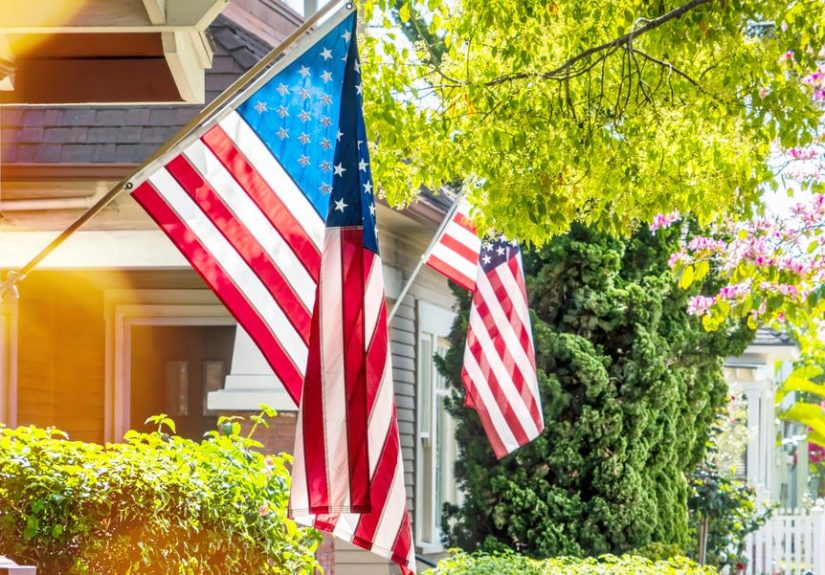
This is one of the most common ways people fly the flag at home. If the pole projects outward from your porch, column, or wall bracket, the union should sit at the topmost point of the flag, nearest the peak of the staff. Make sure the flag can fall free rather than bunching up against brick, siding, or the front light fixture that has not worked since last summer.
Choose a bracket that holds the pole securely and lets the flag move without scraping rough surfaces. If the flag repeatedly whips into railings, wires, tree branches, or metal trim, it will wear out faster than you think.
Flat Against a Wall
If you are hanging the flag flat on a wall, whether indoors or outdoors, place the union at the upper left as the viewer faces it. This rule stays the same whether the flag is horizontal or vertical. The stars should never end up on the upper right from the viewer’s perspective. That is one of the most common errors, and once you see it, you cannot unsee it.
In a Window
When displaying the flag in a window, the union should still appear on the left side of the observer in the street. In other words, think about how the flag looks from outside, not from your couch. Your sofa does not get final authority on flag protocol.
Over a Street or Walkway
If the flag is suspended vertically over a street, the union should face north on an east-west street or east on a north-south street. Most homeowners will never need this rule, but if you are decorating for a parade, neighborhood event, or community celebration, it is worth knowing.
How to Display the American Flag With Other Flags
Things get a little more technical when more than one flag enters the picture.
With State, City, or Organizational Flags
If multiple flags are flown on the same halyard, the U.S. flag should be on top. If the flags are on adjacent staffs, the American flag should be hoisted first and lowered last. It also should not be smaller or placed in a lesser position of honor than the other flags.
With Other National Flags
When flags of different nations are displayed together in peacetime, each country’s flag should be flown on a separate staff of equal height, and the flags should be roughly equal in size. One national flag should not be flown above another in that situation.
At a Church, School, or Public Auditorium
On a speaker’s platform, the flag should be displayed above and behind the speaker if hung flat. If it is on a staff, it belongs in the position of honor at the speaker’s right as the speaker faces the audience. That means it appears to the audience’s left.
When to Fly the Flag
The traditional rule is sunrise to sunset. That is still the standard for display on buildings and stationary outdoor staffs. But the flag may be displayed 24 hours a day when it is properly illuminated during darkness.
It also should not be flown during inclement weather unless you are using an all-weather flag. Strong wind, hard rain, snow, and storms do not just look dramatic; they shorten the life of the fabric fast. A flag that survives rough weather is not automatically heroic. Sometimes it is just shredded.
The flag is especially appropriate on national holidays, state holidays, election days, school days near schools, and patriotic observances such as Flag Day, Independence Day, Veterans Day, and Memorial Day.
Half-Staff Rules You Should Know
Flying the flag at half-staff is one of the areas where people are most nervous about making a mistake. The important rule is simple: when raising a flag to half-staff, first raise it briskly to the top, then lower it to the half-staff position. When taking it down, raise it to the top again before lowering it fully for the day.
On Memorial Day, the flag is customarily displayed at half-staff until noon only, then raised to full staff for the rest of the day. More generally, half-staff observances are ordered by the president, a state governor, or other proper authority in specific circumstances.
If you are unsure whether a half-staff order is in effect, check official government announcements rather than relying on a social media post from someone’s uncle who types in all caps.
American Flag Etiquette: What Not to Do
A lot of flag etiquette is really a list of things to avoid. Here are the big ones:
- Do not hang the flag upside down unless it is a genuine distress signal in extreme danger.
- Do not let the flag touch the ground, floor, water, or merchandise.
- Do not drape it over a car hood, desk, statue, ceiling, or railing.
- Do not use the actual flag as wearing apparel, bedding, or drapery.
- Do not place letters, symbols, designs, or advertising on the flag.
- Do not use it to hold, carry, wrap, or receive objects.
- Do not store it in a way that allows it to become torn, stained, mildewed, or crushed.
If you want patriotic decoration for a party, porch, or podium, use red, white, and blue bunting rather than the flag itself as drapery. That is the respectful alternative the etiquette guidance points people toward.
Flag Care Tips: How to Keep the Flag Looking Respectable
Knowing how to hang an American flag is only half the job. Keeping it in good condition matters just as much.
Inspect It Regularly
Check the fly end, stitching, grommets, and heading often. The first tiny fray can become a dramatic tear after one windy weekend. Catching damage early gives you a better chance to repair or retire the flag before it becomes unfit for display.
Keep It Clean
Yes, a flag can be cleaned. That surprises a lot of people. Washing or dry-cleaning is generally acceptable, depending on the material. Many outdoor flags can be hand-washed with mild soap and rinsed thoroughly, then laid flat or spread out to dry completely. Indoor or parade flags may be better handled by a professional cleaner.
If the flag accidentally brushes the ground, that does not automatically mean it must be retired on the spot. Clean it, inspect it, and continue using it if it remains suitable for display.
Never Store It Damp
Moisture is the enemy. Do not fold or store a wet flag. Let it dry fully first to avoid mildew, color transfer, and fabric damage. A clean, dry, folded flag stored in a protected space will last far longer than one shoved into a garage bin between extension cords and mystery screws.
Protect It From Wear
Choose a spot where the flag can move freely without striking rough surfaces, branches, cables, or hardware. Even a high-quality all-weather flag wears faster if it spends every afternoon getting slapped against brick like it offended the wind.
When to Retire an American Flag
When a flag becomes so worn, faded, torn, or damaged that it is no longer a fitting emblem for display, it should be retired in a dignified manner. Traditional guidance often names burning as the preferred method, carried out respectfully. In practice, many people take worn flags to an American Legion post, VFW location, scout group, or government collection box that handles flag retirement ceremonies.
If you are unsure whether a flag is ready to retire, ask yourself one question: would you feel proud displaying it publicly? If the answer is no, it is probably time.
Common Questions About Hanging the American Flag
Can You Fly the American Flag at Night?
Yes, as long as it is properly illuminated so it remains visible and recognizable during darkness.
Can You Hang It Vertically?
Absolutely. Just keep the union at the upper left from the viewer’s perspective.
Can the Flag Touch the Ground?
It should not. But if it accidentally does, you do not need to panic. Clean and inspect it, then continue to display it if it is still in good condition.
Can You Put the Flag on a Car?
Yes, but not draped over the hood or trunk. If displayed on a vehicle, it should be attached from a staff fixed firmly to the chassis or clamped to the right fender.
Can You Use the Flag as Decoration for a Table or Wall Backdrop?
You can display it flat on a wall if done correctly, but the actual flag should not be used as table drapery, covering, or swag. Use bunting for that instead.
Real-World Experiences and Lessons From Hanging the Flag
One of the most common experiences people have with the American flag starts with good intentions and slightly flawed execution. A new homeowner buys a beautiful flag, mounts a bracket near the front door, and only later realizes the pole angle makes the flag scrape the siding every time the wind shifts. The result is usually a frayed edge within weeks. The lesson is simple: respect is not only about position; it is also about setup. A flag needs room to move freely. A better bracket placement or a longer staff often solves the problem before wear becomes damage.
Another familiar experience happens indoors. A family hangs a flag in a garage, classroom, den, or community hall and gets into a mild debate about which side the stars belong on. Someone confidently says, “Blue field goes on the right,” while someone else says, “No, left.” The confusion usually comes from mixing up the flag’s own right with the viewer’s left. Once people learn that the union belongs in the position of honor and appears on the observer’s left when the flag is hung flat, the argument ends quickly. Usually. There is always one person who remains unconvinced until a government or veterans’ organization says the exact same thing.
Weather is another real-life teacher. Many people proudly start flying the flag every day, then discover that sun, rain, and heavy wind are brutal on fabric. A flag that looked perfect in May can look tired by late summer if it is left out constantly without inspection. Experienced flag owners often develop a routine: bring it in during storms, check the stitching every week or two, and keep a spare flag ready. That habit is not fussy; it is practical. It also prevents the awkward moment when you notice a badly torn flag while guests are already walking up the driveway.
Memorial and family experiences shape how many people think about the flag as well. A burial flag, for example, is often handled differently from an everyday porch flag. Families tend to store it carefully, keep it dry, avoid long exposure to weather, and display it in a case or place of honor. That experience teaches an important broader lesson: the flag is durable, but it is not disposable. The more meaning attached to it, the more intentional the care becomes.
Finally, there is the experience almost everyone has at least once: realizing they have believed a flag myth for years. Maybe it is the idea that a flag must be destroyed immediately if it touches the ground. Maybe it is the assumption that any nighttime display is wrong. Maybe it is thinking patriotic decor always counts as proper flag use. Learning the actual etiquette is useful because it replaces rumor with confidence. And confidence makes respectful display much easier. Once you know the rules, hanging the American flag stops feeling like a test and starts feeling like what it should be: a thoughtful act of civic respect.
Conclusion
Hanging the American flag properly comes down to a handful of clear principles: keep the union in the position of honor, let the flag hang freely, protect it from unnecessary damage, follow half-staff rules carefully, and never treat the flag like disposable decor. Whether you are mounting it on a porch, displaying it in a window, placing it in a school auditorium, or caring for a memorial flag at home, the goal is the same: display it with dignity.
And that is really the heart of U.S. flag etiquette. It is not about chasing perfection or memorizing every niche rule for a flag over a hypothetical east-west street you may never decorate. It is about understanding what respect looks like in practice. Get the placement right, keep the flag clean and serviceable, and treat it as the symbol it is. That is good etiquette, good care, and a much better look than a backwards flag zip-tied to a porch column.