Table of Contents >> Show >> Hide
- Why Honey Bee Identification Can Be Tricky
- How to Identify Honey Bees: 8 Steps
- Step 1: Start with the Overall Size and Shape
- Step 2: Look for Golden-Brown Color with Subtle Stripes
- Step 3: Check the HairBut Do Not Expect a Fur Coat
- Step 4: Study the Abdomen
- Step 5: Watch the Legs for Pollen Baskets
- Step 6: Notice the Behavior Around Flowers
- Step 7: Compare Honey Bee Castes If You See More Than One Kind
- Step 8: Rule Out the Most Common Look-Alikes
- Where You Are Most Likely to See Honey Bees
- Common Mistakes People Make When Identifying Honey Bees
- What to Do If You Find a Honey Bee Colony or Swarm
- Why It Helps to Identify Honey Bees Correctly
- Hands-On Experiences with Identifying Honey Bees
- Final Thoughts
If you have ever spotted a small striped insect hovering near flowers and thought, “Aha, honey bee,” you are not alone. You are also not always right. Plenty of insects wear the same yellow-and-black party outfit. Some are bumble bees, some are carpenter bees, some are wasps, and some are fly impostors pulling off a truly bold fashion scam.
Knowing how to identify honey bees matters for gardeners, homeowners, nature lovers, and anyone who would prefer not to accuse the wrong insect of stealing pollen for a living. Honey bees are important pollinators, but they are not the only bees you will see in a yard or garden. Learning to recognize them helps you better understand what is visiting your flowers, what is nesting nearby, and when you may need a beekeeper instead of a pest-control panic.
This guide breaks the process into eight simple steps. You do not need a microscope, a lab coat, or a detective soundtrack. You just need a good look, a little patience, and a willingness to notice details like body shape, fuzz level, and whether the insect seems busy collecting pollen or just cruising around like it owns the place.
Why Honey Bee Identification Can Be Tricky
Honey bees are not giant, flashy insects with neon signs over their heads. They are medium-sized bees with a practical look: golden-brown to amber coloring, darker bands on the abdomen, and a moderately hairy body. That “moderately” is important. Honey bees are fuzzier than wasps, but not nearly as plush as bumble bees. Think less teddy bear, more hardworking sweater.
They also have look-alikes. Bumble bees are chunkier and furrier. Carpenter bees are larger and tend to have shiny, mostly hairless abdomens. Wasps have narrower waists, smoother bodies, and less interest in pollen. Even some harmless flies mimic bee coloring, which is a clever evolutionary move if your life goal is “Please let predators bother someone else.”
How to Identify Honey Bees: 8 Steps
Step 1: Start with the Overall Size and Shape
A honey bee is usually smaller and slimmer than a bumble bee but thicker and fuzzier than a wasp. At a glance, worker honey bees are often about half an inch long. Their bodies look compact and practical rather than oversized or dramatically elongated.
If the insect looks huge, extra round, and like it could bench-press a daisy, it may be a bumble bee. If it looks long, sleek, and sharply pinched at the waist, you are probably looking at a wasp, not a honey bee. Honey bees land in the middle: sturdy, somewhat oval, and built like an efficient cargo plane for nectar runs.
Step 2: Look for Golden-Brown Color with Subtle Stripes
Honey bees are often amber-brown or golden-brown with darker bands across the abdomen. The stripes are usually softer and more muted than the bold, high-contrast warning pattern you see on many wasps. They do not generally look neon yellow and glossy black. They look more earthy, like they were designed by nature’s department of practical camouflage.
Color alone is not enough for identification, but it is a strong clue. If the insect is metallic green, it is not a honey bee. If it has dramatic orange, white, and black fuzz, it is likely a bumble bee. If it is mostly black with a shiny rear end, carpenter bee should move to the top of your suspect list.
Step 3: Check the HairBut Do Not Expect a Fur Coat
Honey bees are hairy, especially on the thorax, which is the middle section behind the head. That hair helps them trap pollen while visiting flowers. However, they are not as extravagantly fuzzy as bumble bees. Bumble bees tend to look plush all over, while honey bees look hairy in a more workmanlike, low-drama way.
This is one of the easiest ways to separate honey bees from wasps. Wasps usually appear smoother and shinier, with less visible hair. So if the insect looks polished and severe, it is probably not a honey bee. Honey bees usually look like they have been lightly dusted with garden duty.
Step 4: Study the Abdomen
The abdomen of a honey bee is banded and somewhat barrel-shaped. It is not perfectly round, but it does not taper into the dramatic, cinched silhouette of a wasp either. Compared with carpenter bees, the abdomen of a honey bee is much less shiny and usually shows visible striping.
This step is especially useful when comparing honey bees with carpenter bees. Carpenter bees often have a glossy, smooth abdomen that looks almost bald. Honey bees have more texture and a softer look overall. If the back end gleams in the sun like patent leather, you are likely not looking at a honey bee.
Step 5: Watch the Legs for Pollen Baskets
One of the best giveaways is the hind legs. Female worker honey bees have specialized structures called pollen baskets on their hind legs. When they are out foraging, you may see noticeable clumps or pellets of yellow, orange, or even pale pollen attached there. It can look like the bee is wearing tiny cargo pants stuffed with flower dust.
Not every honey bee you see will have full pollen baskets, but when one does, that is a strong clue. Wasps do not carry pollen this way. Some native bees transport pollen in different places on the body, so location and appearance matter. A honey bee worker often looks like it is hauling groceries home after a very successful shopping trip.
Step 6: Notice the Behavior Around Flowers
Honey bees are focused foragers. When they visit flowers, they usually look purposeful and busy, moving from bloom to bloom in a steady pattern. They are there for nectar and pollen, not for drama. You will often see them working methodically instead of hovering around people, soda cans, or lunch plates.
Wasps can visit flowers too, but many species are more likely to investigate food, garbage, or your personal space at the picnic table. Honey bees generally prefer floral business over human nonsense. If the insect is calmly collecting from blossoms and moving with clear intent, honey bee becomes more likely.
Step 7: Compare Honey Bee Castes If You See More Than One Kind
If you are lucky enough to observe a hive, swarm, or colony inspection, you may notice different kinds of honey bees. Workers are the ones most people see outside. They are smaller, female, and responsible for foraging, building comb, and basically keeping the whole enterprise running.
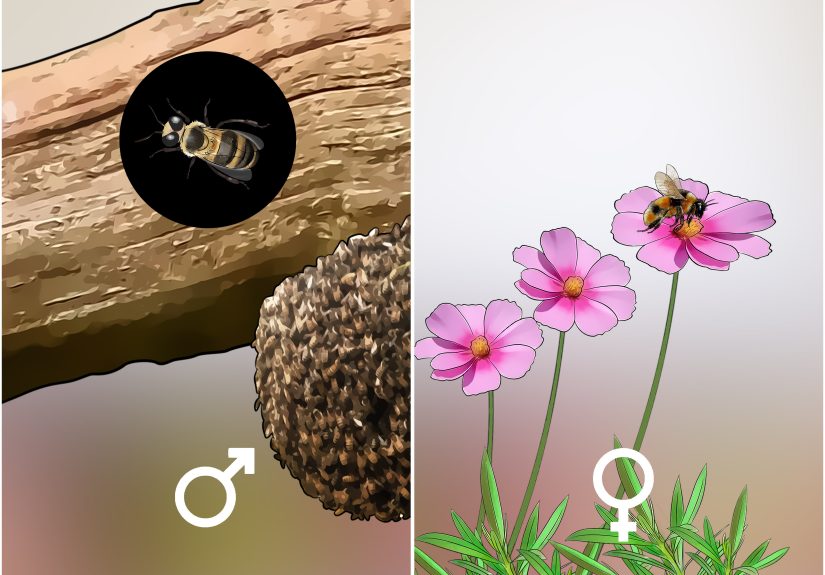
Drones, the males, are stouter and have very large eyes that nearly meet at the top of the head. They look a bit like workers who skipped leg day but overcommitted to goggles. Queens are longer than workers, with a noticeably extended abdomen. You are less likely to see a queen out in the open, but if you do, she often looks more elongated and more commanding, as if the crowd around her got a memo.
Step 8: Rule Out the Most Common Look-Alikes
Before you declare victory, compare your insect with the usual suspects:
- Bumble bee: Bigger, rounder, and much fuzzier.
- Carpenter bee: Larger, robust, and usually has a shiny, hairless-looking abdomen.
- Wasp: Narrow waist, smoother body, less hair, and often brighter contrast.
- Hover fly: Often mimics bees in color but has only one pair of wings and a more fly-like face.
Good identification is often less about finding one magical feature and more about stacking clues. A honey bee is usually medium-sized, golden-brown, moderately hairy, banded on the abdomen, flower-focused, and sometimes carrying pollen on the hind legs. Once enough of those boxes are checked, your confidence goes way up.
Where You Are Most Likely to See Honey Bees
Honey bees are commonly found in gardens, orchards, meadows, farms, and landscaped neighborhoods with lots of flowering plants. They may also be seen near hives, natural cavities, hollow trees, wall voids, and other sheltered spaces where colonies can establish nests. If you see many similar bees traveling back and forth along the same flight path, a colony may be nearby.
During warm months, workers are the most visible because they are out collecting nectar, pollen, water, and plant resins. A single bee at a flower does not automatically tell you there is a hive in your yard, but repeated activity in one direction can be a clue.
Common Mistakes People Make When Identifying Honey Bees
Mistaking Every Fuzzy Insect for a Honey Bee
Not all fuzzy pollinators are honey bees. Bumble bees are especially common and often get mislabeled. They are fantastic pollinators too, but they are not the same thing.
Assuming Yellow-and-Black Always Means Bee
Wasps and many bee mimics use the same color palette. Nature apparently likes a limited wardrobe. Shape, hair, and behavior matter more than color alone.
Ignoring the Legs
Pollen baskets are one of the most useful field marks. People often focus on the face or stripes and miss the “look, I brought groceries” evidence hanging from the hind legs.
Judging from One Quick Fly-By
Insect identification is hard when the subject is moving like it has three meetings and a nectar deadline. A better approach is to watch for a few seconds while the insect is on a flower.
What to Do If You Find a Honey Bee Colony or Swarm
If you spot a swarm, try not to panic. A swarm often looks dramatic because many bees cluster together, but swarming bees are usually focused on protecting the queen and finding a new home. In many cases, local beekeepers can remove or relocate a swarm safely.
If bees are entering a wall, attic, or another structure, it is smart to contact a professional with experience in honey bee removal. Spraying first and asking questions later is usually a bad plan, especially when the insects might be beneficial pollinators and the hive could leave behind honey, wax, and lingering problems inside the structure.
Why It Helps to Identify Honey Bees Correctly
Correct identification can help you make better decisions in the garden, around your home, and in conversations where someone points to a carpenter bee and says, “Look at that honey bee.” You can nod kindly, then become the hero of insect accuracy.
It also helps support pollinator-friendly habits. When you know what honey bees look like, you can plant flowers they visit, reduce unnecessary pesticide use, and distinguish between a harmless pollinator and an insect that may require a different response. In short, identification leads to better stewardship and fewer wildly incorrect backyard announcements.
Hands-On Experiences with Identifying Honey Bees
The first time many people try to identify a honey bee in real life, they discover an uncomfortable truth: bees do not hold still for photo shoots, and they definitely do not wear name tags. What seems simple in a guidebook becomes a small adventure outdoors. One bee looks fuzzy enough to be a honey bee, but then it turns and reveals a shiny abdomen. Another has the right coloring, but it hovers like a tiny helicopter and turns out to be a hover fly pretending to be tougher than it is. That is part of the fun.
A great beginner experience is to stand near a patch of blooming herbs or wildflowers and watch for ten or fifteen minutes. Lavender, salvia, bee balm, sunflowers, zinnias, and clover can all attract a mix of pollinators. At first, every visitor may seem similar. Then the differences start popping out. Bumble bees look like flying pom-poms with a mission. Wasps seem more sleek and intense. Honey bees often move in a steady, practical rhythm, landing, collecting, and heading off as if they are on a strict schedule.
Gardeners often say the hind legs are what finally make identification click. Once you notice pollen baskets on a worker honey bee, it is hard to forget. Those little packed pellets of yellow or orange pollen look almost cartoonish, like the bee stopped at a craft store and glued marbles to its legs. Seeing that detail in person can turn a vague “I think that is a bee” into a confident identification.
Another memorable experience comes from comparing species side by side. If you have a flowering shrub that attracts many pollinators at once, you may get the perfect live lesson. A carpenter bee may buzz in first, bigger and shinier than expected. A bumble bee may appear next, looking like a soft toy with wings. Then a honey bee arrives and suddenly makes sense as the neatly built, medium-sized middle option. Seeing those differences at the same time is worth more than reading ten descriptions in a row.
People who visit apiaries or observe a beekeeper inspecting frames often gain a whole new appreciation for identification. Inside a hive, you can begin to spot workers, drones, and sometimes even the queen. Drones stand out because of their large eyes and thicker bodies. Workers seem more streamlined and numerous. If you are lucky enough to see a queen, her longer abdomen gives her away, and the bees around her often seem to part just enough to suggest she is the center of the operation. It feels a little like spotting royalty in a crowded airport.
Even mistakes are useful. Misidentifying insects is not failure; it is training. Every wrong guess teaches you what to notice next time. Maybe you forgot to check the abdomen. Maybe you relied too much on color. Maybe you learned that “fuzzy” is not a precise enough category when half the garden is wearing stripes. Over time, your eye gets sharper, and what once seemed impossible becomes surprisingly intuitive.
The best experience, though, is the shift in attention. Once you learn how to identify honey bees, a garden stops being just a collection of plants. It becomes a busy, flying neighborhood full of specialists, impostors, workers, loafers, and pollen couriers. And suddenly, every flower bed feels like a tiny airport with excellent landscaping.
Final Thoughts
Learning how to identify honey bees is easier when you focus on a handful of practical clues: medium size, golden-brown coloring, moderate hair, banded abdomen, pollen baskets on the hind legs, and calm flower-foraging behavior. Add a quick comparison with bumble bees, carpenter bees, and wasps, and you are well on your way.
You do not need to become an entomologist overnight. Just look a little closer, notice a little more, and let the bees do the rest of the teaching. They have been field-demonstrating this lesson for millions of years.