Table of Contents >> Show >> Hide
- Quick Comparison: What’s the Difference, Really?
- What Is a Summer Roll?
- What Is a Spring Roll?
- What Is an Egg Roll?
- Nutrition and Dietary Notes (Because Your Roll Deserves a Wellness Check)
- How to Choose the Right Roll When Ordering
- Make Them at Home (Without Starting a Wrapper Crisis)
- FAQ: Clearing Up Common Roll Confusion
- Experience-Inspired Roll Stories (Because Food Is a Contact Sport)
- Conclusion
If you’ve ever stared at an appetizer menu like it’s a pop quiz (and somehow the rolls are judging you),
you’re not alone. “Summer roll,” “spring roll,” and “egg roll” get tossed around like they’re synonyms,
but they’re more like cousins who share a last name and wildly different personalities.
One shows up in a breezy, translucent outfit. One is crisp, golden, and ready for a party. One is the
deep-fried heavyweight that arrives with duck sauce and confidence.
This guide breaks down the real differenceswrappers, fillings, cooking methods, dipping sauces, nutrition,
and the sneaky reason egg rolls often contain… zero egg. Along the way, you’ll get practical ordering tips,
home-cook tricks, and enough roll knowledge to sound like you’ve been secretly studying in the crunchy arts.
Quick Comparison: What’s the Difference, Really?
| Roll Type | Wrapper | Served | Cook Method | Texture | Classic Fillings | Common Sauces |
|---|---|---|---|---|---|---|
| Summer Roll (Vietnamese fresh roll / gỏi cuốn) | Rice paper (translucent) | Cold or room temp | Not fried | Chewy + crisp veggies | Shrimp, pork, rice noodles, lettuce, herbs | Peanut-hoisin sauce, nước chấm |
| Spring Roll (usually fried) | Thin wheat wrapper (sometimes rice-based) | Hot | Fried (sometimes baked) | Light, crisp, shattery | Cabbage, carrots, mushrooms; sometimes pork/shrimp | Sweet chili, soy, plum/duck sauce |
| Egg Roll (Chinese-American style) | Thick wheat wrapper (often bumpy/blistered) | Hot | Fried | Crunchy + chewy, hearty | Cabbage-heavy mix, pork, carrots, aromatics | Duck sauce, hot mustard, soy |
What Is a Summer Roll?
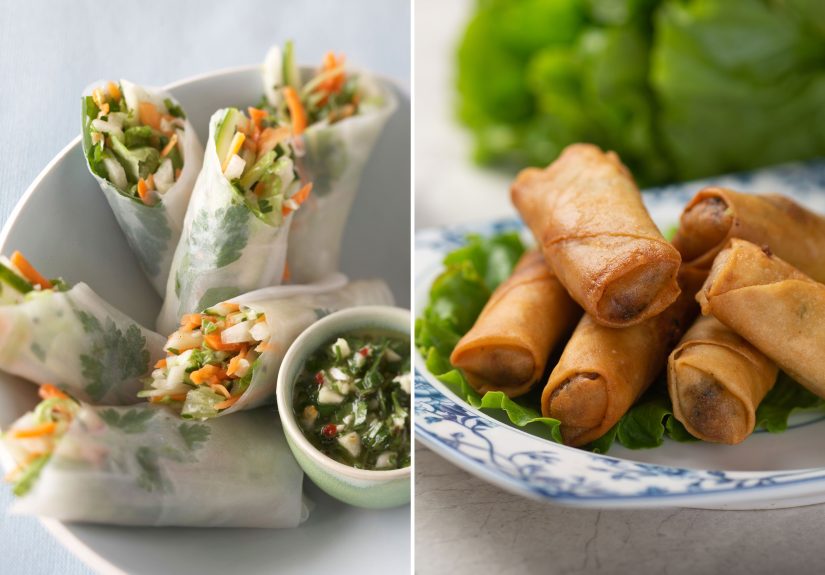
A summer roll is the refreshing, no-fry member of the roll family. In many U.S. restaurants,
it’s essentially a Vietnamese gỏi cuốnoften called a fresh spring roll. The wrapper is
rice paper, which turns soft and slightly chewy after a quick dip in water. You can usually see
the fillings through it, like edible stained glass.
Wrapper: Rice Paper (a.k.a. “Why is this sticking to everything?”)
Rice paper is thin, delicate, and famously dramatic: one second it’s stiff, the next it’s clinging to your fingers
like it pays rent. The trick is to dip it briefly, then let it soften on the plate while you build the roll.
When done right, it becomes pleasantly chewy and lets the fresh fillings shine.
Fillings: Fresh, Herb-Forward, and Custom-Friendly
Classic Vietnamese-style summer rolls often include shrimp and pork, rice vermicelli,
lettuce, and a generous handful of herbsthink mint, cilantro, Thai basil, or chives. Vegetarian versions are
common too (tofu, avocado, crunchy veg, even fruit-forward variations). The vibe is “salad you can pick up.”
Sauces: Peanut-Hoisin or Nước Chấm (Choose Your Adventure)
Summer rolls are basically a delivery system for great dipping sauce. Two classics:
- Peanut-hoisin sauce: sweet-salty, nutty, and slightly stickythe “comfort food” dip.
-
Nước chấm: a bright Vietnamese dipping sauce built around fish sauce, citrus, sugar, garlic, and chili
the “wake-up call” dip.
What Is a Spring Roll?
Here’s where confusion multiplies like rabbits at a lettuce convention: spring roll can mean different
things depending on the restaurant and region. In most American Chinese and Thai contexts, a spring roll is
fried and wrapped in a thin wrapper that turns crisp and flaky. In Vietnamese menus,
“spring roll” might refer to fresh rice-paper rolls (aka summer rolls) or to fried Vietnamese rolls.
Wrappers: Thin and Crisp (the “shatter” factor)
Fried spring rolls often use a thin wheat-based wrapper that turns golden and crisp without the thick,
bubbly chew of an egg roll. Some variations use rice-based wrappers or other regional skins, but the signature is
a lighter crunch and a slimmer shape.
Fillings: Veg-Heavy, Sometimes Meat, Usually Not a Brick
Spring roll fillings frequently lean vegetable-forwardcabbage, carrots, bean sprouts, mushroomssometimes with
pork or shrimp. Many are seasoned gently so the dip can do the loud talking. If egg rolls are a winter coat,
spring rolls are a crisp jacket: still warm, but less bulky.
Culture Note: Why “Spring” Roll?
Spring rolls have roots in Chinese food traditions and are often associated with celebrations around the Spring Festival
(Lunar New Year). Their golden color and shape are commonly linked with prosperitybasically, they look like delicious
little gold bars if you squint in a festive mood.
What Is an Egg Roll?
The egg roll is the crunchy legend of American Chinese takeout. It’s generally larger than a spring roll,
wrapped in a thicker wheat-based skin that fries up blistered and bubbly. The inside often leans
cabbage-forward, seasoned, and hearty. If spring rolls are “crispy snack,” egg rolls are
“crispy commitment.”
The Wrapper: Thick, Bubbly, and Proud of It
Egg roll wrappers tend to be thicker and more substantial than spring roll wrappers, leading to that signature
crunch-then-chew experience. The surface often blisters while frying, creating a craggy texture that
traps sauce like it’s hoarding flavor for winter.
Fillings: Cabbage, Aromatics, and Whatever the Takeout Gods Decree
A classic egg roll filling commonly features shredded cabbage and carrots, sometimes with pork, chicken, shrimp,
or a mix of chopped vegetables. Seasoning varies by restaurant, but the goal is consistent: savory, comforting,
and sturdy enough to survive the ride home in a steamy bag.
So… Why Is It Called an “Egg” Roll?
Here’s the twist: many egg rolls don’t actually contain egg in the filling, and some wrappers don’t
contain much (or any) egg either. The name is debated, and recipes have evolved over time. In practice, “egg roll”
signals a specific stylethicker wrapper, larger size, bubbly crustmore than a literal ingredient list.
Origin Story: A Chinese-American Classic
Food historians commonly describe the modern egg roll as a Chinese-American invention, linked to
early-20th-century restaurant culture in the United States. It’s closely related to spring rolls but adapted to
American tastes and takeout lifebigger, heartier, and unapologetically fried.
Nutrition and Dietary Notes (Because Your Roll Deserves a Wellness Check)
Let’s be honest: none of these rolls are trying to be a multivitamin. But they do vary widely:
-
Summer rolls are typically the lightest: lots of herbs and vegetables, often lean protein, and no frying.
Watch out for sauce portionspeanut-hoisin dips are delicious and can be calorie-dense. -
Spring rolls can range from relatively light (thin wrapper, veg filling) to indulgent (deep-fried, meat-heavy).
They’re often smaller than egg rolls, which can help with portion control… unless you eat six. (No judgment. Math is hard.) - Egg rolls usually have the most “fried wrapper per bite,” so they tend to feel heavier and more filling.
Dietary considerations:
- Gluten-free? Summer roll wrappers are typically rice-based, but always confirm cross-contamination and sauces.
- Vegetarian/vegan? All three can be made plant-based; check for fish sauce, oyster sauce, or egg in wrappers.
- Lower-oil option? Some spring rolls and egg rolls can be baked or air-fried at home for a lighter crunch.
How to Choose the Right Roll When Ordering
Here’s a practical decision guide for the next time you’re negotiating with a menu:
If you want something fresh and light
Choose a summer roll. It’s crunchy vegetables, herbs, and protein in a chewy rice wrappergreat for hot days,
lunch, or when you want appetizer energy without the post-fry nap.
If you want crispy but not too heavy
Choose a spring roll. The wrapper is usually thinner and crispier than an egg roll, and the filling often
leans vegetable-forward. It’s the “I want crunch” compromise that keeps everyone happy.
If you want maximum crunch and takeout nostalgia
Choose an egg roll. Big, bubbly, and built like a snack that can survive a cross-town car ride.
Pair it with hot mustard if you enjoy a little sinus-clearing drama.
Make Them at Home (Without Starting a Wrapper Crisis)
Summer roll success tips
- Set up a rolling station: sliced fillings, herbs, noodles, sauceassembly-line style.
- Don’t over-soak rice paper: a quick dip is enough; it softens as you work.
- Keep textures varied: crunchy cucumber + herbs + protein + noodles = balance.
- Serve immediately: rice paper can dry out or stick if it sits too long.
Fried spring rolls and egg rolls: crispier outcomes
- Keep fillings drier: watery fillings can turn wrappers soggy or cause splatter.
- Seal well: use water (or a light flour slurry) to keep edges closed.
- Fry at a steady temp: too cool = greasy; too hot = burnt outside, cold inside.
- Drain properly: a rack beats paper towels for staying crisp.
FAQ: Clearing Up Common Roll Confusion
Are summer rolls and fresh spring rolls the same thing?
Often, yesespecially on Vietnamese menus in the U.S. “Summer roll” commonly refers to fresh rice-paper rolls
(gỏi cuốn). But “spring roll” can also refer to fried versions depending on the restaurant.
Are egg rolls authentic Chinese food?
Egg rolls are widely described as a Chinese-American creationrelated to Chinese spring rolls but developed
in the U.S. as part of American Chinese restaurant culture.
What’s the easiest way to tell a spring roll from an egg roll?
Look at the wrapper: egg rolls are usually thicker and bubbly, spring rolls are typically thinner and smoother.
Also, egg rolls tend to be bigger and feel more substantial in the handlike they lift weights.
Experience-Inspired Roll Stories (Because Food Is a Contact Sport)
Let’s talk about the part nobody warns you about: rolls aren’t just foodthey’re situations. If you’ve ever tried to
eat an egg roll in a moving car, you know the stakes. One wrong turn and you’re vacuuming cabbage confetti out of the seat
cracks until 2037.
Scenario #1: The Takeout Bag Mystery. You open the bag and see a golden cylinder. Your brain goes,
“Ah yes, spring roll.” Then you bite in and realize you’ve been duped by thickness. It’s an egg rollbubbly crust, hearty
filling, and enough crunch to be heard three rooms away. Meanwhile, the dipping sauce packets are playing roulette:
hot mustard, duck sauce, soy sauce, a mysterious orange gel that may or may not be sweet-and-sour. Your job is to
pair correctly before the roll cools down and becomes a lukewarm autobiography.
Scenario #2: The Summer Roll Glow-Up. Someone brings summer rolls to a picnic and suddenly everyone acts
like they’ve been eating herbs on purpose their whole lives. That translucent rice paper shows off the shrimp and greens
like it’s on a cooking show runway. The peanut-hoisin sauce appears, and people who “don’t really like peanut sauce”
become people who “need the recipe immediately.” Summer rolls do thatthey’re disarming. They make you feel like you made
a healthy choice even if you double-dip like it’s an Olympic event.
Scenario #3: The First Time You Roll Rice Paper at Home. You lay down a rice paper round. It’s stiff.
You dip it. Now it’s floppy. You panic. It sticks to itself. You panic harder. You try to peel it apart and create a small
tear that becomes a large tear that becomes “this is now a salad.” The secret “experienced” move is to dip quickly, set it
down, and wait a few seconds. Rice paper softens on its own, like it’s taking a deep breath before the main event.
Also: less filling than you think. Your roll is not a sleeping bag; it does not need to pack for a long weekend.
Scenario #4: Sauce as Personality Test. Spring rolls with sweet chili sauce? You like balancesweet, heat,
a little tang, and you probably own at least one matching set of bowls. Egg rolls with hot mustard? You’re bold,
slightly chaotic, and you believe appetizers should fight back. Summer rolls with nước chấm? You appreciate brightness,
acid, and flavors that snap. Summer rolls with peanut-hoisin sauce? Comfort-seeker. Reliable. You’d pet every dog
if time allowed.
Scenario #5: The Party Platter Politics. Put all three rolls on one platter and watch the social dynamics.
The egg rolls go first because they’re familiar and loud. The spring rolls disappear next because people love crunch but
don’t want to admit they’re still hungry. The summer rolls get picked last… until someone tries one and starts evangelizing.
Suddenly they’re gone too, and the remaining guests are negotiating over the last tablespoon of sauce like it’s a limited
resource in a post-apocalyptic film.
The point? These rolls aren’t just different by wrapper and cooking methodthey behave differently in the wild.
Once you know what you’re dealing with, you can order like a pro, build a platter that makes everyone happy, and avoid
calling every cylinder “a spring roll” like it’s a universal roll license plate.
Conclusion
When it comes to summer roll vs. spring roll vs. egg roll, the simplest truth is this:
summer rolls are fresh, spring rolls are typically light and crispy, and
egg rolls are thick, bubbly, and extra (in the best way). The wrapper tells you the story.
The temperature seals the deal. And the sauce? The sauce is the plot twist you deserve.
Next time you order, think of it like picking a movie:
summer rolls are a feel-good summer comedy, spring rolls are an action flick with clean fight choreography,
and egg rolls are a blockbuster where the explosions are… crunch sounds.