Table of Contents >> Show >> Hide
- What a “sector quilt” is (and why it’s weirdly addictive)
- 2024 in one glance: big winners, mild losers, and one lonely red square
- Why the top sectors led in 2024 (with real-world examples)
- The quilt’s real lesson: leadership rotates (and it rotates rudely)
- Should you “rebuild” the S&P 500 with sector ETFs?
- A smarter way to use the 2024 sector quilt (without letting it ruin your life)
- Conclusion: the 2024 quilt is a reminder, not a map
- Experience Notes (500-ish Words): What People Learn When They Actually Live With a Sector Quilt
If you’ve ever stared at a colorful “sector quilt” and thought, “Well, obviously I should just buy the green squares and avoid the red ones”congratulations.
You’ve just experienced the investor equivalent of walking into a casino and saying, “I’ll take whatever just hit black.”
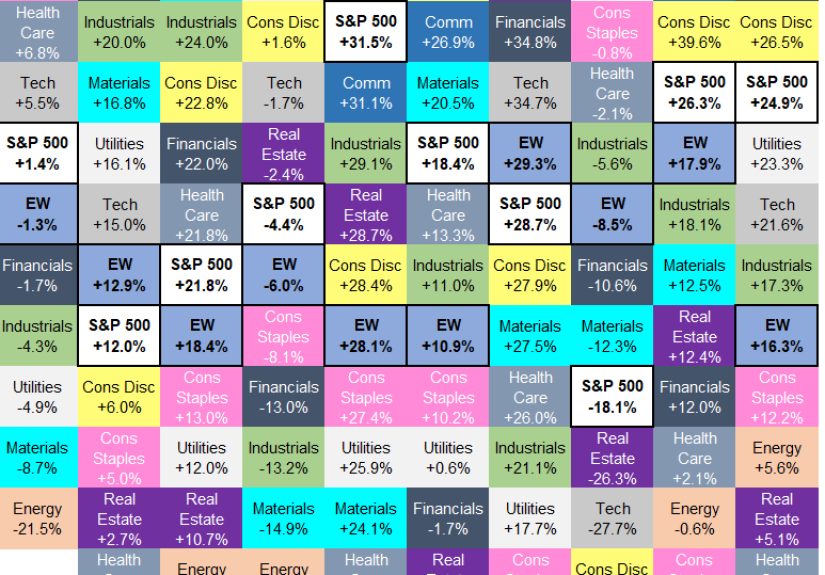
Ben Carlson’s annual “Sector Quilt” on A Wealth of Common Sense is popular for a reason: it takes a year’s worth of market chaos and turns it into something you can understand in five seconds.
The problem is what happens at second six, when your brain tries to turn that quilt into a to-do list.
This article breaks down what the 2024 sector quilt actually shows, why 2024 looked the way it did, and the biggest lesson the quilt keeps teaching (even when we keep pretending we’ve already learned it).
We’ll also talk honestly about the temptation to “rebuild the S&P 500” using sector ETFsand why that plan often sounds easier than it behaves in real life.
What a “sector quilt” is (and why it’s weirdly addictive)
A sector quilt is a grid that ranks stock market sectors by performance over timeusually by yearso you can see leadership rotate from one corner of the market to another.
It’s like a highlight reel for diversification: the same cast of characters, different winner every season.
In the S&P 500, those characters are the 11 GICS sectors (Technology, Financials, Health Care, etc.).
A quilt doesn’t just show who wonit shows how quickly “obvious” can become “oops.”
That’s the magic: the quilt is a behavioral finance chart disguised as home décor.
It quietly whispers, “Trends change,” while investors shout back, “Not this time!”
2024 in one glance: big winners, mild losers, and one lonely red square
U.S. stocks had a strong 2024, with the broad S&P 500 up roughly in the low-to-mid 20% range depending on the measure used (price vs. total return).
But the quilt’s job isn’t to clap for the indexit’s to show you how uneven that ride was by sector.
Approximate S&P 500 sector performance in 2024 (price-return style)
| Sector | 2024 Return | Approx. S&P 500 Weight (Year-End) |
|---|---|---|
| Communication Services | ~39.7% | ~8.9% |
| Information Technology | ~37.6% | ~31.3% |
| Consumer Discretionary | ~29.5% | ~10.7% |
| Financials | ~28.9% | ~13.9% |
| Utilities | ~20.1% | ~2.5% |
| Industrials | ~16.2% | ~8.6% |
| Consumer Staples | ~12.2% | ~5.7% |
| Real Estate | ~2.0% | ~2.2% |
| Energy | ~1.9% | ~3.4% |
| Health Care | ~1.1% | ~10.6% |
| Materials | ~-1.2% | ~2.1% |
The headline is simple: Communication Services and Technology did the heavy lifting, while Materials was the only sector that finished meaningfully negative.
The more interesting part is how that happenedand what it implies for anyone tempted to “optimize” an index by chopping off a few sectors.
Why the top sectors led in 2024 (with real-world examples)
1) Communication Services: the “not-just-phone-companies” surprise
Communication Services is one of those sectors that sounds boring until you remember what’s inside it.
It’s not just telecom. It includes major internet platforms, media, and interactive servicesbusinesses that can sprint when ad spending improves and engagement stays sticky.
In 2024, this sector benefited from a rebound in digital advertising and the sheer scale of mega-cap platforms.
When a handful of giants have strong years, they can pull a whole sector up like a freight elevator.
2) Information Technology: AI enthusiasm meets real earnings power
Technology’s strength wasn’t just “vibes.” It was a mix of AI-driven spending (especially around chips and infrastructure), resilient software demand, and continued dominance by a few massive firms.
When the market gets excited about a theme as big as AI, Tech often becomes the default “pick-and-shovel” aisle.
A good example is how semiconductor and mega-cap tech performance can ripple outward:
when the market prices in years of growth for AI infrastructure, it tends to reward the ecosystemhardware, cloud, and key platform players.
The quilt captures a core truth: big sectors with big weights don’t need every stock to win.
They just need their largest holdings to keep showing up.
3) Consumer Discretionary and Financials: the economy refuses to faint
Consumer Discretionary did well in part because the U.S. consumer proved tougher than many forecasts expected.
Meanwhile, Financials benefited from a combination of economic resilience, credit staying relatively contained, and continued attention on how interest rates affect bank profitability.
These sectors also highlight why “macro narratives” are tricky. Rates, growth, inflation, and policy expectations shifted throughout the yearyet the winners were still the sectors with the best blend of growth expectations and earnings delivery.
4) Utilities: the plot twist nobody ordered (but everyone watched)
Utilities posting a ~20% year sounds like a typo if you’re used to thinking of them as the market’s sleepy dividend providers.
But 2024 had two storylines that helped:
interest-rate expectations matter a lot for rate-sensitive sectors, and electricity demand narratives got louder thanks to data centers and AI infrastructure.
The important lesson isn’t “Utilities are the new Tech.”
The lesson is that even the “boring” sectors can take a turn in the spotlight when conditions change.
The quilt’s real lesson: leadership rotates (and it rotates rudely)
The most useful thing a sector quilt does is embarrass certainty.
It shows that sector leadership isn’t a permanent rankingit’s a rotating cast.
The sector that looks unstoppable over one window can look disappointing over another.
Carlson’s commentary on the quilt makes a point that investors hate (because it’s true):
even when you think you’ve found a “forever winner,” the market has a long history of flipping the script over longer cycles.
Winners cool off. Laggards recover. And the middle-of-the-pack sectors keep quietly compounding while nobody makes a victory speech about them.
This is also where the quilt connects to a broader 2024 theme: concentration.
When a small group of very large companies becomes a bigger slice of the index, performance can look strong even if the “average” stock is having a much more normal year.
That doesn’t mean the index is brokenit means the market is doing what market-cap weighting always does: it gives the biggest companies the biggest influence.
Should you “rebuild” the S&P 500 with sector ETFs?
The temptation usually sounds like this:
“I’ll keep the good sectors, drop the weak ones, and basically own a better version of the index.”
It’s the investing equivalent of saying you’ll only eat the foods you like and still get all your nutrientspossible in theory, harder in practice, and you will eventually miss fiber.
The practical issues most people underestimate
-
Small sectors don’t move the needle as much as you think.
Some of the sectors people want to delete (often Real Estate, Utilities, and Materials) are relatively small weights in the S&P 500.
Cutting them can feel dramatic while making a surprisingly modest difference to long-run results. -
More holdings means more decisions.
A single index fund is one decision: buy, hold, rebalance your overall portfolio if needed.
A sector “rebuild” is many decisions: buy, monitor weights, rebalance sectors, handle index changes, and resist performance-chasing when the quilt rubs your face in last year’s winners. -
Rebalancing is emotionally unpleasant.
Rebalancing means trimming what did well and adding to what didn’t.
In a year like 2024, that can mean selling some of the market’s darlings and buying the sectors that felt like wet cardboard.
That’s a feature, not a bugbut it’s also where many strategies fall apart. -
Taxes and friction are real.
In taxable accounts, more moving parts can mean more taxable events.
Even without taxes, trading spreads and small tracking differences can quietly nibble returns. -
The biggest risk is behavioral, not mathematical.
The original plan is “match the index, minus a few sectors.”
The next planafter you see a quiltoften becomes “tilt toward what’s hot.”
That’s where long-term underperformance tends to be born.
A smarter way to use the 2024 sector quilt (without letting it ruin your life)
The quilt is best used as a teaching tool, not a trading signal.
Here are a few ways to make it work for you instead of turning you into an unpaid intern for your own portfolio.
1) Keep a simple core, then earn the right to be fancy
If you want to express views, consider the “core-and-satellite” approach:
keep a broad index fund as the foundation, and limit any sector tilts to a small, rules-based slice.
That way, you’re not betting your whole plan on your ability to outguess rotation.
2) Use rules, not vibes
Sector investing without rules usually turns into performance-chasing with better branding.
If you tilt, decide in advance:
how much, how often you rebalance, and what would cause you to stop.
(Hint: “when it starts feeling embarrassing” is not a rule. It’s a cry for help.)
3) Treat sector exposure like seasoning, not the meal
Sectors can be useful for risk management (defensive vs. cyclical exposure) or for expressing a modest thesis.
But the quilt keeps reminding us that today’s “obvious” trade can become tomorrow’s “why did I do that?”
If you want a portfolio you can live with, build it so you don’t have to be right every year.
Conclusion: the 2024 quilt is a reminder, not a map
The 2024 sector quilt makes 2024 look tidy: a couple of big winners, a bunch of decent outcomes, and one sector that couldn’t find the party.
But the deeper message is the same one it always delivers:
sector leadership rotates, and simplicity wins more often than complexity.
If you want the spirit of A Wealth of Common Sense in one line, it’s this:
owning the index is boringuntil you compare it with the excitement of being wrong in public.
The quilt doesn’t exist to help you pick winners. It exists to remind you that picking winners is hard.
Experience Notes (500-ish Words): What People Learn When They Actually Live With a Sector Quilt
Here’s the part that doesn’t show up in the neat grid: the human experience of watching sectors rotate in real time. A quilt makes the market look like a clean scoreboard.
Living through the year feels more like trying to carry a cup of coffee through a trampoline park.
A common experience goes like this: you start the year feeling proud of your “diversified” portfolio… right up until you notice your friend’s portfolio is basically three tech names and a dream.
In a year like 2024, where Communication Services and Technology ran hot, the diversified investor’s internal monologue can get spicy:
“Why do I own this slow-moving stuff?” “Should I just trim the boring sectors?” “Is Real Estate even real, or is it just a concept?”
Then something changessometimes it’s rates, sometimes it’s earnings, sometimes it’s simply that expectations got too high.
Suddenly a sector you ignored starts working. Utilities rally. Industrials find a groove. Financials catch a bid.
And the emotional whiplash kicks in: you didn’t buy those sectors because you were brilliant; you bought them because you were diversified.
The quilt makes it obvious after the fact, but the lived experience is realizing diversification feels “unnecessary” precisely when it’s doing its job.
Another repeated experience: people underestimate how much of sector performance is driven by a few giants.
In 2024, you didn’t need every tech stock to be a masterpiece. You needed the biggest weights to be strong.
That creates a strange feeling: the news says “the market,” but your portfolio behaves like it’s dating one sector and “seeing other sectors casually.”
Investors notice concentration and start trying to fix it with sector tinkering, which can help if done intentionallyor create new problems if it becomes reactive.
The most valuable experience, though, is what the quilt teaches over multiple years: you can’t sustainably build a plan around being correct about the next winner.
People who try often end up doing the same cycle: buy last year’s best sector, wait for it to cool, sell in frustration, then buy whatever is now leading.
It feels active and smart. It also tends to be a very efficient way to buy high and sell low with extra steps.
Investors who come out healthier usually adopt one of two mindsets:
(1) “I’ll own the broad market and accept that I won’t always own the hottest thing,” or
(2) “I’ll tilt, but only with rules, small sizing, and the humility to be early (and look silly) sometimes.”
The quilt doesn’t judge you for wanting to do moreit just keeps documenting what happens when you do more without a plan.
If you want a practical takeaway from the lived experience of 2024: let the quilt inspire better behavior, not more activity.
Use it to remind yourself that long-term investing is less about guessing right and more about staying reasonable while the market tries to recruit you into short-term drama.